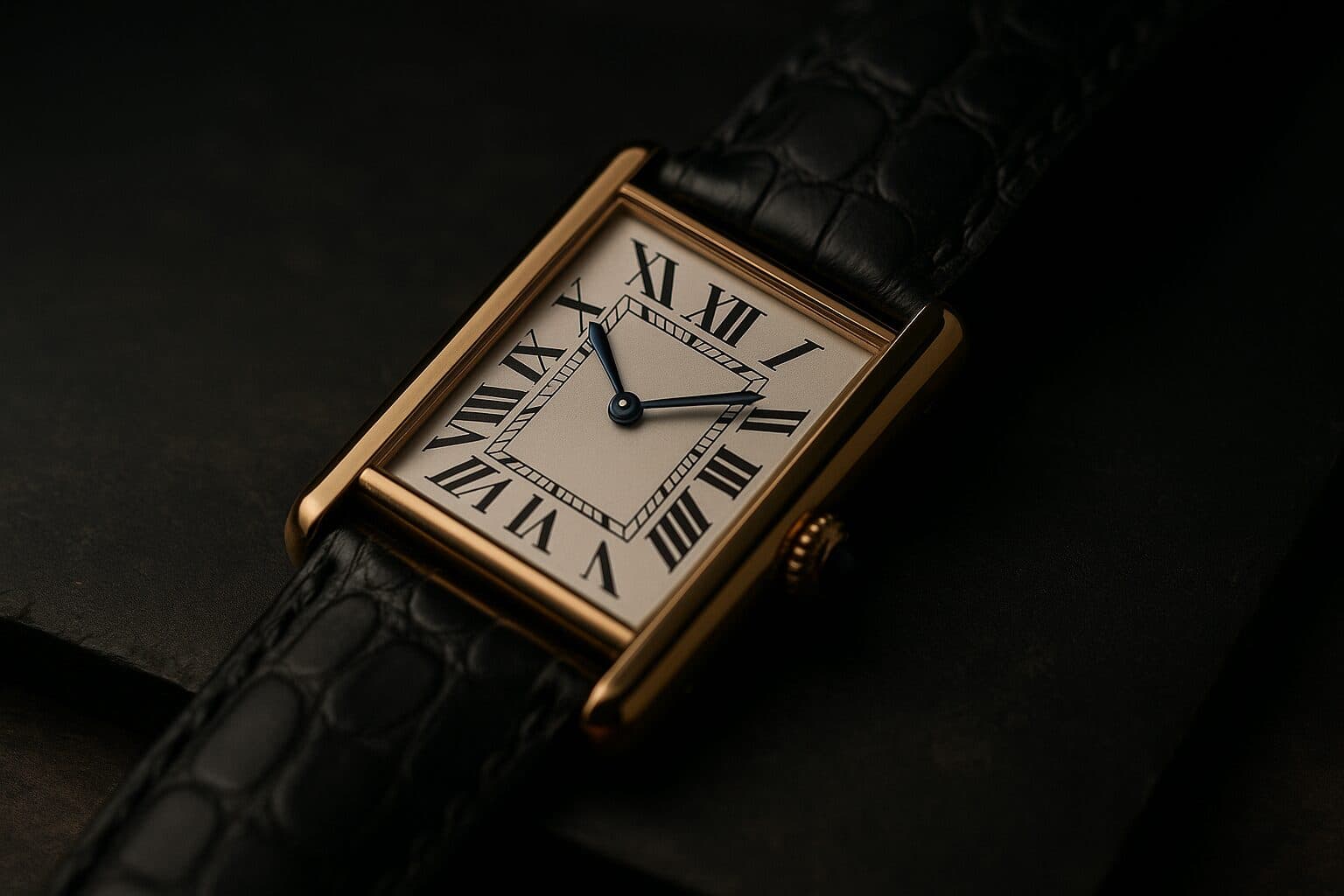
The Cartier Tank: How a Dress Watch Became a Serious Collector's Anchor
By The Subdial Editors ·
For most of the last decade, serious watch collecting has been a steel sports watch story — integrated bracelets, screw-down crowns, and waitlists that read like a velvet rope.
That said, as those references have grown crowded and their grey-market premiums have flattened, a quieter category has re-emerged as the thinking collector's anchor: the rectangular dress watch, and at its center, the Cartier Tank.
The Tank is not a hedge against the sports-watch trade so much as the missing other half of a complete collection — the piece that does what a diver or a chronograph structurally cannot. If you have spent recent years chasing tool watches and are now looking for ballast, this is the case we want to make.
The Cartier Tank is a rectangular dress watch designed by Louis Cartier in 1917 and first sold in 1919. It anchors a collection because its design is era-proof, its entry references stay attainable, and its rarest variants carry real auction weight.
Why The Tank Earns A Place Beyond The Sports-Watch Trade
A collection built entirely on steel sports watches is, structurally, one idea expressed many ways — the same case logic, the same lume, the same crowd of buyers competing for the same lots. The Tank breaks that monoculture, and it does so without asking you to compromise on pedigree or liquidity.
Cartier occupies a rare position: a jeweller the watch world takes seriously and a watchmaker the jewellery world respects, which means a Tank reads correctly in rooms where a dive bezel would not. That dual fluency is exactly why the model has survived more than a century of taste cycles without a redesign that matters.
What's more, the Tank gives a collection a true dress register — flat, rectangular, and quiet under a cuff — that the sports-watch canon simply cannot cover. Among modern dress watches only a handful, a thin Lange Saxonia among them, compete on that pure flatness, and none carry the Tank's cultural reach.
There is also a liquidity argument, which matters more than collectors like to admit. A clean, correctly specified Tank is among the easier luxury watches to sell, because demand is global, the design needs no explanation, and the buyer pool extends well beyond watch enthusiasts.
A Short History — From Renault Treads To Wrist Icon
Louis Cartier designed the Tank in 1917, and the lineage most often cited is military: the case's vertical sidebars, or brancards, echo the tracks of the Renault FT tanks then appearing on the Western Front. Cartier presented an early example to General John Pershing, and the model reached the public in 1919.
The genius of the design is that almost nothing about it is incidental — the brancards flow directly into the strap, the dial is framed rather than decorated, and the blued sword hands and railway minute track have barely changed in a hundred years. That restraint is why a 1920s Tank and a 2020s Tank read as the same object, a continuity almost no other watch can claim.
The cultural reach is part of the durability, not a footnote to it. Jacqueline Kennedy Onassis wore a Tank for years, Andy Warhol collected them, and Princess Diana's Tank Française became one of the most photographed watches of the 1990s.
Cartier's Tank takes its name from the Renault FT tanks of World War I, whose tracks inspired the case's vertical brancards. Louis Cartier designed it in 1917 and Cartier began selling it to the public in 1919.
The Reference Map — Knowing Your Tank
The Tank is not one watch but a family, and fluency in its branches is the difference between buying well and overpaying for the wrong case. The names repeat across eras, so it pays to learn what each one actually signals before you start tracking listings.
| Reference family | What it is | Collector note |
|---|---|---|
| Tank Louis Cartier | The purist's Tank — rounded brancards, gold, often hand-wound | Most often called the definitive Tank; strongest dress credentials |
| Tank Must | 1970s vermeil line, revived in steel in 2021, including the solar SolarBeat | The modern entry point; vintage lacquered colour dials are the cult favourites |
| Tank Française | Late-1990s design with an integrated steel bracelet | The recognisable Diana-era Tank; quartz-heavy, with broad supply |
| Tank Américaine | Elongated, curved case that wraps the wrist | More watch on the wrist; a mix of quartz and automatic |
| Tank Cintrée | Long, dramatically curved Art Deco case | A connoisseur grail; Privé and CPCP examples command serious money |
| Tank Asymétrique | Rhomboid case with a diagonally set dial | Rare by design; Privé 2020 reissues and CPCP originals are blue-chip |
Two acronyms recur once you move upmarket, and both move value. Collection Privée Cartier Paris (CPCP), produced roughly from 1998 to 2008, housed better movements in shaped cases, while the current Cartier Privé program issues small, numbered runs of historic shapes for collectors.
Vintage Versus Modern — The Real Decision
This is the choice that defines the buy, and it is less about age than about what you want the watch to do. A modern Tank is a turnkey, warrantied object you can wear daily, while a vintage Tank is a smaller, more characterful piece that asks for a service budget and a careful eye.
On the contrary to the sports-watch market, where vintage often means fragile lume and aggressive premiums, vintage Tanks remain genuinely usable and, at the entry end, genuinely affordable. The trade-off is condition risk — redialled examples, replaced hands, and over-polished brancards are common, and each one quietly erases value.
Buy modern for daily wear, warranty, and water resistance; buy vintage for slimmer cases, character, and lower prices. Vintage Tanks stay wearable but need condition scrutiny — original dials, hands, and unpolished brancards drive value.
For a first Tank that has to cover both formal and everyday duty, the modern Tank Must in steel is the rational pick, and the hand-wound Tank Louis Cartier is the upgrade most collectors eventually make. If you want the version that feels like an heirloom rather than a purchase, a clean vintage Tank Louis Cartier in yellow gold is the move — provided you have verified the dial.
Where Secondary-Market Values Actually Sit
Numbers here move with condition, metal, and movement, so treat every figure as a range to verify rather than a quote. The headline is that the Tank spans an unusually wide price ladder, from a few thousand dollars to the high six figures, all under one design language.
At the accessible end, modern Tank Must steel references retail from approximately $3,000 and up — verify current Cartier pricing — and trade lower used, while estimates from marketplaces such as Chrono24 put vintage Must de Cartier vermeil examples at roughly $1,500 to $3,500 depending on dial and condition. Hand-wound gold Tank Louis Cartier pieces generally sit higher, commonly in the mid four figures to low five figures, again subject to originality.
As our read on vintage market dynamics argues, condition and originality, not age alone, set the price — and the Tank is a textbook case. A redialled gold Tank and an honest one can wear identically yet trade a multiple apart.
The clearest proof of the Tank's collector ceiling is provenance. At Christie's in June 2017, the Cartier Tank once owned by Jacqueline Kennedy Onassis sold for $379,500 — reportedly to Kim Kardashian — far above its pre-sale estimate.
The lesson is not that every Tank is an investment, but that the model sits in the small club of designs where history, not just horology, can be priced.
At the top of the market, shaped rarities rewrite the math entirely — Tank Cintrée and Tank Asymétrique examples, especially CPCP and platinum pieces, have realised five and six figures at Phillips, Christie's, and Sotheby's. For how those hammer prices are set against estimates, our breakdown of auction estimate mechanics is the place to start.
Entry-level modern Tanks trade in the low thousands and vintage gold Tank Louis Cartier pieces in the mid-four to low-five figures, per Chrono24 estimates. Rare Cintrée and Asymétrique examples have reached five and six figures at major houses.
What To Verify Before You Buy
Because so much of a Tank's value lives in originality, the pre-purchase inspection matters more here than on a tool watch with swappable parts. The good news is that the checklist is short, and most red flags are visible to a careful buyer.
Start with the dial and hands, where Cartier's printing, the Swiss Made placement, and the secret signature hidden in a Roman numeral are common failure points on redialled fakes. Then assess the case for over-polishing, since crisp brancard edges are far harder to fake than a clean dial and are the truest tell of an honest example.
Verify the dial printing and Cartier's hidden secret signature, confirm original hands, and check the brancards for over-polishing. On mechanical references demand service history; on quartz, budget for a movement that may need replacement.
Finally, match the movement to the reference and to your expectations — many Tanks are quartz, several are hand-wound or automatic, and the price should reflect which. Remember that a serviced mechanical Tank with papers will always be easier to resell than a bargain example with an unknown history.
Editorial Recommendation
The Tank rewards a clear brief more than a big budget, so decide what role the watch plays before you chase a specific reference. For most collectors broadening beyond steel sports watches, these are the spec-led picks we would actually buy.
- The sensible first Tank. A modern Tank Must in steel, large model, on a strap — current production, warrantied, and the lowest-risk way to learn whether the rectangle suits your wrist.
- The collector's core. A hand-wound Tank Louis Cartier in yellow gold — the reference most often called the definitive Tank, and the one that reads as serious in any room.
- The heirloom play. A clean vintage Tank Louis Cartier or Must de Cartier with an original, unrestored dial — bought on condition, not on price, with a service budget already set aside.
- The grail. A Tank Cintrée or Tank Asymétrique from CPCP or the Privé program — blue-chip, auction-tracked, and transacted only with full provenance and an independent inspection.
Across all four, the discipline is the same: originality over apparent bargain, and provenance over hype. Buy the best-condition example of the right reference, and the Tank does the rest — quietly, and for decades.
If you are rebalancing a collection that has tilted too far into steel, the Tank is the most defensible single addition you can make — and the one most likely to be worn rather than stored. For the tool-watch half of that same logic, the case for collectible dive watches maps the rest of the terrain.