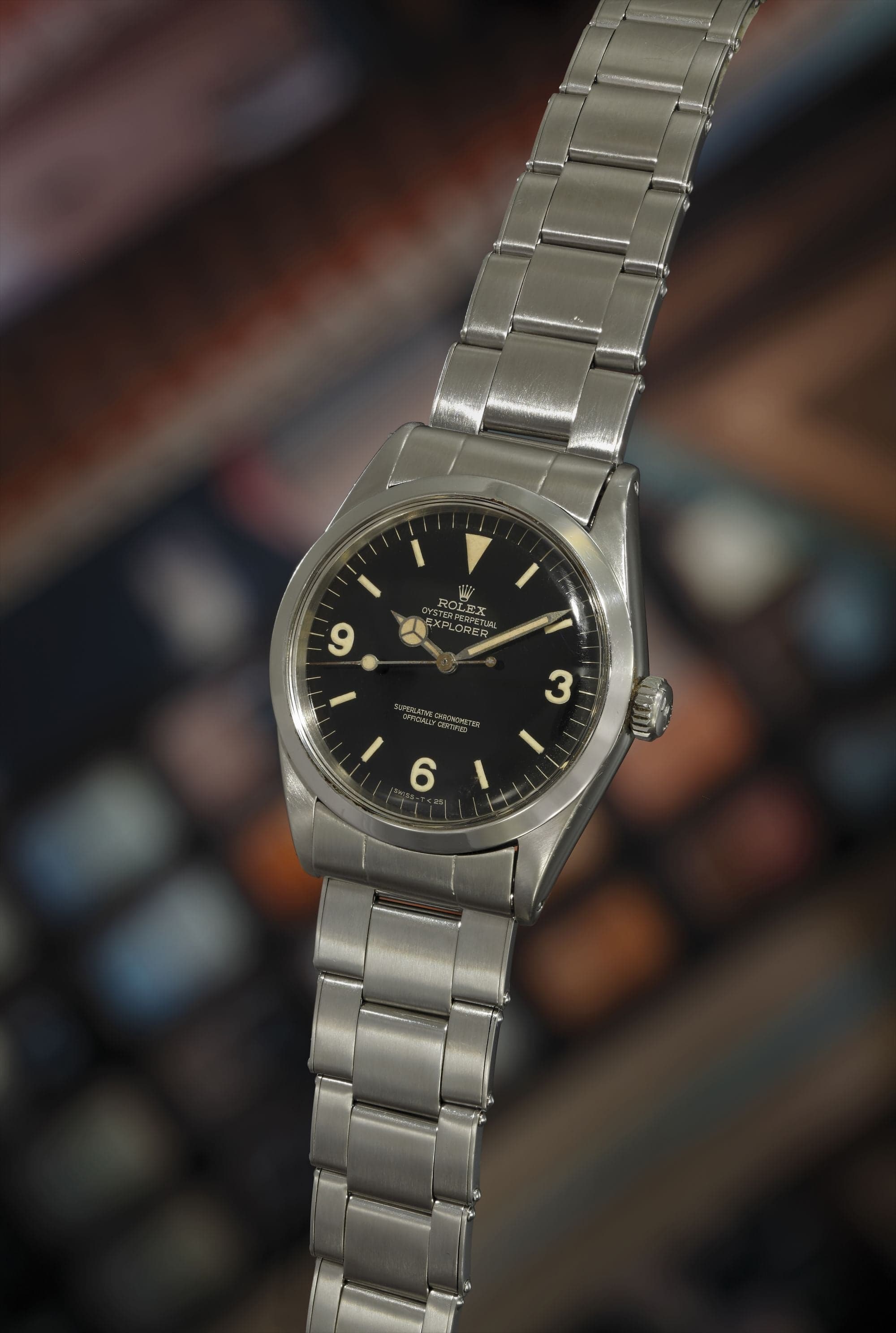
 Photo: Phillips Auctioneers
 What counts as vintage
The vintage watch terminology is contested, but three commonly accepted thresholds map the market. The strict pre-1970 threshold separates pre-quartz from post-quartz watchmaking — every watch made before 1970 was mechanical or manual-wind quartz prototype, and the design language of mechanical watchmaking dominated. The 30-year threshold (currently pre-1995) is the most common collector definition and roughly tracks the "classic" era of modern Swiss watchmaking through the quartz crisis recovery. The pre-current-production threshold is the loosest — anything not in the current catalog — and includes "neo-vintage" references from the late 1990s and 2000s.
For most practical purposes: pre-1995 watches are vintage, 1995–2010 are neo-vintage, post-2010 are modern. The neo-vintage range is increasingly collector-focused — references like the Rolex Submariner 16610 (1988–2010), the Omega Speedmaster Professional 3570.50 (1996–2014), the IWC 3717 Pilot Chronograph, and the Patek Philippe Nautilus 5711/1A (2006–2021) all sit in this bracket and command meaningful collector interest despite not being old enough for the strictest vintage definition.
Why people collect vintage
Three reasons drive vintage watch collecting, and most collectors balance all three:
Aesthetic. Vintage watches have proportions, dial designs, lume aging, and case wear that current production can't replicate. A 1965 Submariner 5513 with original gilt dial and tritium lume that has aged to creamy yellow-gold has a visual character no modern watch can match. The specific patina of vintage tritium lume — the way it ages from green-glowing to creamy off-white over 30–50 years — is itself a collector category.
Cultural. Specific vintage references carry historical weight: the Speedmaster 105.012 worn on Apollo 11, the Submariner 6538 worn by Sean Connery in the early Bond films, the Heuer Monaco 1133B worn by Steve McQueen in Le Mans, the Rolex Daytona 6239 owned and worn by Paul Newman. Owning the specific reference connects the wearer to a moment in cultural history that current production can only reference, not embody.
Financial. Specific vintage references have appreciated dramatically — the Paul Newman Daytona variants moved from ~$50,000 in 2005 to $200,000–$1,000,000+ today. Paul Newman's personal Daytona Reference 6239 sold for $17.7 million in 2017. The vintage Patek Philippe 1518 perpetual calendar chronograph sold for $11M in 2016. These appreciation curves are specific to a small number of references with the right combination of rarity, cultural weight, and provenance — most vintage watches do not appreciate this way, but the upper-end vintage market has been one of the best-performing collectible asset categories of the past 20 years.
The vintage market rewards patience and authentication. The watches that have appreciated most all share original-condition provenance, full service history, and dealer or auction-house verification. The watches that have not are mostly redials, service dials, and frankenwatches.
Subdial Editors
Authentication first
The universal rule of vintage watch buying is authentication before price. Five factors determine whether a vintage watch is what it claims to be, and every factor matters independently:
- Reference number verification. The reference number on the case (typically engraved between the lugs) must match the dial language, bezel, and movement architecture for the period. A 5513 Submariner case with a 1680 dial is a frankenwatch.
- Movement matching. Every Rolex case has a serial number; every movement has a separate movement number. The pairing should match Rolex archives. For non-Rolex makers, equivalent movement-case pairing verification is available through the manufacturer's service department (Patek Extract from the Archives, Omega Extract, Vacheron archives).
- Dial originality. Original dials show specific aging patterns (tritium yellowing, paint patina, lume composition) that service dials and redials cannot replicate consistently. Comparison with verified-original reference photography (Phillips auction photos, Bonhams catalogs, the Hodinkee Reference Points archive) is essential.
- Papers and provenance. Original warranty card, instruction manual, service receipts, original box, and hangtags add 20–50% to value and provide chain-of-custody documentation. A vintage watch with full set (paper, box, hangtag, original retail receipt) is meaningfully more valuable than the watch alone ("head only").
- Service history. Documented service from the maker (Rolex Service Center, Patek Service, Omega Service) or established independent watchmakers (Vintage Time Mart, La Connoisseur, Robert at Watch Geek) proves the watch has been maintained by qualified hands. Undocumented service or evidence of amateur work is a red flag.
Service philosophy: preserve vs restore
The vintage watch community is divided between two philosophies about how to maintain old watches. The preservation school favors keeping the watch in its original aged condition — original dial with patina, tritium lume that has aged naturally, case scratches and crown wear from honest use, original parts throughout. The restoration school favors returning the watch to a like-new appearance — replacing aged dials with service dials, replacing tritium with modern Super-LumiNova, polishing cases to remove scratches, replacing worn parts with current-production substitutes.
The collector market overwhelmingly favors preservation. A vintage Submariner 5513 with original gilt dial, original tritium lume, and an unpolished case with honest wear sells at 2–5× the price of an equivalent watch that has been fully serviced and restored. The reasoning is genuine: original parts cannot be replaced, original aging cannot be replicated, and the "new again" appearance is precisely what removes the watch from being vintage in the meaningful sense. Service work that preserves original character — cleaning the movement, lubricating gaskets, replacing only failed components — is acceptable and necessary. Restoration that swaps original parts for service-tier replacements destroys collector value.
Where to buy
The vintage watch market has three tiers of seller, each with different risk profiles:
Established dealers. Watches of Switzerland Pre-Owned, Bob's Watches, WatchBox, Hodinkee Shop pre-owned, Wempe Pre-Owned, and brand-direct programs (Rolex Certified Pre-Owned, Patek Philippe Vintage Sales). These dealers carry authentication policies, typically offer warranty (12–24 months from established programs), and have reputations to protect. Pricing is the highest in the market — typically 10–25% above auction-house prices — but the risk is the lowest.
Auction houses. Phillips, Christie's, Sotheby's, Antiquorum. Auction houses provide professional authentication, chain-of- custody documentation, and detailed condition reports. Pricing is market-driven (whatever the buyer will pay), and the houses charge a buyer's premium of 25–28% on top of the hammer price. The catalog photography from Phillips and Christie's sets the standard for vintage-watch reference imagery.
Private dealers, eBay, Chrono24. The cheapest pricing, with the highest risk. Private dealers and online platforms can carry genuine watches at meaningful discounts, but they can also carry frankenwatches, service-dialed watches presented as original, and outright fakes. Buying from private channels requires either pre-existing relationship trust, third-party authentication (sending the watch to an established dealer for verification before purchase), or accepting meaningful risk. Most first-time vintage buyers should not start in this tier.
Common traps
Six gotchas that account for the majority of vintage-watch buying mistakes:
- Service dials presented as original. The most common authentication failure. A service dial reduces value 30–60%, but is often hidden in listings or described ambiguously.
- Redials. Aftermarket dial restoration that recreates the original dial design but is not original. Redials are sometimes obvious (modern lume on a vintage dial); sometimes only a specialist can identify them.
- Frankenwatches. Cases, movements, and dials from different watches assembled to look like a single coherent reference. Particularly common in vintage Daytona, Submariner, and GMT-Master markets.
- Married watches. A movement from one reference paired with a case from a different reference. Not as deceptive as a frankenwatch but materially reduces value.
- Polished cases. Original case lines have specific proportions; aggressive polishing rounds the lugs and softens the bevels. A heavily polished vintage Rolex case is worth meaningfully less than an unpolished example with honest wear.
- Undocumented service history. Without documented service from qualified watchmakers, you can't verify what work has been done, what parts have been replaced, or whether the watch is mechanically sound. Pricing should reflect this risk.