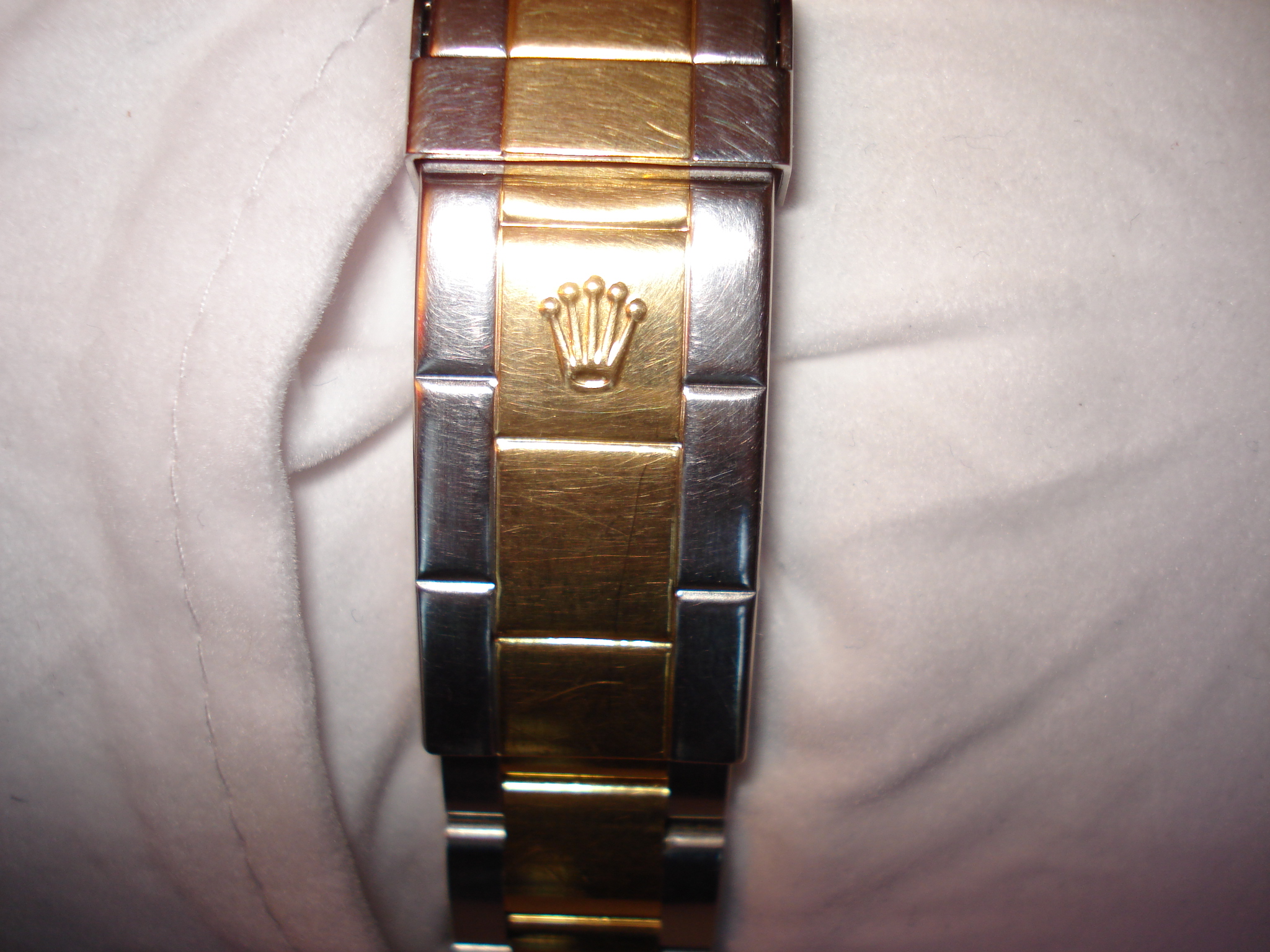
 Photo by Eternalsleeper (English Wikipedia), via Wikimedia Commons, public domain
 What makes a watch a dive watch
The category is defined by ISO 6425, the international standard updated most recently in 2018. The standard specifies seven requirements for a watch to be labeled a divers' watch: water resistance tested at depth (at least 100m for the basic spec, with separate tests at depth and at temperature), a unidirectional rotating bezel marked at minute intervals (so accidental rotation can only shorten dive time, never extend it), luminescent markings on the bezel zero-marker and the dial 0 / 5 / 10 / 15 / 20 / 25 / 30 / 35 / 40 / 45 / 50 / 55 minute positions, an indication that the watch is running (typically a luminescent second hand), magnetic resistance to 4,800 A/m (60 gauss), shock resistance through testing, and salt-water corrosion resistance through salt-spray testing.
Beyond the formal standard, the dive-watch language includes design conventions that aren't in ISO 6425 but are universal to the category: a screw-down crown (so the crown can't accidentally pull out underwater), a screw-down caseback (for water-tight closure), a screw-locked bezel or a click-detent system (so the bezel can't accidentally rotate), a high-contrast dial with applied or printed indices (so the time is readable through a face-mask or in murky water), and a robust strap or bracelet system (since the watch must accommodate a wetsuit cuff). Most modern dive watches add a helium escape valve if rated above 300m, sapphire or scratch-resistant crystals, and ceramic or steel rotating bezels.
A short history of the dive watch
The dive watch as a category began in 1953 with the Blancpain Fifty Fathoms. The French Navy combat divers (Nageurs de Combat), under Captain Robert Maloubier and Lieutenant Claude Riffaud, specified a watch for underwater demolition work — water-resistant to 50 fathoms (91m), with a rotating bezel for dive-time measurement and luminescent dial markings for low-visibility conditions. Blancpain Watch Company, then a small Vallée-de-Joux maker, built the watch under the direction of Jean-Jacques Fiechter. The first Fifty Fathoms entered French Navy service in late 1953.
The Rolex Submariner debuted at Baselworld in 1954 as a commercial product. Rolex had been developing waterproof watches since the 1926 Oyster — Mercedes Gleitze swam the English Channel wearing one in 1927 to prove the concept — but the Submariner was the first Rolex specifically designed for diving with a rotating dive bezel. Reference 6204 was the first production model; references 6536, 6538 (the "Big Crown" James Bond Submariner), and 5512/5513 followed across the 1950s and 1960s. The Submariner became the most-imitated watch design of the post-war era.
Omega's Seamaster predates both — the original 1948 Seamaster was a dressier water-resistant watch built around the same Lemania-derived caliber that would later anchor the Speedmaster. The Seamaster 300 (1957) added the dive-watch language with rotating bezel and 200m+ water resistance. Omega expanded the line through the 1960s and 1970s with the Ploprof (1971, 600m, the "Plongeur Professionel" commercial diver), the Seamaster Professional 300m (1993, James Bond's watch since GoldenEye), and the modern Seamaster Diver 300M, Planet Ocean, and Planet Ocean Ultra Deep.
The Japanese contribution started with the 1965 Seiko 62MAS — the first Japanese dive watch — followed by the 6105 (1968, the "Captain Willard" from Apocalypse Now), the 6309 (1976, the original cushion-case "Turtle"), the SKX007 (1996, the most-bought sub-$300 dive watch in history), and the modern Prospex SPB-series and Marinemaster references. The Doxa SUB 300 launched in 1967 with a distinctive orange-dial "Sharkhunter" variant developed in collaboration with Jacques Cousteau's research team. Each of these references became a cult-collector piece beyond its original functional intent.
The dive watch is the most-imitated category in horology. Every other tool watch — pilot, field, racing chronograph — exists in dialogue with what the Submariner and Fifty Fathoms established in the early 1950s.
Subdial Editors
Three categories of dive watch
The modern dive-watch market divides into three layers, each with its own buyers and price ranges:
The founding pieces — Submariner, Seamaster, Fifty Fathoms, Black Bay 58, Doxa SUB. These are the watches built originally for actual diving in the 1950s–1960s and continued in modern production with respect for the original design language. Most owners buy them for everyday wear and the cultural significance, not for actual underwater work. Pricing: $450 (Seiko Turtle) to $35,000+ (vintage 5513 with gilt dial in original condition).
The modern luxury divers — Tudor Black Bay 58 / Pelagos / Pelagos FXD, Omega Planet Ocean / Planet Ocean Ultra Deep, Rolex Sea-Dweller / Deepsea, Cartier Calibre Diver. These are modern interpretations of the founding language that emphasize finishing, brand premium, and everyday-luxury wearability. Most are over-engineered for recreational diving and serve primarily as everyday-luxury watches. Pricing: $4,000 (Tudor BB58) to $15,000+ (Rolex Deepsea, Omega Planet Ocean Ultra Deep).
The specialist saturation divers — Sea-Dweller Deepsea Challenge (11,000m), Planet Ocean Ultra Deep (15,000m), Doxa SUB 1500T (1,500m), Bell & Ross BR 03-92 Diver Bronze (300m but specifically marketed for actual professional diving). These are pieces engineered for actual professional underwater work — saturation divers, deep-sea exploration, military combat divers. The HEV is mandatory above 300m water resistance. Pricing: $1,000 (Squale, Vostok Amphibia) to $40,000+ (specialist Sea-Dweller and Planet Ocean Ultra Deep references).
Tool watch vs dress diver
An ongoing distinction in dive-watch culture is the "tool diver" vs "dress diver" tension. The tool diver — Submariner, Seamaster Diver 300M, Tudor Black Bay 58, Seiko Prospex — keeps the rotating bezel, the high-contrast dial, the visible dive-watch language. The dress diver — Omega Aqua Terra (which omits the rotating bezel entirely), Cartier Calibre Diver, JLC Polaris — adapts the case construction (water resistance, anti-shock) to dressier proportions and removes the visible tool-watch markers. Both work as one-watch collections. The tool diver is more visually distinctive; the dress diver is more wearable across the range of contexts.
For most buyers, the question isn't tool vs dress — it's how committed they are to the dive-watch aesthetic. A buyer who never plans to dive but loves the visible dive-watch language buys the Submariner. A buyer who wants the durability without the visible dive-watch language buys the Aqua Terra. A buyer who wants the most-versatile single watch buys whichever one fits their lifestyle and dress-code distribution best.
What to look for
Beyond the ISO 6425 specs, six things matter when selecting a dive watch:
- Bezel material and action. Ceramic bezels (Submariner, Sea-Dweller, Tudor Black Bay 58) resist scratching and color-fading better than aluminum bezels (vintage Submariner, Seiko 5 SRPD). Bezel action should be firm with positive minute clicks; a loose bezel or one without click-detents is a defect.
- Bracelet quality and clasp. Solid-link bracelets, milled clasps, and tool-free micro-adjustment (Tudor T-Fit, Omega adjustable bracelet, Rolex Glidelock) are the modern standard. Folded-link bracelets with stamped clasps are entry-tier and date a watch's perceived quality.
- Lume composition. Modern dive watches use Super-LumiNova (X1 grade is the brightest, BGW9 is the bluish variant) or Chromalight (Rolex's proprietary blue-glowing lume). Tritium tubes (Ball, Marathon, Luminox) generate light through radioactive decay and don't require charging — useful for actual diving.
- Movement quality. ETA 2824-2 / Sellita SW200 (modified) is the entry; Powermatic 80 / H-10 is mid-tier; in-house Manufacture Calibers (Tudor MT5402, Omega 8800, Rolex 3230) are luxury-tier. Power reserve, anti- magnetic specifications, and chronometer certification scale with price.
- Case proportions. The 38–42mm range fits most wrists; some buyers prefer 39–40mm vintage proportions. Above 42mm is large-wrist territory; below 38mm is dressy-vintage. Lug-to-lug measurement is often more important than diameter — a 41mm watch with 47mm lug-to-lug fits a 6.5- inch wrist; a 41mm watch with 51mm lug-to-lug doesn't.
- Service history (vintage). A vintage Submariner with original gilt dial, full set, and complete Rolex service history sells at 30–50% premium over the same watch with no service records. For modern watches, service intervals are still 5–10 years and matter for total ownership cost.