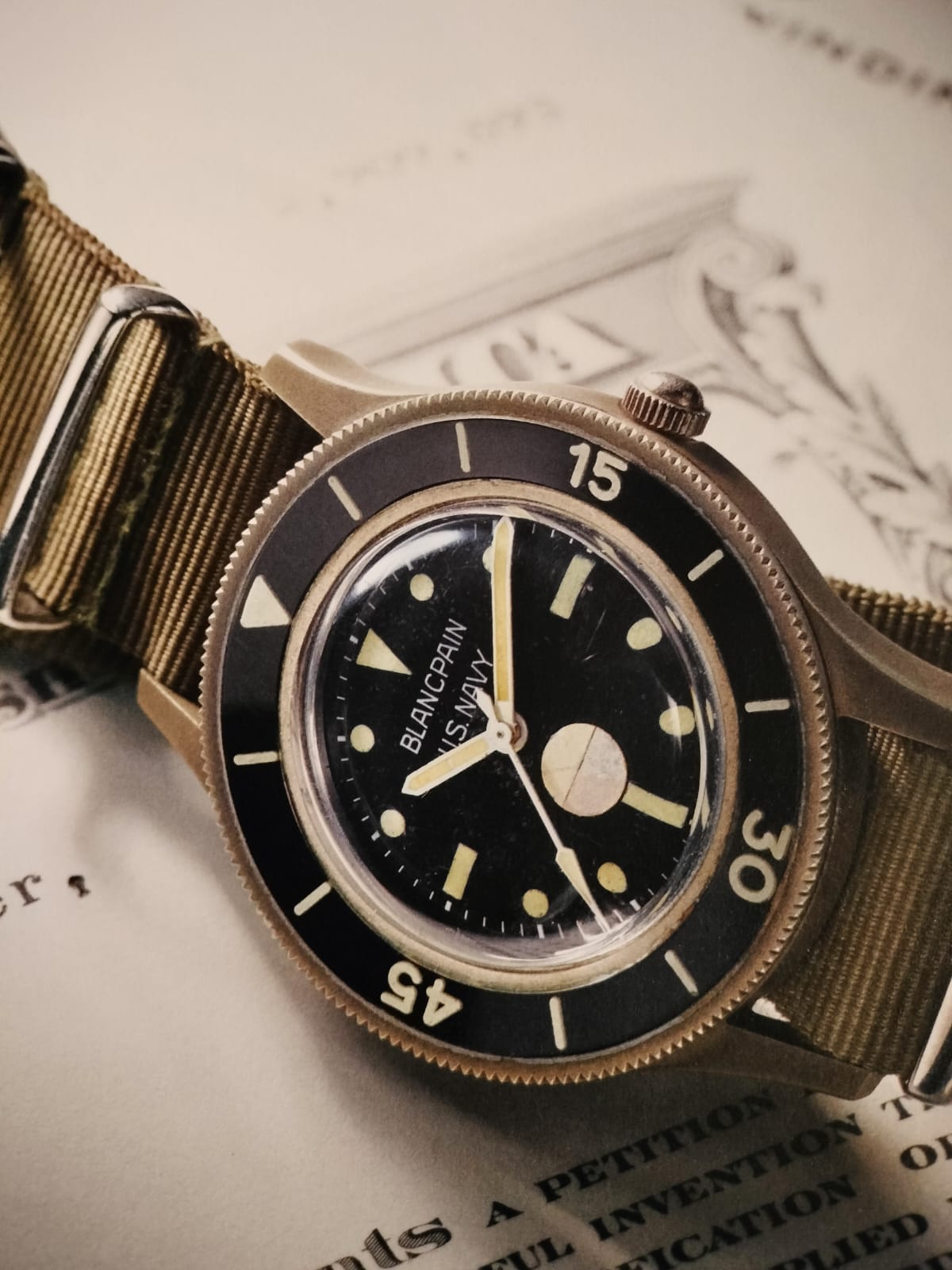
 Photo by EMore98 (Wikimedia Commons), CC BY-SA 4.0
 What is the Blancpain Fifty Fathoms?
The Blancpain Fifty Fathoms is the first modern dive watch — released 1953, narrowly predating the Rolex Submariner. Developed for the French Navy's Nageurs de Combat (combat divers). The original spec called for 50 fathoms (91.45m) water resistance; modern references run to 300m. Current production: Fifty Fathoms 5015 ($15,400 in steel), Fifty Fathoms Bathyscaphe ($14,000, smaller 38–43mm variant), and limited 70th-anniversary reissues. In-house Caliber 1315 with five-day power reserve.
Origin
In 1952, French Navy Captain Robert "Bob" Maloubier and Lieutenant Claude Riffaud — both combat divers in the Nageurs de Combat unit, a French military combat-diving organization established 1952 in the wake of WWII underwater-demolition operations — needed wristwatches that could support tactical underwater operations. The watches available at the time were inadequate. Most were water-resistant only to 30 meters; few had legible dive bezels; the lume compositions used for low-visibility diving were inconsistent. The combat divers needed equipment they could trust their lives to.
Maloubier and Riffaud specified what they needed in detail: 50-fathom water resistance (91m, the depth their tactical missions required), anti-magnetic case construction (to prevent the underwater compass-heading watches that military divers carried from interfering with the wristwatch movement), unidirectional rotating bezel for measuring dive time (with accidental rotation always indicating shorter remaining time, never longer — a critical safety feature), screw-down crown (so the crown couldn't accidentally pull out underwater), large legible numerals and applied indices (readable in murky water through a face mask), and luminescent markings for low-visibility conditions. Each requirement came from operational experience.
They approached major Swiss watchmakers. Most refused — the requirements were too demanding for the small order quantities the French Navy could justify. Blancpain CEO Jean-Jacques Fiechter agreed to take the project. Fiechter was himself a recreational diver and understood the engineering requirements personally; he had previously experienced near-fatal underwater accidents that motivated his interest in serious dive-watch engineering. The first Fifty Fathoms entered service with the French Navy in early 1953, predating the Rolex Submariner debut at Baselworld 1954 by approximately 12 months.
We needed a watch our divers could trust. We didn’t have one. Blancpain made one. That was ‘fifty fathoms’ — the depth our missions required.
Captain Robert Maloubier, French Combat Diving School, on the Fifty Fathoms development
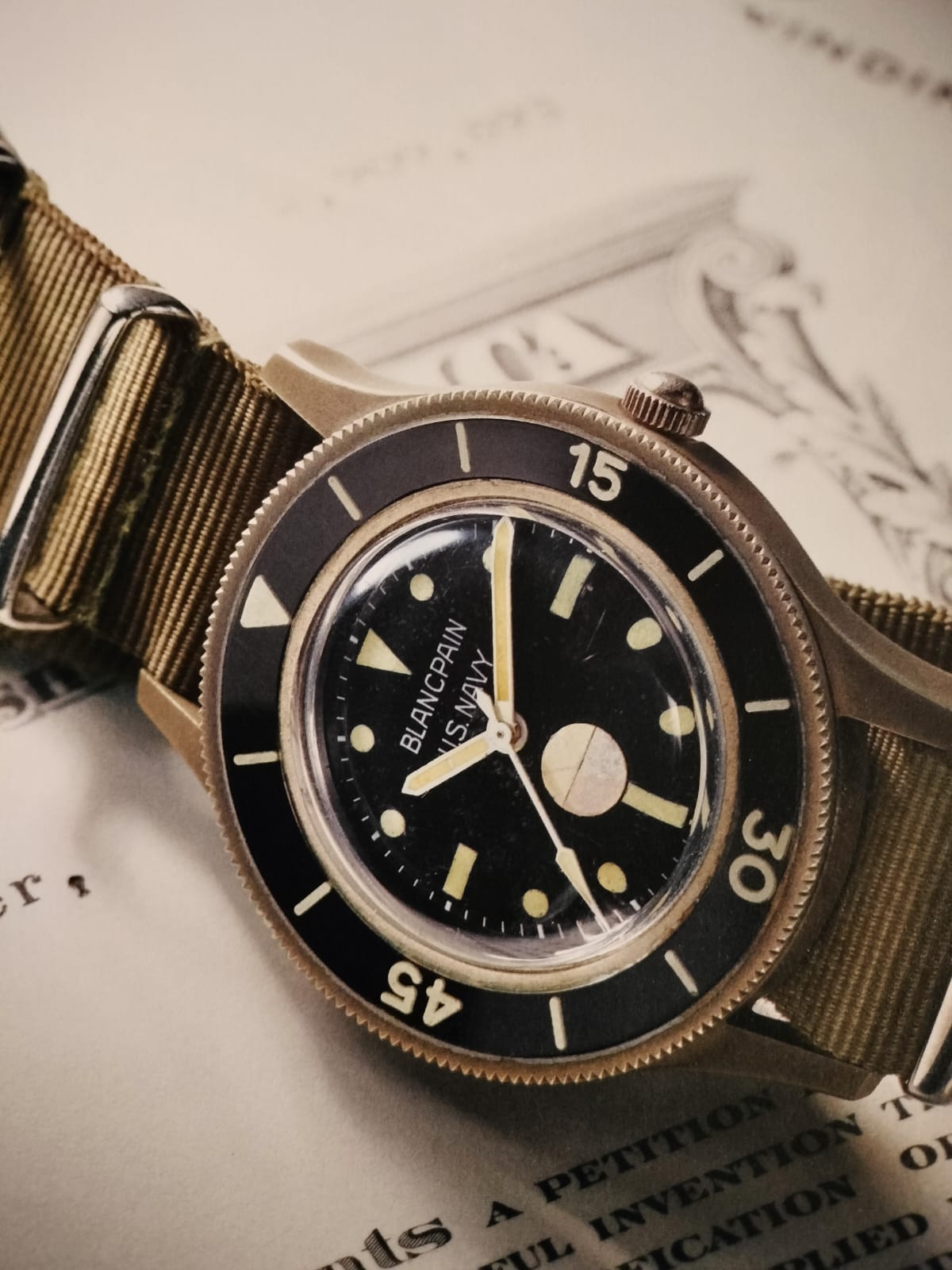
The 1953 specifications and military adoption
The 1953 Fifty Fathoms specifications became the template for the modern dive watch and were ratified into ISO 6425 (the international dive-watch standard, adopted 1996) decades later with minor refinements. The original specifications:
- Water resistance to 50 fathoms (91m). Tested at depth in pressure chambers, not just static immersion. Modern ISO 6425 requires 100m minimum.
- Anti-magnetic case construction. Soft-iron inner case to shield the movement from external magnetic fields. The military diver's wrist compass was the specific magnetic source the inner case had to shield against.
- Unidirectional rotating bezel. Counterclockwise-only rotation. The convention is now universal in dive watches.
- Screw-down crown. Threaded crown that cannot be accidentally pulled out underwater. Adopted by Submariner in 1954 and universal in dive watches since.
- Luminescent markings. Radium-painted (in the 1953 original; later tritium, now Super-LumiNova) on the dial and bezel marker. Required for low-visibility diving operations.
- Large applied indices. 12-3-6-9 with bold geometry. Designed for legibility through a dive mask in murky water.
The specifications were demanding enough that Blancpain had to create new manufacturing standards to meet them. The watch was issued to the Nageurs de Combat starting late 1953. By 1957, the same specifications had been adopted by US Navy SEALs (the Mil-Spec Fifty Fathoms), the German Bundesmarine (German Federal Navy), Israeli combat divers, Spanish military divers, and several other NATO and allied combat-diving units. The Fifty Fathoms was the standard combat-diver watch through the 1970s — the watch military divers actually wore on missions.
Mil-Spec and SEALs
The 1957 Mil-Spec Fifty Fathoms (Reference 1257-A) was the military-issued reference adopted by US Navy SEALs and the German Bundesmarine. The watch added a moisture indicator at six o’clock — a small humidity-detection gauge that turned color (typically from red to a contrasting color) if the case seal was breached and moisture entered the case. The moisture indicator was a unique safety feature: a diver could check at a glance whether the watch's seal was compromised, before relying on it for a mission. The Mil-Spec ran in service through the 1960s and 1970s and is the reference most prized by vintage Fifty Fathoms collectors today.
Vintage Mil-Spec examples in honest condition trade $15,000–$30,000 at auction; the rarest variants (with original Mil-Spec engraving on the caseback, original moisture indicator still functional, original crown and bezel insert) reach $50,000–$80,000+. The 70th Anniversary Act II reference (released 2023) is Blancpain's modern interpretation of the Mil-Spec — same case proportions, modernized movement, similar moisture indicator tribute.
The 1957 Mil-Spec Fifty Fathoms was issued to US Navy SEALs and German Bundesmarine. The watch existed because military divers needed it before recreational divers knew they wanted one.
Reference history across the decades
The Fifty Fathoms has had distinct generations across 70 years of production:
- 1953–1956 — Reference 1102 / 1103. The original Fifty Fathoms. AS 1361 movement (modified). 36mm case. Distinguished by the ribbed Bakelite bezel ring (rather than steel) — a feature unique to the earliest references.
- 1957–1965 — Mil-Spec / Reference 1257-A. Military-issued Fifty Fathoms with moisture indicator. Adopted by SEALs, Bundesmarine, and multiple other combat-diver units.
- 1965–1976 — Bathyscaphe family. Smaller and dressier variants — the original Bathyscaphe was a 36mm Fifty Fathoms designed for wearability beyond pure military use.
- 1979–2003 — "Quartz crisis" era. Fifty Fathoms production was reduced significantly during the quartz crisis. Limited production runs only.
- 2003–present — Modern Fifty Fathoms revival. Reference 5015 introduced 2007 with the in-house Caliber 1315 (5-day power reserve). Bathyscaphe revived 2013 in 38mm and 43mm sizes. 70th Anniversary Acts released 2023.
The Caliber 1315 movement
The Blancpain Caliber 1315, introduced 2007 for the modern Fifty Fathoms 5015, is one of the longest-running in-house dive-watch movements in modern horology. Specifications: 28,800 vph (4 Hz), 5-day (120-hour) power reserve from three series-coupled mainspring barrels, anti-magnetic silicon balance spring (introduced 2010 across the range), 35 jewels, COSC chronometer- equivalent accuracy without formal certification (Blancpain regulates internally to tighter standards than COSC requires).
The 5-day power reserve is exceptional at any price and exceeds Rolex's Caliber 3230 (70 hours), Omega's Caliber 8800 (55 hours), and most other in-house dive movements. The structural advantage: a Fifty Fathoms can be set down on Friday evening and picked up the following Wednesday morning still running — useful for buyers who rotate between watches. The 1315 is shared across the Fifty Fathoms 5015 and several Bathyscaphe 43mm references; the smaller Bathyscaphe 38mm uses the related Caliber 1150 (4-day power reserve, same architecture, scaled for the smaller case).
Modern collection
- Fifty Fathoms 5015 — 45mm steel, 300m water resistance, in-house Caliber 1315 (5-day power reserve), $15,400. The reference Fifty Fathoms.
- Fifty Fathoms 5015 Titanium — Titanium case version, similar specifications. Lighter on the wrist by approximately 35%.
- Fifty Fathoms Bathyscaphe 38mm — Smaller variant, 38mm steel, 300m water resistance, in-house Caliber 1150 (4-day power reserve), $14,000. The most-recommended Fifty Fathoms for daily wear.
- Fifty Fathoms Bathyscaphe 43mm — 43mm variant of the Bathyscaphe with Caliber 1315. Sized between the 38mm Bathyscaphe and the 45mm 5015.
- Fifty Fathoms Bathyscaphe Day Date — 43mm with day-date complication, $16,000+. The most-complicated Bathyscaphe.
- Fifty Fathoms 70th Anniversary Act I (Tribute, 2023) — Limited 70-piece edition referencing the original 1953 reference. Sold out at retail; secondary market $40,000+.
- Fifty Fathoms 70th Anniversary Act II (Mil-Spec, 2023) — Limited reference referencing the 1957 Mil-Spec with moisture-indicator tribute. Allocation controlled.
- Fifty Fathoms 70th Anniversary Act III (Bathyscaphe, 2024) — Limited reference completing the 70th-anniversary trilogy.
- Bathyscaphe X Fathoms — Specialist saturation-diving reference, 1,000m water resistance, mechanical depth gauge complication. Limited production.
Blancpain Ocean Commitment
Blancpain's ocean-conservation positioning is unusually integrated for a luxury watch brand. The Blancpain Ocean Commitment program, established 2014, funds marine biology research, expedition documentation, and conservation work. Co-branded Fifty Fathoms references (the Ocean Commitment Bathyscaphe and limited-edition Fifty Fathoms Pristine Seas references) directly support the program — a portion of each watch sale flows to ocean conservation. The positioning predates the broader luxury industry's sustainability turn by approximately a decade.
The structural reason this positioning fits: Blancpain is privately held (owned by the Swatch Group since 1992 but operationally distinct), produces modest annual volumes (~10,000 watches per year, vs Rolex's 1,000,000+), and has historical brand identity tied directly to underwater operations. Ocean conservation isn't marketing-grafted to the brand — it follows naturally from the Fifty Fathoms' military-diving origins and Blancpain's 60-year continuous engagement with serious diving.
What's worth knowing
The Fifty Fathoms' historical priority over the Submariner is well-documented but rarely emphasized in mainstream watch culture. Among horology historians and serious collectors, the Fifty Fathoms is recognized as the founding modern dive watch. Among the broader public, the Submariner is more recognized because Rolex marketed it more aggressively in the decades that followed and because the Submariner appeared in more films (Bond) and cultural moments. The historical record favors Blancpain; the cultural record favors Rolex. Both are correct in their respective domains.
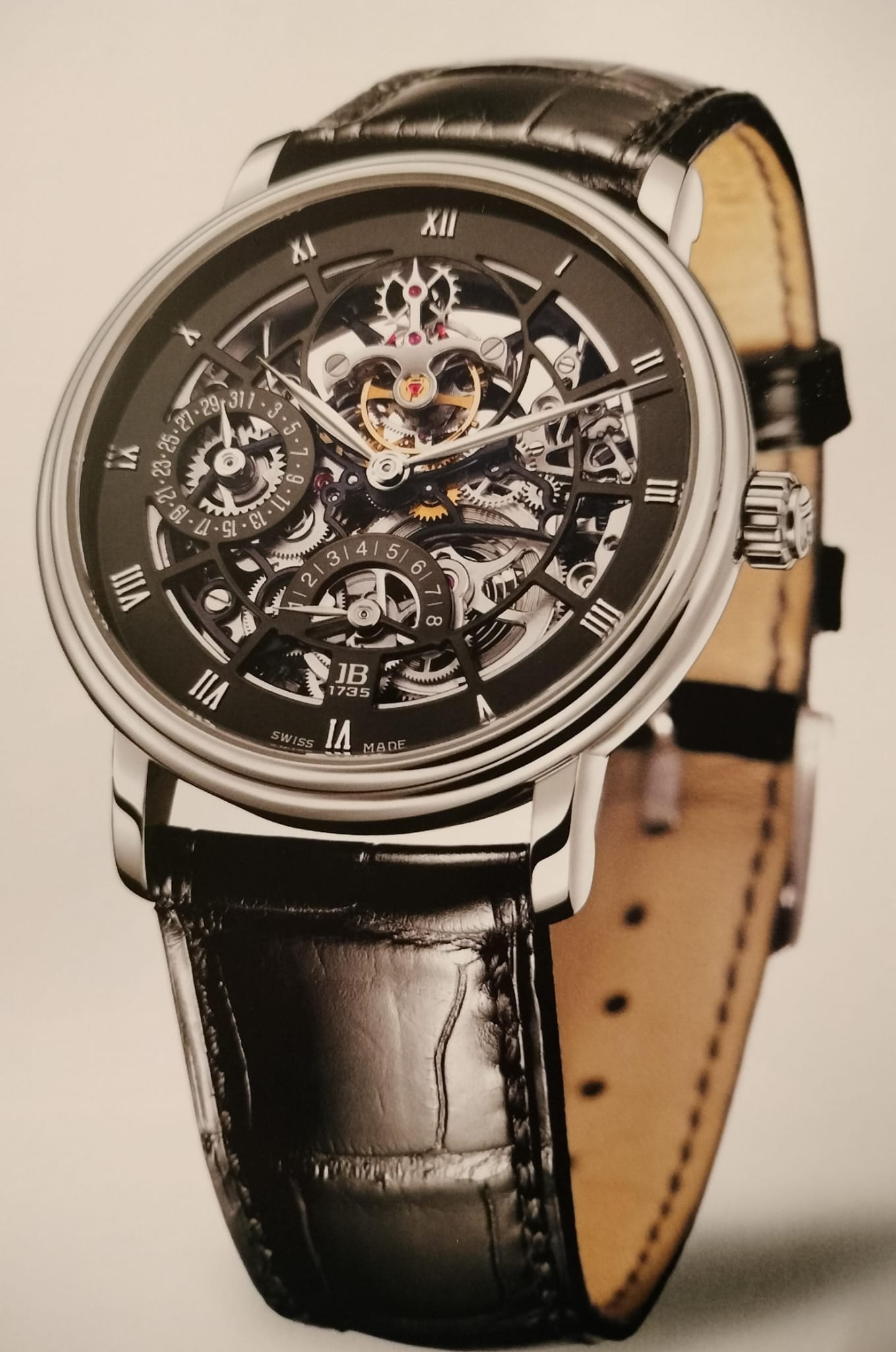
Blancpain has produced watches continuously since 1735 — the brand claims the longest continuous operation of any Swiss watchmaker. Famously, the brand's position is "Since 1735, there has never been a quartz Blancpain. There never will be." The Fifty Fathoms is part of that continuity: a mechanical-only line that has resisted every quartz-era and electronic-watch trend across 70 years of production. For buyers who specifically want a serious mechanical-only brand with deep historical identity, Blancpain is one of a small handful of choices.
Read next
For deeper coverage of Blancpain as a maker:
For comparable dive references and historical context:
- Rolex Submariner — The Benchmark
- Omega Seamaster — The Bond Watch
- Tudor Black Bay — The Best Under $5,000
- Doxa SUB — The Cousteau Watch
For the dive-watch category context and budget-tier ladder: