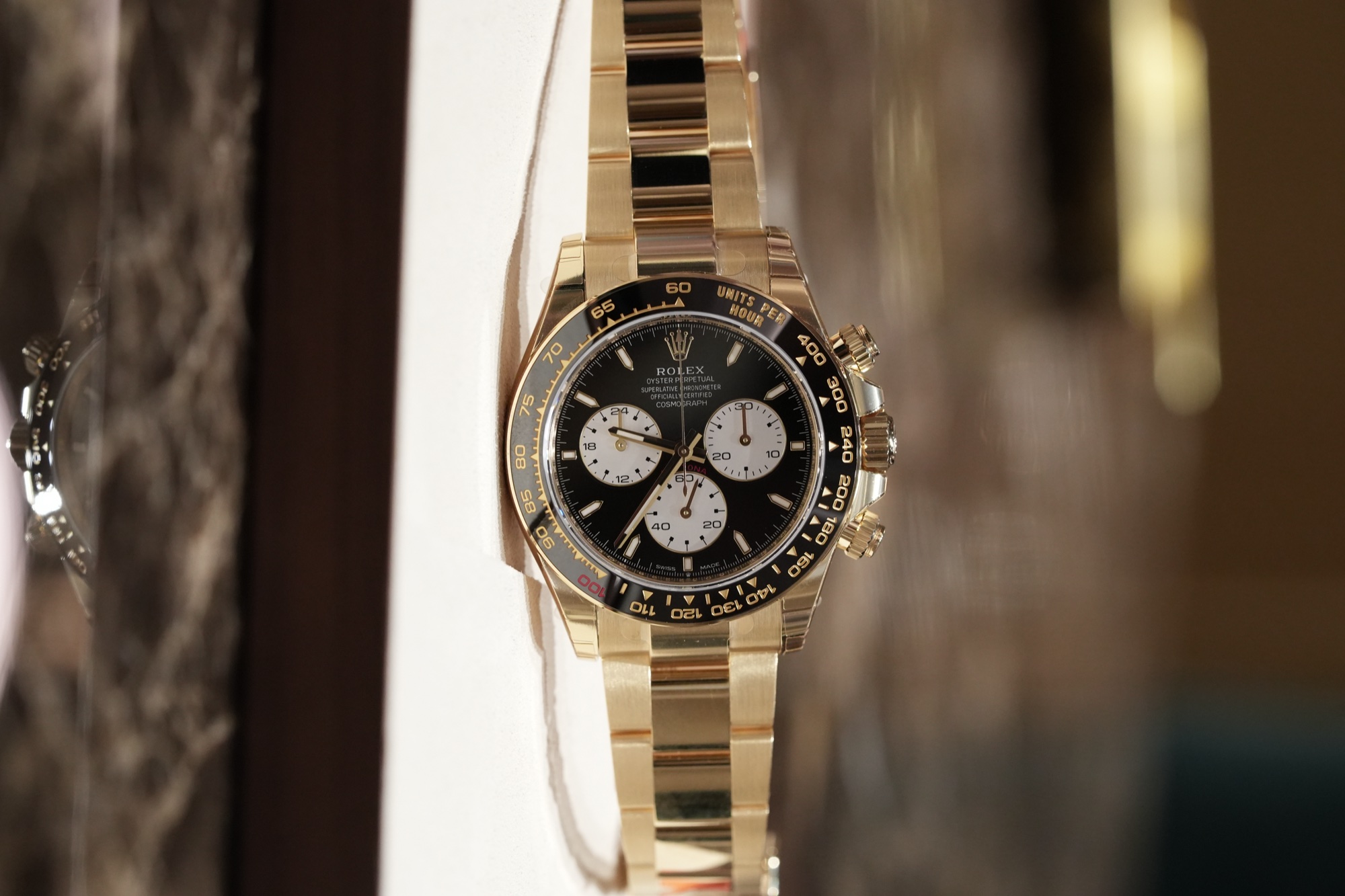
 Photo by Verygoodlord, via Wikimedia Commons, CC BY-SA 4.0
 How should I think about watch price tiers?
Five tiers, each with a defining transition. Under $500 is where mechanical watchmaking starts. Under $1,000 is where sapphire crystal becomes standard and in-house movements appear. Under $5,000 is where in-house Manufacture Calibers and COSC certification become standard. Under $10,000 is where the major Swiss houses offer their accessible icons. Over $10,000 is haute horlogerie — the Holy Trinity, the Daytona, and the independents. Each tier represents a real transition in finishing, brand premium, and resale curve.
How to think about price tiers
Watch pricing is non-linear. The improvement curve from $300 to $1,000 is steeper than from $1,000 to $3,000, and the improvement curve from $5,000 to $10,000 is mostly about brand premium rather than mechanical advancement. A $10,000 Rolex Submariner and a $4,500 Tudor Pelagos 39 are made on overlapping production infrastructure and share most movement architecture; the price difference reflects the Rolex crown, the Submariner waitlist, and the cultural recognition the watch carries — not five thousand dollars of mechanical advancement.
The transitions that genuinely matter are these. Between under-$500 and under-$1,000: sapphire crystal becomes standard, in-house Japanese movements (Seiko 6R35) appear, bracelets gain solid links and milled clasps. Between under-$1,000 and under-$5,000: in-house Manufacture Calibers (Tudor MT-series, Cartier 1847 MC) replace ETA-derived movements, COSC chronometer certification becomes standard, dial work gains applied indices and proper finishing. Between under-$5,000 and under-$10,000: established sport-watch icons (Submariner, Speedmaster, Santos) become accessible, brand-recognition premium accelerates, and the resale curve flips from gradual depreciation to selective appreciation. Between under-$10,000 and over-$10,000: the Holy Trinity becomes available, hand-finishing becomes standard, and steel sport-luxury references trade at 200–400% above retail on the secondary market.
The right tier for any specific buyer is rarely the highest tier they can afford. The right tier is the one where the watch they want sits at retail with reasonable availability. A buyer who wants a Submariner does not benefit from owning a Datejust at $9,200 retail; they benefit from waiting (or paying secondary market) for the Submariner. A buyer who wants a daily-wear sport watch does not benefit from a $35,000 Royal Oak Jumbo if a $3,950 Tudor Black Bay 58 will satisfy the use case at one-tenth the cost. Knowing which watch you actually want — and at which tier it sits — is the buying decision. The tier is incidental.
The right tier is rarely the highest one you can afford. It's the one where the watch you actually want sits at retail with reasonable availability. Spend the budget on the watch, not on the price.
Subdial Editors
What changes at each tier
Five things change predictably as you move up the tier ladder, and each one compounds the next:
- Movement quality. Entry quartz (under $150) → entry mechanical with mineral crystal (Seiko 5, $300) → in-house mechanical with sapphire (Seiko SPB143, $900) → COSC chronometer (Tudor BB58, $3,950) → Master Chronometer with anti-magnetic certification (Omega Aqua Terra, $5,400) → hand-finished haute movement (Patek 6119G, $30,000) → independent hand-finishing at the per-piece level (Philippe Dufour Simplicity, $350,000+).
- Case construction and finishing. Stamped steel with mineral crystal → forged steel with sapphire → finished steel with applied indices → hand-finished steel with polished bevels → hand-anglage and Côtes de Genève visible through display caseback → solid-gold movement plates (FP Journe).
- Bracelet quality. Folded link with stamped clasp → solid link with milled clasp → integrated bracelet with quick-change → tool-free micro-adjustment (Tudor T-Fit, Omega adjustable, Rolex Glidelock) → hand-finished bracelet with hand-polished beveled edges.
- Brand-recognition premium. No premium below $500 → modest premium ($500–5,000) → significant premium ($5,000–10,000) → multi-x retail premium for sport-luxury above $10,000 (Submariner 1.4×, Daytona 2.5×, Royal Oak 2.5×, Nautilus 3.5×).
- Resale curve. 40–60% retention (under $500) → 50–70% (under $1,000) → 60–75% with some appreciation (under $5,000) → 70–90% with consistent appreciation on icons (under $10,000) → 100–300%+ secondary on steel sport-luxury (over $10,000).
Common buying mistakes by tier
Different mistakes happen at different tiers. The over-spending mistake is tier-specific too:
- Under $500: the fashion-watch trap. Daniel Wellington, MVMT, Fossil, and Movado sit in this price range and look mechanical from a distance. They aren't. Quartz movements in styled cases without serviceable internals — the watch lasts as long as the battery cells and gaskets, then becomes uneconomic to repair. A Seiko 5 at $300 is a different category of watch entirely.
- Under $1,000: micro-brand resale risk. Christopher Ward, Maen, Baltic, Halios, and other micro-brands offer genuinely strong watches at under-$1,000 prices, but resale runs 20–40% below comparable Seiko/Tissot/Hamilton retail. Buy because you want the watch, not as a hold.
- Under $5,000: Black Bay variant fatigue. Tudor releases new Black Bay variants frequently — bronze, ceramic, GMT, chronograph, 36mm, 39mm, 41mm. Some are limited or discontinued faster than expected. Buy the variant you want, not the rarest one — collector premiums on discontinued BB variants are real but unreliable.
- Under $10,000: chasing the Submariner waitlist. First-time Rolex buyers do not receive Submariners. Authorized-dealer allocation depends on multi-year purchase history. Either build the relationship and wait, or pay $13,000–$15,000 secondary, or buy a different watch — but don't expect a Submariner allocation as a first-time buyer at retail.
- Over $10,000: the "rare reference" trap. Limited editions, special anniversary references, and tropical-dial vintage pieces appreciate dramatically — but only the right ones. Most limited editions are marketing-limited rather than genuinely scarce. Buy from established dealers with provenance documentation; auction history matters more than retail rarity.
The five tiers in detail
Each tier has a dedicated guide with the most-recommended specific watches, what changes at the tier, what you give up, ownership cost, and the bridge to the next tier: