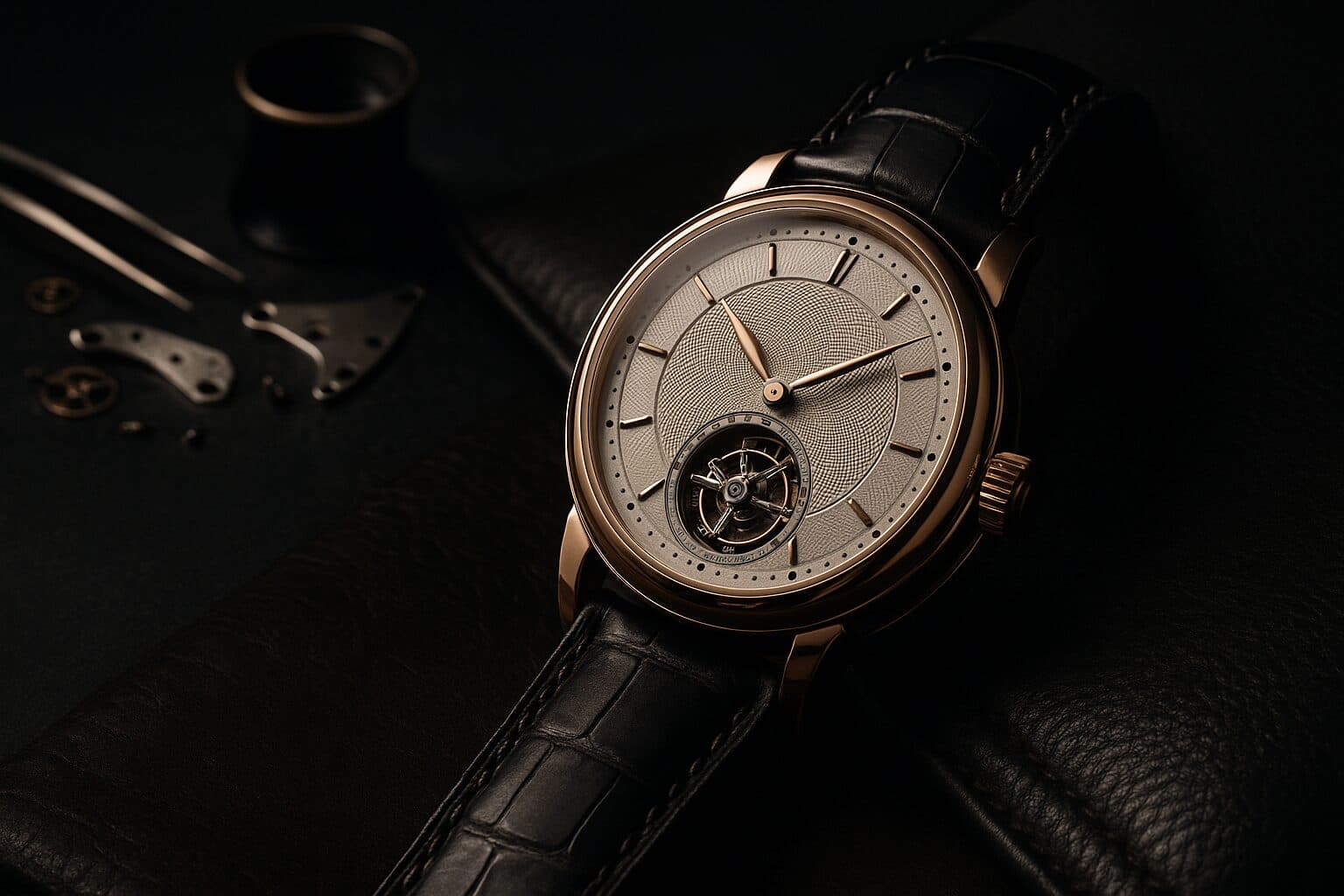
The advances independent watchmaking has made over the last two decades are extraordinary — a handful of small ateliers now command prices that rival, and occasionally eclipse, the grandes maisons that have existed for centuries. That said, few names illustrate this shift more sharply than Kari Voutilainen and Rexhep Rexhepi's Akrivia.
Both began as essentially the work of one watchmaker, and both now sit behind closed waitlists with secondary-market premiums that run to multiples of original retail. The question worth asking is not whether collectors pay more for these pieces, but why the premium has proven so durable.
Collectors pay a premium for Voutilainen and Akrivia because each combines genuine hand-finishing, in-house movement construction, and annual production estimated in the dozens — not thousands. Recent Phillips and Christie's results suggest clean examples regularly clear multiples of original retail, driven by closed waitlists and structural scarcity.
What Actually Drives the Independent Premium?
Before isolating either maker, it helps to separate the three forces that compound into an independent premium. They are craft, scarcity, and access — and they reinforce one another rather than operating in isolation.
Craft sets the ceiling on desirability, scarcity restricts how many people can satisfy that desire, and access — the waitlist — converts both into a queue. When all three align, the secondary market becomes the only open door, and that door is priced accordingly.
This is the same mechanism we traced in the F.P. Journe premium, where a maker's move toward steel and limited editions turned modest retail prices into six-figure secondary results. Voutilainen and Akrivia sit further along the same curve, with even smaller output and even longer queues.
Access deserves particular emphasis because it is the least visible of the three forces. An allocation at an independent is rarely transactional; it is built on relationship, history, and a maker's judgment about who should receive a watch from a tiny annual run.
The independent premium is the gap between an atelier's retail price and its secondary-market value, driven by three compounding forces: hand-finished craft, deliberately small production, and waitlists that close to new clients. When demand outpaces a few dozen watches a year, the secondary market sets the real clearing price.
The Hand-Finishing Premium: Voutilainen
Kari Voutilainen built his reputation in Môtiers, in the Val-de-Travers, on a level of hand-finishing that is difficult to industrialize and therefore difficult to scale. His dials are frequently produced in-house through the specialist Comblémine, with guilloché and grand feu enamel work that varies meaningfully from piece to piece.
The flagship Vingt-8 caliber is finished to a standard — bevelled bridges, polished countersinks, and frosted surfaces — that requires hours of bench work no machine fully replicates. This is the part of the value proposition that photographs poorly and rewards ownership.
Consider anglage, the bevelling of a movement's edges to a mirror polish, rounded by hand against a wooden or tin lap. The technique cannot be fully automated at this level, and its quality is one of the first things a knowledgeable buyer inspects under a loupe.
What's more, Voutilainen's willingness to take on custom dial commissions means many examples are effectively unique. That individuality is precisely what thins the supply of directly comparable watches and supports pricing on the secondary market.
Voutilainen's premium rests on hand-finishing that resists automation: in-house guilloché and grand feu enamel dials, hand-bevelled movement bridges, and frequent custom commissions. Because so many examples differ in dial treatment or metal, directly comparable watches are scarce, which supports both retail pricing and the multiples seen on the secondary market.
Scarcity by Design
Annual output is where the premium becomes structural rather than sentimental. Industry estimates place Voutilainen's total production in the region of 50 to 70 watches per year across all references — a figure dwarfed by a single morning's output at a large Swiss brand.
Akrivia is smaller still, with estimates suggesting fewer than 100 pieces annually across the entire catalogue, and far fewer of the flagship Chronomètre Contemporain. Treat both numbers as approximate, since neither atelier publishes audited production figures and any serious buyer should verify current output before drawing conclusions.
When supply is measured in dozens, ordinary demand becomes excess demand almost immediately. This is the same supply starvation that drives Patek's allocation reality, except that here there is no industrial capacity waiting in reserve to ever meaningfully expand it.
There is a second-order effect worth naming. Because output is fixed and demand keeps rising, even the act of one collector selling becomes an event — a rare liquidity moment in a market with very little float.
A note on figures: production volumes, retail prices, and secondary multiples in this piece are estimates drawn from secondary-market platforms and auction reporting. Verify any specific number against the auction house's published lot record or a current dealer quote before you transact.
Rexhep Rexhepi and the Akrivia Ascent
Akrivia is the house; Rexhep Rexhepi is the watchmaker, and the distinction matters because the market is buying the maker. Trained in Geneva and having passed through Patek Philippe early in his career, Rexhepi launched his own work young and built a reputation on classical, chronometer-grade construction.
The Chronomètre Contemporain — first as the RRCC I and later the RRCC II — became a reference point for a new generation of collectors. In 2024 the Chronomètre Contemporain II took the Aiguille d'Or, the top prize at the Grand Prix d'Horlogerie de Genève, which crystallized demand that was already running ahead of supply.
That award is the kind of catalyst that resets a waitlist overnight. Once a maker is validated at that level, the queue lengthens and the secondary market absorbs the overflow.
Akrivia's premium is concentrated in Rexhep Rexhepi, whose Chronomètre Contemporain II won the 2024 Aiguille d'Or, the top GPHG prize. With production estimated below 100 watches a year and a closed waitlist, that validation pushed secondary-market demand well beyond what the atelier can supply, lifting clearing prices to multiples of retail.
What the Auction Results Suggest
Auction houses are the clearest window into independent pricing because the results are public and competitively bid. Phillips and Christie's have both built dedicated independent-watchmaking sections, and the hammer prices there set the reference points dealers use privately.
The pattern across recent sales is consistent even if individual figures vary: flagship Voutilainen and Akrivia references tend to clear well above their original retail, often by a multiple rather than a margin. Exact results depend on metal, dial, condition, and the completeness of box and papers, so treat the ranges below as directional.
| Factor | Voutilainen | Akrivia (Rexhep Rexhepi) |
|---|---|---|
| Founded / base | 2002, Môtiers, Switzerland | 2012, Geneva, Switzerland |
| Flagship reference | Vingt-8 / 28ti | Chronomètre Contemporain (RRCC I / II) |
| Est. annual production | ~50–70 watches (estimated) | <100 watches (estimated) |
| Est. flagship retail | ~$90,000–$130,000+ (estimated) | ~CHF 100,000–110,000 (estimated) |
| Secondary vs retail | ~1.5–2.5× retail (estimated, condition-dependent) | ~2–5× retail (estimated, reference-dependent) |
| Key catalyst | Multiple GPHG awards; in-house dials | 2024 Aiguille d'Or; single-maker mythology |
Note the directionality rather than the precision: both makers trade above retail, and the scarcer the reference, the steeper the multiple. The Akrivia range runs wider largely because the Chronomètre Contemporain II is newer, rarer, and freshly award-validated.
Provenance also moves the number. Single-ownership examples with full books, tools, and a documented service history consistently outperform incomplete watches, and for independents that paper trail doubles as a check on authenticity.
Recent Phillips and Christie's sales suggest flagship Voutilainen references clear roughly 1.5 to 2.5 times original retail, while scarce Akrivia Chronomètre Contemporain examples can reach two to five times retail. Figures are estimated and condition-dependent; verify each against the auction house's published lot record before treating it as a comparable.
Waitlists, Allocation, and the Closed Door
The waitlist is the quiet engine of the premium, because it converts demand into a structurally permanent shortage. Both ateliers have, at various points, closed their lists to new clients entirely — which means even a willing buyer at full retail simply cannot get in line.
When the primary market is shut, the secondary market is the only market, and price discovery moves entirely to auction and private sale. This is the same retail-versus-secondary fracture we examined in Rolex's retail dysfunction, only without the production scale that lets Rolex eventually satisfy some of the queue.
For collectors, the closed door also functions as a signal. A waitlist you cannot join implies a community you must pay a premium to enter, and that exclusivity is itself part of what is being purchased.
Closed waitlists are central to the premium because they remove the primary market as an option. When neither Voutilainen nor Akrivia is accepting new clients at retail, the secondary market becomes the only way in, and auction results — not list prices — set the true cost of ownership.
Is the Premium Sustainable?
No premium is permanent, and the honest answer is that independent valuations carry real risk. Succession is the obvious one — a market that buys the maker is exposed when the maker steps back, scales up, or hands the bench to others.
Akrivia's value is unusually concentrated in one person's continued involvement, while Voutilainen's expansion into dial-making for others could, in theory, dilute the perception of singular scarcity. These are the structural questions a serious buyer weighs against the broader vintage market dynamics that govern long-term collectibility.
Demand has also broadened: where independent collecting was once a niche within a niche, auction visibility and social media have pulled new buyers into the category. That widening base is part of why the premium has held even as prices have climbed.
That said, the forces underpinning today's premiums — hand-finishing, dozens-per-year output, and validated reputation — are slow to unwind. For now, the queue is long, the supply is fixed, and the secondary market continues to clear above retail.
Frequently Asked Questions
Why is Voutilainen so expensive compared to mainstream luxury watches?
Voutilainen's pricing reflects hand-finishing and in-house dial work that cannot be industrialized, combined with annual production estimated at only 50 to 70 watches. Limited supply against rising demand pushes both retail and secondary prices well above comparably specced pieces from larger brands.
What makes Akrivia's Chronomètre Contemporain so sought after?
The Chronomètre Contemporain is the flagship of Rexhep Rexhepi's atelier, built to chronometer-grade standards and produced in tiny numbers. Its 2024 Aiguille d'Or win at the GPHG validated the reference at the highest level, intensifying demand that already outran supply.
Do Voutilainen and Akrivia hold their value at auction?
Recent Phillips and Christie's results suggest flagship references from both makers regularly sell above original retail, often by a multiple. Actual outcomes depend on condition, dial, metal, and completeness of box and papers, so verify any figure against the published lot record.
Can you still buy these watches at retail?
Both ateliers have closed their waitlists to new clients at various points, meaning retail access is effectively unavailable to most buyers. When the primary market is shut, the secondary market becomes the only route, which is the primary driver of the premium.
Is the independent premium a bubble?
The premium carries genuine risk, particularly around succession and any future increase in production. That said, the underlying drivers — hand-finishing, dozens-per-year output, and validated reputations — are slow to change, so the premium is structural rather than purely speculative.
For collectors weighing an entry into independent watchmaking, the takeaway is that the premium is a structural feature of the category rather than a temporary distortion. Approach the secondary market with verified comparables, complete provenance, and the patience the segment demands — and treat every quoted figure as a starting point to confirm, not a fact to assume.