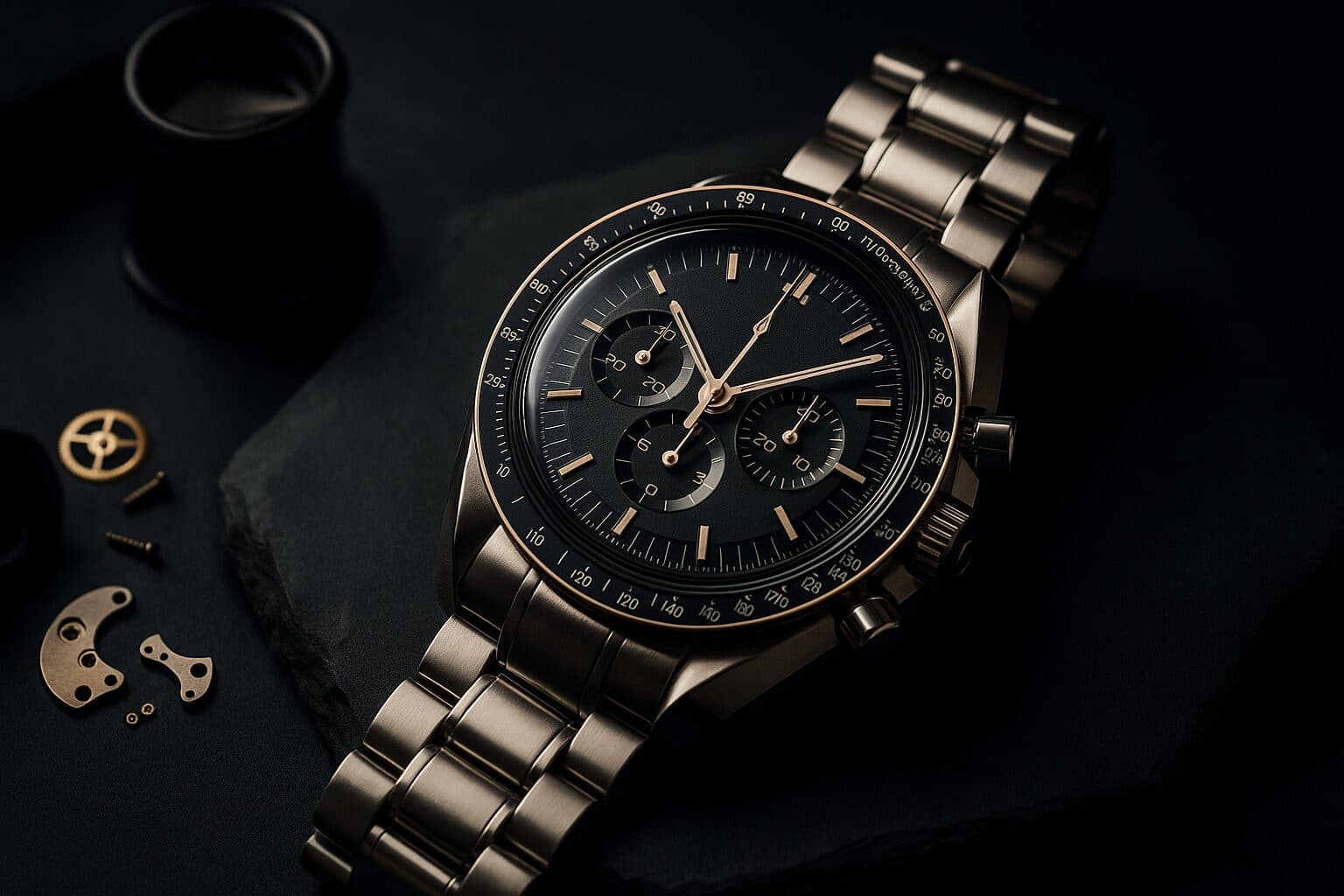
The Omega Speedmaster Professional: Collecting the Moonwatch Across Its References
By The Subdial Editors ·
More wristwatches have reached the surface of the Moon on an Omega Speedmaster than on any other reference, and yet the watch most buyers picture is only one chapter of a much longer story.
The Speedmaster Professional has been in continuous production since 1957, which makes it less a single object than a family tree of references, calibers, and dial variants spanning nearly seventy years.
That continuity is exactly what makes the Moonwatch the most collected chronograph in the hobby — and also what makes building a position in it genuinely demanding.
Knowing which reference you are holding, and why one trades in the low four figures while its near-twin trades in the high six, is the entire exercise.
What is the Omega Speedmaster Professional Moonwatch?
It is Omega's manual-wind chronograph, in production since 1957, flight-qualified by NASA and worn on the Moon. “Moonwatch” refers to the Professional line across its many references.
Why the Speedmaster Is the Most Collected Chronograph in the Hobby
The appeal begins with provenance no marketing department could invent: the Speedmaster is the only watch certified by NASA for all manned space missions, a qualification it earned in 1965 and has never relinquished.
What's more, the design has barely moved in decades, so a watch you can buy new today is recognizably the same instrument that was strapped over a spacesuit cuff in 1969.
That stability has a practical consequence for collectors — real depth of supply across every price tier, from a few thousand dollars to several million.
For context on how a single model can sustain that kind of breadth, our analysis of vintage market dynamics covers why continuously produced references behave differently from one-off rarities.
The Caliber Story That Drives Everything
Before any discussion of cases or dials, the movement inside dictates where a given Speedmaster sits in the market.
The reference history breaks cleanly along caliber lines, and collectors price accordingly.
Here is how the four principal calibers map to the eras a buyer will encounter:
- Caliber 321 (1957–1968). The original column-wheel chronograph, based on the Lemania 2310, and the movement that flew to the Moon. It is the single most important value driver in vintage Speedmaster collecting.
- Caliber 861 (1968–1996). A cam-actuated successor that is more robust and less costly to service. It anchors the most accessible vintage references.
- Caliber 1861 (1996–2021). A refined evolution of the 861 that defined the modern Moonwatch for a generation of buyers.
- Caliber 3861 (2021–present). A Master Chronometer movement with a co-axial escapement and strong antimagnetic resistance, powering the current production watch.
Keep in mind that the 1968 transition from the 321 to the 861 is the most consequential line in the entire catalog.
References on the 321 side of that line carry the lunar pedigree and the column-wheel romance, while everything after is, in collecting terms, the modern era.
What is the difference between the Caliber 321 and the 861?
The Caliber 321 (1957–1968) is a column-wheel chronograph collectors prize for its lunar pedigree. The 861, from 1968, is a cam-actuated design that is more robust and cheaper to service.
The Vintage References That Define the Market
Six references do most of the heavy lifting in vintage Speedmaster collecting, and learning them is the fastest route to literacy in this corner of the hobby.
The table below sketches the references most collectors compete for, with approximate production windows and the reason each one matters.
| Reference | Era (approx.) | Caliber | Why it matters |
|---|---|---|---|
| CK2915 | 1957–1959 | 321 | The first Speedmaster ever made; broad-arrow hands and a steel bezel on the earliest examples. |
| CK2998 | 1959–1962 | 321 | First black bezel and alpha hands; the lineage worn in orbit by Wally Schirra in 1962. |
| 105.003 “Ed White” | 1963–1969 | 321 | Symmetric case; worn on the first American spacewalk in 1965; the connoisseur's favorite. |
| 105.012 | 1964–1966 | 321 | First “Professional” dial and asymmetric case; a lunar-flown reference on Apollo 11. |
| 145.012 | 1967–1968 | 321 | The last Caliber 321 Speedmaster, and also worn on the Moon. |
| 145.022 | 1968–late 1980s | 861 | The Caliber 861 transition; the most accessible vintage entry point. |
Of these, the CK2915 sits alone at the top as the genesis reference, while the 105.012 and 145.012 carry the literal distinction of having been worn on the lunar surface.
The 105.003 “Ed White” occupies a beloved middle ground — early enough to wear the Caliber 321 and the symmetric case, yet produced in sufficient numbers to remain attainable.
Which Speedmaster reference is the most collectible?
The CK2915 of 1957 is the most valuable, as the first Speedmaster ever made. For most collectors the 105.003 “Ed White” and the lunar-flown 105.012 and 145.012 define the field.
What Drives Premiums Within a Single Reference
Two examples of the same reference can differ in value by a factor of five or more, and understanding why is where a collector earns their margin.
The variables that move price within a reference are consistent across the vintage market:
- Caliber and correctness. The right movement for the reference, with matching case and caseback markings, is the baseline; a service-swapped caliber erodes value immediately.
- Case originality. An unpolished case with sharp, original chamfers and lug bevels commands a substantial premium over a watch that has been buffed thin.
- Dial and lume condition. Even, matched tritium aging and a “tropical” brown patina can multiply value, while a redial or relume does the opposite.
- Provenance and sets. Original box, papers, and an Omega extract from the archives reassure buyers and reduce the risk of replaced parts.
Naturally, these factors compound, so the genuine grails are watches that satisfy all four at once.
For a deeper read on how condition and originality translate into hammer prices, our guide to how auction estimates are set walks through the mechanics in detail.
What drives premiums on a vintage Speedmaster?
Caliber, originality, and dial condition drive premiums. An unpolished case, matched tritium lume, a “tropical” brown dial, and full provenance can multiply value over an identical example.
The Auction Results That Set the Ceiling
Public auction results matter to collectors not because most watches change hands at those numbers, but because they anchor the top of the market and pull the tiers beneath them.
The headline figure for the model arrived when a tropical-dial CK2915-1 reportedly achieved a result near CHF 3.1 million at Phillips in Geneva in late 2021, according to the auction house's published results.
That example combined the genesis reference, an exceptional tropical dial, and unimpeachable originality — the exact compounding of factors described above.
Note that this is a ceiling, not a midpoint: the overwhelming majority of vintage Speedmasters trade for a small fraction of that figure, and production estimates and grades should always be verified against authoritative sources before any transaction.
Demand at the modern limited-edition end tells the same story from a different angle — the 2017 “Speedy Tuesday” edition of 2,012 pieces reportedly sold out online within hours.
What is the auction record for an Omega Speedmaster?
A tropical-dial CK2915-1 reported a result near CHF 3.1 million at Phillips in Geneva in late 2021, the public ceiling for the model. Most vintage Speedmasters trade far below that.
The Modern Moonwatch and Its Collectible Variants
For most buyers, a position in the Speedmaster begins not with a seven-figure CK reference but with a watch available at retail.
The Caliber 1861 reference 3570.50, produced from roughly 1996 to 2014, is the established value benchmark and the cleanest way to own the Hesalite Moonwatch with modern serviceability.
Since 2021, the Caliber 3861 has powered the current production watch, offered in a historically correct Hesalite version and a sapphire-crystal “sandwich” variant that exposes the movement.
That said, the limited editions are where the modern market generates its own premiums, and the Snoopy series is the clearest example.
The Apollo XIII Silver Snoopy Award pieces — the 2003 edition and the 2020 fiftieth-anniversary release — trade well above their original retail on the strength of demand and tight production.
For collectors weighing the Speedmaster against other steel sport icons, our coverage of collectible dive watches and of Royal Oak heritage maps the adjacent territory.
Should I buy a Hesalite or sapphire modern Moonwatch?
Hesalite is the historically correct, NASA-flown choice and holds the strongest collector identity. The sapphire “sandwich” shows the movement and resists scratches, but draws a smaller following.
Building a Position: Where to Start
A coherent Speedmaster collection is built in tiers, not in a single purchase, and the smartest first acquisition is rarely the most expensive one.
The Subdial Editors' framework below is deliberately spec-specific rather than a vague exhortation to “buy the best you can afford.”
Editorial recommendation — by tier:
- Entry. A clean Caliber 861/1861 reference — a 145.022 or a 3570.50 — with box and papers, as the value benchmark and a daily-wearable foundation.
- Sweet spot. An honest 105.003 “Ed White” with an unpolished case and matched lume — the connoisseur's Caliber 321 reference at a comparatively sane multiple.
- Trophy. A lunar-flown 105.012 or 145.012 with documented provenance, for the collector buying the literal Moon-era reference.
- Modern. The current Caliber 3861 in Hesalite for wear, with the sapphire sandwich reserved for those who want the movement on display.
Across every tier, originality outranks cosmetic condition, and a verifiable set outranks a slightly cleaner watch with no history.
Collectors coming from the Rolex world will find the Speedmaster a refreshing contrast, as there is no allocation game here — a dynamic our piece on Rolex retail dysfunction describes for comparison.
Frequently Asked Questions
The questions below address the details that most often decide a Speedmaster purchase.
What is the difference between the Caliber 321 and 861?
The Caliber 321 (1957–1968) is a column-wheel chronograph based on the Lemania 2310 and the movement collectors prize. The Caliber 861, from 1968, uses a cam-actuated design that is more robust and cheaper to service.
Which Speedmaster references were actually worn on the Moon?
The flight-qualified lunar references are the 105.012 and the 145.012, both powered by the Caliber 321. Buzz Aldrin wore a 105.012 on Apollo 11; Armstrong's stayed in the lunar module as a backup timer.
Is a Hesalite or sapphire Moonwatch better for collecting?
Hesalite is the historically correct, NASA-flown choice and tends to hold the strongest collector identity. The sapphire sandwich shows the movement and resists scratches, but commands a smaller enthusiast following.
What does a tropical Speedmaster dial mean?
A tropical dial is a black dial that has aged to warm brown under UV exposure. When even and attractive, the effect is highly desirable and can add a significant premium over a standard black dial.
How much does a vintage Omega Speedmaster cost?
Estimated ranges: clean Caliber 861 examples often run roughly $4,000–$9,000; an Ed White 105.003 commonly $12,000–$35,000; early CK references reach six and seven figures. Verify current comps before buying.
Do box and papers matter on a Speedmaster?
Yes. Original box, papers, and an extract from the archives meaningfully affect price on vintage and limited references, and full sets reduce the risk of replaced parts or a redial that erodes long-term value.
Where Your Speedmaster Search Should Begin
The Moonwatch rewards patience and literacy more than budget, because the same reference can hide both a bargain and a trap depending on originality.
Start with the caliber, confirm the case has not been polished away, and insist on a story you can verify before you commit funds.
For more collector playbooks across the market, explore the rest of the Subdial editorial library.