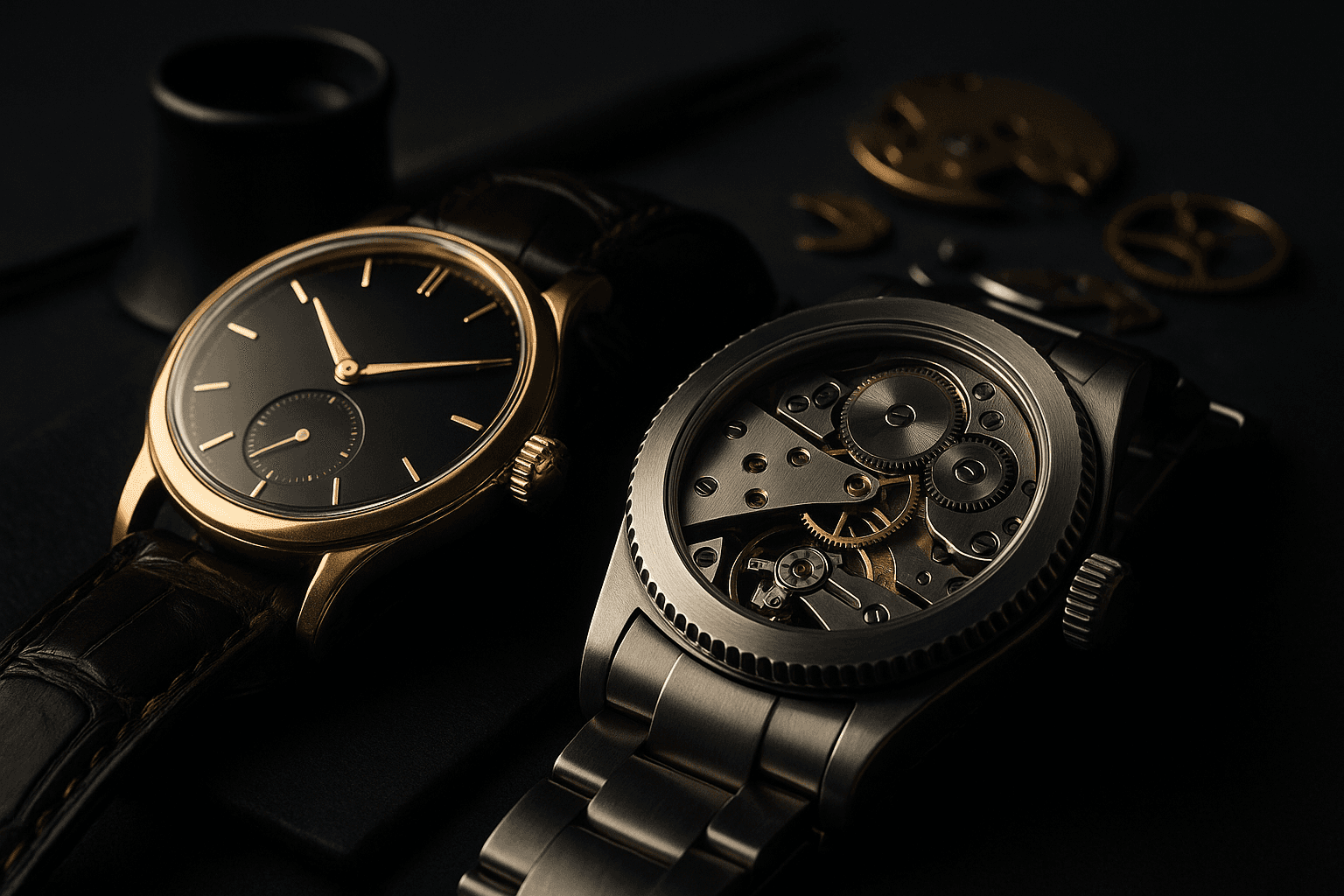
Vintage Patek Philippe vs Tudor Pricing: What Separates the Two Markets
By The Subdial Editors ·
In 2024 a stainless steel Patek Philippe Calatrava reference 96 sold at Sotheby's for $45,600. A Tudor Oyster Prince reference 7965 from the same postwar decades trades today across roughly fifteen Chrono24 listings priced between $1,275 and $3,425.
Both are mid-century Swiss wristwatches of comparable diameter, comparable case architecture, and comparable everyday intent. They are separated by more than an order of magnitude, and the reasons are structural rather than sentimental.
What follows puts the two markets side by side with sourced price bands, the mechanisms that produce them, and the spec-level detail that moves any given example within its band. Where a figure is an estimate rather than a recorded result, it is marked as one.
Why The Two Markets Price So Differently
The gap begins at the movement. The reference 96 runs the caliber 12-120, the manufacture's first in-house movement, developed under Jean Pfister and used across every ref. 96 built between 1934 and 1973.
Tudor took the opposite path by design. The Submariner ref. 7016 introduced in 1968 runs a sourced ETA 2483 — 25 jewels, 18,000 beats per hour — housed in a Rolex-made Oyster case.
That single decision cascades through everything downstream. In-house movements in precious-metal cases produced in small numbers create scarcity, while sourced calibers in steel cases produced for volume create supply.
Accordingly, the two markets answer to different forces. Vintage Patek is priced on rarity, dial originality, and archival documentation, while vintage Tudor is priced on condition, dial variant, and the reflected authority of the Rolex case.
These are the same forces we track across the wider vintage market dynamics, applied at two very different altitudes. Understanding which force is dominant in each market is what makes the price gap legible rather than arbitrary.
Where Vintage Patek Prices Actually Sit
Two references anchor the accessible end of vintage Patek, and they sit two generations apart. The reference 96 is the founding Calatrava, and the reference 3796 is its late-century successor.
Calatrava Reference 96 (1932 to 1973)
The 96 is the reference that defined the modern dress watch, running a manual-wind caliber 12-120 inside a case measuring roughly 30.5mm. Four decades of production means series variation matters enormously to price.
Yellow gold examples in honest condition trade in a broad band of roughly $12,000 to $45,000, per Sotheby's collecting guidance. Steel is far rarer than gold in this reference, which inverts the usual precious-metal logic.
The recorded results bear that out. A steel 96 realized $45,600 at Sotheby's New York in 2024, and a pink gold example with a matching pink gold dial reached €82,500 — approximately $89,000 — in July 2024.
Keep in mind that the 96 is unusually condition-sensitive. Dial condition, case profile after prior polishing, and index originality move an example across the full width of that band rather than within a narrow slice of it.
Calatrava Reference 3796 (1982 to the late 1990s)
The 3796 succeeded the 96 in role if not in exact form, introduced in 1982 and produced into the late 1990s. It carries the caliber 215 PS, a slim manual-wind movement of 21.9mm by 2.55mm running at 28,800 beats per hour with a 44-hour power reserve.
Dealer listings show the practical band clearly. Yellow gold examples appear around $8,200, rose gold near $12,500, and platinum above $24,000.
Note that aggregator listing ranges for this reference are noisy — one platform shows a nominal spread from $324 to $19,500,000, which reflects data errors and mismatched listings rather than a real market. Use dealer asks and auction results, not raw aggregator extremes.
Where Vintage Tudor Prices Actually Sit
Tudor's vintage market has two distinct tiers, and the distance between them is larger than most buyers expect. The Submariner sits at the top, and the Oyster Prince sits at the floor.
Submariner Reference 7016 (1968 onward)
The 7016 replaced the ref. 7928 in 1968 and is the reference most associated with the Snowflake handset. It is the piece that carries Tudor's vintage market on its back.
Snowflake 7016 and 7021 values run roughly $8,000 to $15,000 and above. Chrono24 examples start near $8,700, with the working cluster between about $10,789 and $14,935, and one 1971 ghost-dial 7016/0 listed at $11,346.
Dial color is the single largest variable inside that band. Blue dials are substantially rarer than black, and the blue 7016/0 Snowflake ranks among the rarest Tudor Submariners of any reference.
That variant premium is not unique to Tudor, and it is the same mechanism that separates good from great across the wider market for collectible dive watches. For instance, a common dial in exceptional condition will still trail a rare dial in merely good condition at this level.
Oyster Prince Reference 7965 (1960s)
The 7965 is a 34mm automatic in a Rolex-made case, its screwed caseback engraved "Original Oyster Case By Rolex Geneva." It is the most affordable credible entry into Rolex-adjacent vintage collecting.
Chrono24 currently shows fifteen examples from three dealers between $1,275 and $3,425. Auction estimates run lower still — one steel example carried an estimate equivalent to roughly $642 to $856, another $500 to $1,000, with a recorded sale at $550.
Dial variant again does the heavy lifting. A circa-1961 example with a black honeycomb dial carried a £1,200 to £1,500 estimate, well clear of the plain-silver band, and tuxedo and big rose dials command their own followings.
The Side-By-Side Price Bands
Placed against each other, the two markets barely overlap. Here are the bands as sourced above, with the caveat that every figure is a market observation rather than a valuation of any specific watch:
- Patek Calatrava 96 — steel, recorded auction result$45,600
- Patek Calatrava 96 — pink gold with pink dialapprox. $89,000
- Patek Calatrava 96 — yellow gold, honest condition$12,000–$45,000
- Patek Calatrava 3796 — platinumapprox. $24,300
- Patek Calatrava 3796 — rose goldapprox. $12,500
- Patek Calatrava 3796 — yellow goldapprox. $8,200
- Tudor Submariner 7016 — Snowflake dealer cluster$10,800–$14,900
- Tudor Submariner 7016 — entry listingsfrom approx. $8,700
- Tudor Oyster Prince 7965 — dealer listings$1,275–$3,425
- Tudor Oyster Prince 7965 — auction estimates$500–$1,000
The only near-contact point is a yellow gold 3796 at roughly $8,200 against a top-condition Snowflake 7016 at roughly $14,900. Below that line the markets separate entirely, and above it they never meet again.
What Moves An Example Within Its Band
Band membership is set by reference, while position inside the band is set by four variables. They apply to both markets, though with different weightings.
Dial Originality
Dial is the dominant price variable in vintage across both houses. For the 96, sector and scientific layouts, enamel dials and Breguet numerals sit at the top of the range, while refinished dials fall out of the collector market almost entirely.
For Tudor the equivalent hierarchy runs through handset and color. Snowflake beats the earlier handsets, blue beats black, and honeycomb or tuxedo beats plain silver on the Oyster Prince.
Case Integrity
Polishing is irreversible, and on a 30.5mm gold case the loss of a crisp bezel edge is visible without a loupe. This is why unpolished examples carry premiums that look disproportionate until you compare two cases in hand.
On steel Tudor cases the calculus shifts slightly, since a working dive watch is expected to show some life. However, over-polished lugs and replaced bezel inserts still remove a meaningful share of value.
Paperwork And Archival Provenance
Patek's Extract from the Archives is a formal, chargeable service, and its availability is a genuine differentiator between the two markets. The fee is CHF 500, one extract may be requested per timepiece per twelve-month period, and delivery runs up to ten weeks from order confirmation.
Tudor has no comparable archival product for vintage references. Accordingly, Tudor provenance rests on original bracelets, dealer paperwork and single-ownership history rather than factory confirmation, which changes how a buyer should read auction estimate mechanics in each market.
Service Access
Service is where running cost diverges from purchase price. Genuine Tudor parts are generally routed through Rolex service infrastructure, and independent watchmakers without a Rolex parts account often cannot source components.
The vintage ETA-based calibers are the practical exception, since a competent independent can service an ETA 2483 without factory access. Patek's in-house 12-120 and 215 calibers, by contrast, concentrate serious work in a much smaller pool of specialists — a factor worth modeling before purchase alongside the broader ownership economics of a collectible watch.
How The Two Markets Have Been Moving
Trend data separates the two markets as clearly as price does. WatchCharts records the Tudor 7016 up 27.0% over the trailing year, which is a strong figure for a reference trading under $15,000.
Patek's published index movement is more measured at the brand level. WatchCharts put Patek Philippe up 3.0% in Q1 2026, with an average brand price near $51,000 as of July 2026, led by the Nautilus at 17.2% year over year.
Be aware that those Patek figures are brand-wide and heavily weighted toward modern sports references rather than vintage Calatravas. The honest reading is that Tudor's vintage tier is currently the faster-moving market in percentage terms, while Patek's vintage tier is the more capital-intensive and less liquid one.
That liquidity difference matters more than the headline percentages. It also shapes the demand pressure behind Patek allocation reality at retail, where scarcity at the counter feeds directly back into secondary pricing.
Percentage growth favors the cheaper market. Absolute value favors the rarer one.
Editorial Recommendation
Our position is that these are two separate purchases serving two separate briefs, and evaluating them against each other on price alone produces bad decisions. Here is how we would allocate against five common situations:
- Budget under $5,000. Buy the Tudor Oyster Prince 7965 with an honest dial and an unmolested Rolex Oyster case, and prioritize a honeycomb, tuxedo or big rose dial even at the top of the $1,275 to $3,425 band.
- Budget $8,000 to $15,000. The decision is a Snowflake 7016/0 against a yellow gold 3796, and it turns on wearing intent rather than value — take the 7016 for a watch you will wear hard, take the 3796 for a dress watch with in-house provenance and an available extract.
- Budget above $15,000. Concentrate on the reference 96 and buy condition over configuration, since a clean yellow gold example near $20,000 will outperform a compromised steel example at twice the money.
- Documentation-first buyers. Order the Extract from the Archives before committing on any Patek, and budget the CHF 500 fee plus a ten-week wait into your acquisition timeline.
- Every brief. Commission an independent condition assessment on dial, case and movement before transacting, and treat unverifiable service history as a price reduction rather than an automatic deal-breaker.
Production and survival estimates for both references vary by source, so verify against authoritative records before any transaction. Prices cited are observations drawn from Sotheby's, Chrono24, WatchCharts and dealer listings as of July 2026, and they will move.
Frequently Asked Questions
Why is a vintage Patek worth more than a vintage Tudor?
What is the cheapest way into vintage Patek Philippe?
Is the Tudor Submariner 7016 a good investment?
How much does a Patek Extract from the Archives cost?
Can independent watchmakers service a vintage Tudor?
Which dial variants command the largest premiums?
Where To Go From Here
Vintage pricing rewards the buyer who reads the reference before reading the ask. Our reference-level coverage of the segment continues in the vintage watches guide, where each market is broken down by house, era and condition tier.
If you are weighing a specific example in either market, start with the dial and the case and let the paperwork settle the final number. Everything else in this comparison is downstream of those three checks.