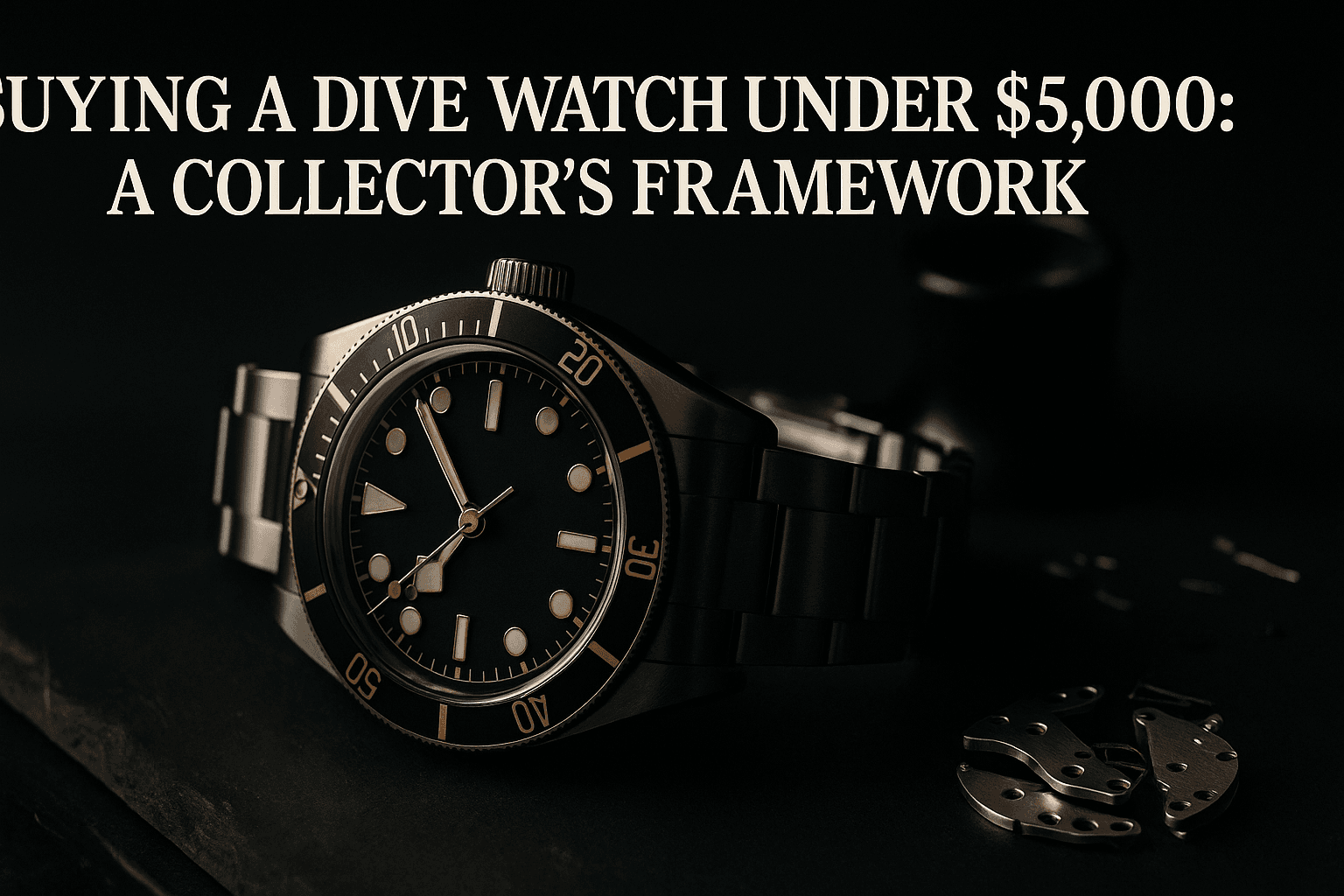
The dive watch is the most over-engineered object in modern horology, built to survive a pressure environment that the overwhelming majority of owners will never enter, and worn almost entirely at a desk. That gap between engineered capability and actual use is exactly what makes the category difficult to buy well, because the specification sheet is measuring something other than what most buyers are really purchasing.
Under $5,000, the difficulty sharpens considerably. This is the band where genuine ISO 6425 certification, in-house calibers, and durable secondary-market demand all become available — but seldom in the same watch, and almost never in the same reference.
What follows evaluates the segment on the four variables that actually predict long-term satisfaction and residual behavior: movement architecture, ISO 6425 compliance, lume specification, and resale pattern. Everything past those four is finishing and taste, and taste is not something a framework can arbitrate.
Why The Sub-$5,000 Band Rewards Discipline
The sub-$5,000 segment is the most competitively crowded price band in the watch market, which is good news for buyers and bad news for anyone hoping the price tag will do the sorting for them. Swiss, Japanese, and German manufacturers all field serious dive references here, and several of them out-specify watches costing three times as much.
What the segment does not offer is a reliable correlation between price and durability of value. A Japanese diver at the bottom of the band with a 70-hour movement and full ISO certification can hold a higher percentage of its purchase price than a Swiss diver at the top of the band with a sourced caliber and thin brand demand.
This is why the segment diverges so sharply from the steel-sports dynamic covered in our analysis of Rolex retail dysfunction and waitlist economics. Below $5,000, there is no allocation game and no manufactured scarcity premium — you buy at or below retail, and residual value is earned by the reference itself.
Under $5,000 there is no allocation premium to pay. You buy at or below retail, and residual value depends on the reference's own demand depth rather than on manufactured scarcity.
What ISO 6425 Actually Requires
ISO 6425 is the international standard for divers' watches, and it is considerably more demanding than the water-resistance figure printed on a caseback suggests. It sets a 100-metre minimum, requires a unidirectional elapsed-time bezel marked at five-minute intervals, mandates legibility of the time and the running indication at 25 cm in total darkness, and adds tests for magnetic resistance, shock resistance, thermal shock, salt-water corrosion, and strap attachment strength.
The provision that matters most to buyers, however, is procedural rather than technical. ISO 6425 requires that every individual watch be tested rather than a sample drawn from the production run — which is precisely why the certification carries real cost, and why relatively few sub-$5,000 references bother to pursue it.
The Marking Distinction Most Buyers Miss
A watch that meets the standard may be marked DIVER'S followed by its rated depth. A watch marked only WATER RESISTANT 200M has been rated under ISO 22810, the general water-resistance standard, which carries no bezel requirement, no darkness-legibility test, and no per-unit testing obligation.
Two watches can therefore carry the same depth number while representing entirely different engineering commitments. For instance, the Seiko SKX007, discontinued in 2019 and still among the most-traded dive references in the world, carried the DIVER'S 200m marking, while a great many contemporary 200-metre divers at similar and higher prices do not.
A dial or caseback marked DIVER'S 200M meets ISO 6425 and was individually tested. One marked only WATER RESISTANT 200M meets ISO 22810, with no bezel, lume, or per-unit testing requirement.
What A Depth Rating Actually Buys You
Recreational scuba diving on air is generally limited to a maximum depth of around 40 metres, and technical diving on mixed gas extends that without approaching the ratings printed on most dive watches. In practical terms, a 200-metre ISO-certified watch is already over-specified for every human application short of saturation work.
Ratings beyond 300 metres therefore buy engineering margin and case construction quality rather than usable capability, which is a legitimate thing to pay for provided you understand what you are paying for. A helium escape valve, in particular, addresses saturation-diving decompression and has no function for a recreational diver, though it does signal a certain construction standard.
Where depth rating does carry practical weight is in gasket and crystal specification, since a higher-rated case generally means thicker sapphire, better-sealed crowns and pushers, and more tolerance for the abuse a watch actually receives on the wrist. Read the number as a proxy for build quality rather than as a use case.
Recreational scuba tops out near 40 metres, so a 200-metre ISO-rated watch is already over-specified. Higher ratings buy thicker crystals and better sealing rather than usable depth.
Movement Architecture And What Each Choice Costs You Later
In-house calibers dominate the marketing copy in this segment, and they are frequently the wrong priority. What actually determines cost of ownership over a twenty-year horizon is parts availability, service network breadth, and whether an independent watchmaker can open the watch without factory support.
Sourced Swiss movements — the ETA 2824-2 and the architecturally similar Sellita SW200-1 — are the most serviceable mechanisms in the price band, backed by decades of parts supply and a global bench that can rebuild them. In-house calibers, by contrast, buy you longer power reserves, tighter regulation, and in some cases materially better warranty terms, at the cost of tying service to the manufacturer.
| Caliber | Architecture | Power reserve (manufacturer-published) | Service considerations |
|---|---|---|---|
| ETA 2824-2 | Sourced Swiss | Approximately 38 hours | Broadest independent serviceability in the segment; parts widely stocked |
| Sellita SW200-1 | Sourced Swiss, 2824-compatible architecture | Approximately 38 hours | Near-identical service profile to the 2824-2; largely interchangeable bench knowledge |
| Seiko 6R35 | In-house Japanese | 70 hours | Serviced through Seiko's network; third-party parts supply is constrained |
| Tudor MT5402 | In-house Swiss, COSC-certified | 70 hours | Brand service network; Tudor publishes a five-year transferable warranty |
| Oris Calibre 400 | In-house Swiss | Five days | Oris publishes a ten-year warranty and a ten-year recommended service interval |
Read that table as a cost curve rather than a quality ranking. A sourced Swiss movement will generally be cheaper to maintain and easier to keep running at year twenty, while an in-house caliber carrying a ten-year published service interval front-loads the value and defers the expense.
Keep in mind that service pricing varies by market, by year, and by complication, so any figure quoted without those attached should be treated as unreliable. Request a written quote from the manufacturer's service centre or your independent watchmaker before you transact, and read our breakdown of watch ownership economics for the full carrying cost of a mechanical collection.
Sourced calibers such as the ETA 2824-2 and Sellita SW200-1 are cheapest to maintain long-term. In-house movements buy power reserve and warranty length while tying service to the brand.
How To Read Lume Grades
Luminescence is simultaneously the most marketed and the least understood dive-watch attribute, largely because manufacturers describe it in adjectives rather than in grades. Super-LumiNova, produced by RC Tritec in Switzerland, is sold in defined grades — C3 for maximum green brightness, BGW9 for a white daylight appearance with a blue emission, and X1 for higher initial intensity — and the grade is a specification any serious seller should be able to name on request.
Seiko uses its proprietary LumiBrite compound rather than Super-LumiNova, which is one reason cross-brand lume comparisons circulate so freely and settle so rarely. What matters more than compound choice, in fact, is application: deposit thickness, coverage on the bezel pip and the full handset, and whether the minute hand stays as legible as the hour hand underwater.
Accordingly, the practical move is to ask the seller for the grade before you ask anything else about the dial. A retailer or dealer who cannot tell you whether a watch runs C3 or BGW9 is unlikely to know much else about the reference, and that gap is diagnostic information in its own right.
Super-LumiNova is sold in graded compounds: C3 for peak green brightness, BGW9 for a white daylight face with blue emission, X1 for higher initial output. Ask any seller to name the grade.
How Sub-$5,000 Divers Behave On The Secondary Market
Residual behavior in this band is driven by three factors: production continuity, brand depth in the dive category specifically, and whether the reference had a defined production window. References that ran continuously for a decade tend to settle into a broad, liquid trading range, while short-run and discontinued references show thinner volume and wider spreads.
Any blanket claim that divers hold seventy percent of their value should be read as marketing, since a retention figure without a named reference and a stated condition tier cannot be verified. The only defensible method is to pull sold-listing data for the exact reference on Chrono24 or a comparable platform, filter by condition and completeness, and read the distribution rather than the asking prices.
That said, two structural patterns do hold across the segment. Discontinuation reliably tightens supply and firms pricing for references that already had demand, and a complete set with bracelet, box, and papers consistently trades above a head-only example of the same reference by a margin visible in sold data.
These dynamics run parallel to, but are not identical with, the vintage market, where condition grading and originality dominate everything else — a subject we treat separately in our analysis of vintage watch market dynamics. Modern sub-$5,000 divers trade on liquidity and completeness far more than on patina or provenance.
Pull sold listings for the exact reference on Chrono24, filter by condition and completeness, then read the distribution. Blanket retention percentages across the category are marketing, not data.
What To Inspect Before You Transact
Every purchase in this band, whether from an authorized dealer or a private seller, should clear the same short checklist. The items below are ordered by how expensive they are to discover after the fact:
- Bezel action and alignment. The bezel must be unidirectional and counterclockwise-only, and the pip should sit dead-centre over the 12 marker. Misalignment is a manufacturing defect that erodes resale value permanently and is rarely corrected under warranty.
- Crown and gasket condition. A screw-down crown that cross-threads or feels gritty signals a gasket or tube problem. A watch that has not been pressure-tested since it was last opened is not a diving instrument until it has been.
- Service documentation. Ask for the date of the last full service and the last pressure test, in writing. Absence of records is not disqualifying on a modern reference, but it should be reflected in the price you pay.
- Completeness. Box, papers, bracelet, spare links, and the original strap materially affect the exit price. Reassembling a complete set after the fact almost always costs more than the discount you accepted.
- Case and lug integrity. Check for polishing that has softened the lug chamfers or rounded the case flanks, which indicates prior cosmetic work and represents a permanent deduction.
Independent authentication is worth its cost on any private-party transaction, particularly for references with heavy counterfeit traffic. A watchmaker's pressure test and movement inspection typically runs a fraction of the loss you would absorb on a bad purchase, though you should request a local quote rather than budgeting from a number you read online.
Editorial Recommendation
The segment resolves into five defensible strategies, and the right one depends on whether you are optimizing for cost of ownership, for specification, or for exit liquidity. All of them are legitimate, and mixing them is what produces the compromise purchases that people quietly sell within a year:
- Lowest cost of ownership. A Swiss diver on an ETA 2824-2 or Sellita SW200-1 — the Christopher Ward C60 Trident line and the Longines HydroConquest are the reference points — keeps you inside the independent-service ecosystem for the life of the watch.
- Best specification per dollar. Seiko's Prospex line, particularly the SPB14x family running the 70-hour 6R35, delivers ISO-grade dive credentials and a modern power reserve near the bottom of the band. Verify current pricing and reference availability with an authorized dealer, since Seiko rotates the line frequently.
- Strongest exit liquidity. The Tudor Black Bay Fifty-Eight, reference M79030N, pairs a COSC-certified in-house caliber with the deepest secondary-market volume in the segment and Tudor's published five-year transferable warranty.
- Highest engineered specification. Sinn's U-series divers, built from German submarine steel with manufacturer-published depth ratings well beyond ISO minimums, are the technical answer for a buyer who wants the instrument rather than the icon.
- The patient play. A pre-owned Omega Seamaster Diver 300M from an earlier generation frequently lands inside the budget, delivering co-axial escapement architecture and a 300-metre rating that would cost meaningfully more new.
Of course, pricing across all five moves with market conditions, currency, and dealer discount, so every figure you encounter should be verified against current authorized-dealer pricing or sold-listing data before you commit. For the collector-grade end of the category, where references cross well past this budget and provenance begins to dominate the equation, see our survey of collectible dive watches.
One rule governs the entire segment: buy the reference, not the brand. Demand depth in the dive category specifically, rather than overall brand prestige, is what determines whether you exit at a discount or near parity.
Definitions And Background Information
Is ISO 6425 certification necessary for a dive watch under $5,000?
It is not strictly necessary, but it is the only objective proof of dive capability available to a buyer. ISO 6425 requires per-unit testing, a unidirectional elapsed-time bezel, and legibility at 25 cm in darkness, and it permits the DIVER'S marking on the dial or caseback.
Does an in-house movement make a dive watch a better buy?
Not automatically. In-house calibers typically deliver longer power reserves and stronger warranty terms, while sourced ETA and Sellita movements remain cheaper to service and can be rebuilt by an independent watchmaker without factory support.
How much water resistance does a dive watch actually need?
ISO 6425 sets a 100-metre minimum, and recreational scuba rarely exceeds 40 metres. A 200-metre rating covers every realistic use, and higher ratings buy build margin such as thicker sapphire and better-sealed crowns.
Which sub-$5,000 dive watches hold value best?
References with deep dive-category demand and continuous production trade most liquidly, with Tudor and Seiko Prospex showing the highest volume in the band. Verify against sold listings on Chrono24 rather than against asking prices.
What is the difference between DIVER'S 200M and WATER RESISTANT 200M?
DIVER'S 200M means the watch met ISO 6425 and was individually tested. WATER RESISTANT 200M means it met ISO 22810, which requires no bezel, no darkness-legibility test, and no per-unit testing obligation.
Should I buy new or pre-owned under $5,000?
Pre-owned expands access to references that retail above the budget, such as earlier Omega Seamaster Diver 300M generations. Insist on a recent pressure test, service records, and a complete set with box and papers.
Where To Take This Next
The sub-$5,000 band rewards buyers who treat the specification sheet as a set of verifiable claims rather than as a marketing document. Confirm the ISO marking, name the caliber, ask for the lume grade, and read the sold data before you commit.
Subdial covers the dive category continuously, from entry-band framework pieces through to auction-grade references. Browse the full Subdial editorial archive for reference-level coverage across the category, or start with our companion analyses of Grand Seiko collecting and the Swiss watch marques.