MB&F and the Horological Machine: Why Collectors Pay for Conceptual Watchmaking
By The Subdial Editors ·
Most mechanical watchmaking, for all its artistry, still answers to a familiar silhouette — a round case, a flat dial, two or three hands tracing the hours across it. That convention is the inheritance of three centuries, and it is precisely the thing MB&F set out to abandon.
Founded in 2005 by Maximilian Büsser, the brand whose name reads as Maximilian Büsser & Friends has spent two decades building objects that look less like watches and more like small kinetic sculptures. The question this raises — and the one serious collectors answer with their wallets — is why conceptual watchmaking commands the prices that it does.
What Exactly Is MB&F?
MB&F is an independent Swiss watchmaker built on a deliberately unusual premise: that a horological brand should operate more like a creative collective than a traditional manufacture. Büsser arrived at the idea after running Harry Winston's Rare Timepieces division — where he conceived the influential Opus series — and, earlier, a formative stretch in product roles at Jaeger-LeCoultre.
The "Friends" in the name is not a marketing flourish but the operating model itself. Each creation publicly credits the independent watchmakers, movement constructors, and case designers who built it, a transparency that remains rare in an industry historically devoted to the single-maison myth.
MB&F — Maximilian Büsser & Friends — is an independent Swiss watchmaker founded in 2005. It builds sculptural, concept-led timepieces and openly credits the outside specialists who help engineer and finish each one.
The "Friends" Model — Why the Credits Matter
Most maisons present a finished watch as the singular output of a house style, with the individual hands behind it kept anonymous. MB&F inverts that, naming the collaborators on every project as a point of principle and pride.
Movement construction has long run through specialists such as Jean-François Mojon of Chronode, while the unmistakable case shapes owe much to designer Eric Giroud. Crediting them is not merely ethical bookkeeping — it is part of the product, signaling that you are buying a collaboration among named talents rather than an anonymous corporate object.
For collectors, this authorship is load-bearing. It turns each piece into something closer to a co-signed work, and co-signed works by recognized makers tend to behave differently — and often more durably — in a collecting market than mass-branded goods.
Why Do Collectors Pay for Conceptual Watchmaking?
The short answer is that an MB&F buyer is not purchasing a better version of a familiar object — they are purchasing an idea rendered in metal and sapphire. The value lives in authorship and concept, much the way a collector pays for a named sculptor rather than for a quantity of bronze.
Keep in mind that scarcity reinforces this. Production estimates place MB&F's annual output in the low hundreds of pieces across all collections — a figure worth verifying against the brand's own disclosures, but unambiguously tiny by Swiss standards.
What's more, the pieces are emotionally legible in a way that traditional haute horlogerie often is not. A Horological Machine shaped like a jet fuselage or a spacecraft communicates its ambition instantly, and that immediacy is part of what a collector is paying to own.
There is also a positional element that collectors rarely say aloud. Owning an MB&F signals a particular kind of taste — a willingness to prioritize ideas over orthodoxy — and within serious collecting circles that signal carries real social weight.
Collectors pay for MB&F because each piece is a singular concept, not a refined convention. Tiny output, credited authorship, and an instantly legible design thesis create demand ordinary watchmaking cannot replicate.
The Horological Machines — Telling Time Sideways
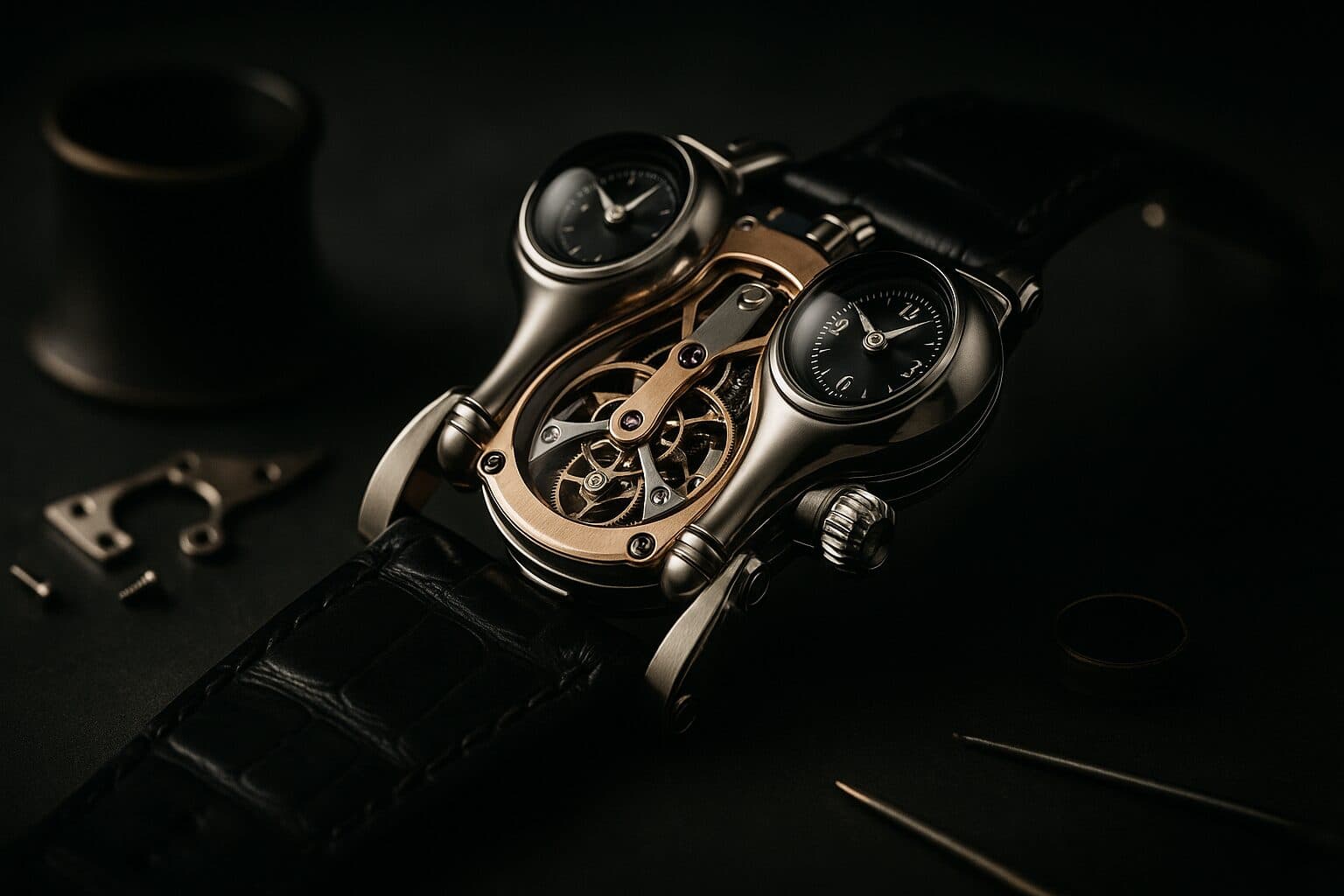
The Horological Machine series, launched with HM1 in 2007, is where the brand's thesis is most aggressive. These are three-dimensional movements first and timekeepers second, often rejecting the flat dial entirely in favor of domed sapphire, vertical architecture, and rotating cones or dials read from unexpected angles.
Consider the range of references the line draws on. HM4 took its cues from aviation and looks the part; HM6 earned the nickname "Space Pirate" for its biomorphic, spherical-dome layout; HM9 channels mid-century aerodynamics into a flowing, twin-pod case.
The engineering cost of this is real, not cosmetic. Curving a movement into three dimensions, suspending a balance under a sapphire dome, or driving displays through chains of gears at right angles all demand bespoke construction that a conventional caliber never requires.
Horological Machines are MB&F's sculptural line, launched with HM1 in 2007. They treat the movement as 3D architecture — domed sapphire and vertical layouts read from unconventional angles, not a flat dial.
Legacy Machines — The Quiet Counter-Argument
If the Horological Machines prove MB&F can break the rules, the Legacy Machines prove it is a choice rather than a limitation. Introduced in 2011 with LM1, this round-cased collection imagines what a nineteenth-century watchmaker might have built with modern tools, frequently centered on a large balance wheel suspended dramatically above the dial.
The finishing here is deliberately classical, and tellingly, MB&F brought in outside masters to execute it. Early Legacy Machine dials were finished by Kari Voutilainen — the same independent whose hand-finishing commands its own premium, a dynamic we examine in our look at the finishing premium behind Voutilainen and Akrivia.
This duality is the strategic core of the brand. A collector who owns both a Horological Machine and a Legacy Machine holds proof that the conceptual extremity is intentional, which is a large part of why the vision retains its value.
| Dimension | Horological Machines (HM) | Legacy Machines (LM) |
|---|---|---|
| Debut | HM1, 2007 | LM1, 2011 |
| Case form | Sculptural, three-dimensional | Round, classically proportioned |
| Design reference | Aviation, sci-fi, biomorphic forms | 19th-century watchmaking reimagined |
| Signature feature | Domed sapphire, vertical movement | Suspended balance wheel |
| Collector appeal | Boundary-pushing statement | Traditional craft, classical finishing |
How This Differs From the Finishing Premium
It is worth being precise about what kind of premium MB&F actually commands, because it is not the same premium that defines most independents. With makers like Voutilainen or Akrivia, the value concentrates in execution — anglage, black-polished steel, hand-frosted surfaces that reward a loupe.
MB&F's premium, by contrast, is concentrated in concept and architecture. You are paying for the audacity and coherence of the idea first, and for the finishing that serves it second — a different value equation from the independent premium that F.P. Journe commands on movement innovation and signature.
This distinction matters at resale. A finishing-led piece is judged largely on the quality and condition of its decoration, whereas an MB&F is judged on the desirability and rarity of the concept it embodies.
The MB&F premium is conceptual, not decorative. Where Voutilainen or Akrivia are valued for hand-finishing, MB&F is valued for the audacity and coherence of the design idea — a different driver entirely at resale.
Where MB&F Sits Among the Independents
The independent watchmaking world is not monolithic, and MB&F occupies a corner of it that few others contest. Where some independents compete on the purity of hand-finishing and others on chronometric performance or movement innovation, MB&F competes almost exclusively on conceptual design.
That positioning is strategically defensible precisely because it is so hard to copy. A rival can hire finishers or license a tourbillon, but a coherent, two-decade design language built around kinetic sculpture is not something acquired off a shelf.
This is also why MB&F rarely trades on the same terms as its peers. Comparing it head-to-head with a finishing-led independent misses the point — the brands are answering different questions, and collectors who grasp that tend to own across categories rather than choosing between them.
MB&F competes on conceptual design, not finishing or chronometry. That is hard to copy — a coherent, two-decade sculptural design language can't be bought off the shelf — which underpins its durability.
What Drives MB&F's Secondary-Market Values?
On the secondary market, a handful of factors do most of the work. Originality of the concept, the rarity of the specific reference or metal, completeness with box and papers, and condition together set where a piece lands.
Be aware that pricing here is wide and model-dependent. Reported retail and secondary figures for Horological and Legacy Machines range from the tens of thousands into the several hundred thousands of dollars depending on model, metal, and complication — ranges you should confirm against authoritative listings on Chrono24 or major auction-house results before any transaction.
Access is its own variable. MB&F's more attainable M.A.D.1, released through the M.A.D. Editions arm, has historically been distributed by lottery rather than open sale — an allocation dynamic that echoes the allocation reality at the established maisons and concentrates early demand onto the secondary market.
Facts discipline: Production volumes, retail prices, and secondary-market ranges for MB&F move constantly and vary by reference. Every figure here is an estimate or a range — verify against the brand's disclosures, Chrono24, and published auction results before treating any number as fixed.
MB&F resale is driven by concept originality, reference and metal rarity, completeness, and condition. Reported ranges span tens to hundreds of thousands of dollars — always verify against Chrono24 and auction results.
Should You Buy Into the Vision?
MB&F is not a value play or a safe-harbor asset, and it should not be framed as one. It is a conviction purchase — a bet that conceptual watchmaking, executed at this level, will keep finding an audience that pays for vision over convention.
For a collector weighing entry, our editorial recommendation is to let the thesis guide the purchase rather than the spec sheet alone.
- Buy the concept you actually love. An MB&F holds its appeal on the strength of its idea, so the reference that genuinely moves you is the one most likely to satisfy long-term.
- Favor completeness and provenance. Box, papers, and documented service history matter disproportionately on low-production independents — the same discipline that governs how auction estimates get set.
- Decide between statement and craft. Choose a Horological Machine if you want the boundary-pushing object, a Legacy Machine if you want classical finishing inside the same authorship.
If you are drawn to MB&F, the right next step is study before acquisition — read the references, handle the pieces where you can, and treat every price you see as a starting point to verify. The vision is real, and so is the premium it commands; understanding both is how you buy well.
Frequently Asked Questions
Who founded MB&F and when?
MB&F was founded in 2005 by Maximilian Büsser, formerly of Harry Winston and Jaeger-LeCoultre. The name stands for Maximilian Büsser & Friends, reflecting a creative-collective model that credits collaborating specialists.
What is the difference between Horological and Legacy Machines?
Horological Machines are sculptural, three-dimensional designs that reject the flat dial. Legacy Machines are round and classically finished, reimagining 19th-century watchmaking, often around a suspended balance wheel.
Are MB&F watches a good investment?
MB&F is a conviction purchase, not a guaranteed investment. Values hinge on concept rarity, condition, and completeness, and secondary prices vary widely — verify against Chrono24 and auction results before buying.
Why are MB&F watches so expensive?
Each piece is a bespoke, low-production concept requiring custom movement architecture and outside specialists. You pay for originality and authorship, not a refined version of a conventional watch.
How can I buy a more accessible MB&F piece?
The M.A.D.1, from MB&F's M.A.D. Editions arm, is the entry point and has historically been allocated by lottery rather than open sale. That demand often pushes early examples onto the secondary market at a premium.