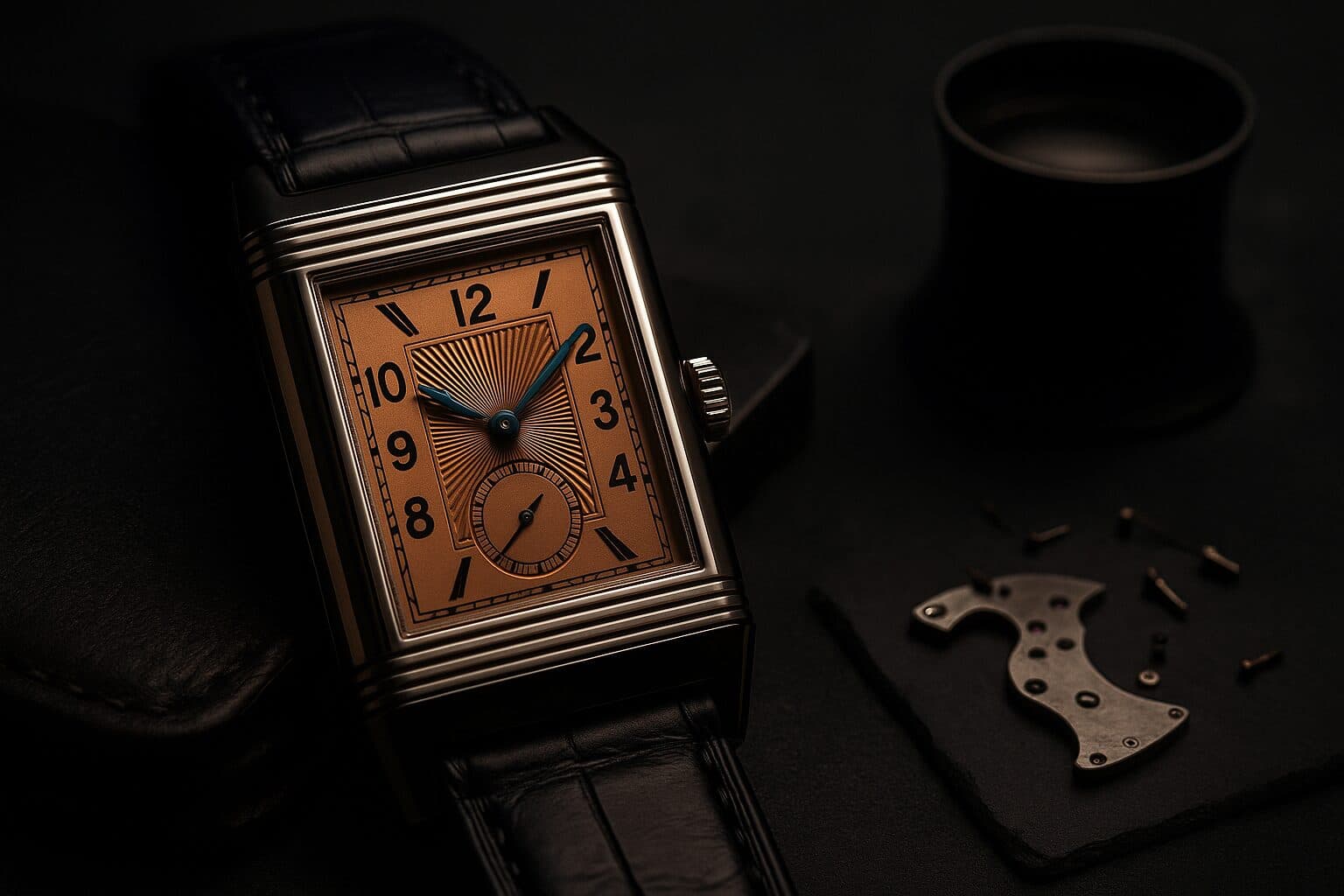
The Jaeger-LeCoultre Reverso: Why an Art Deco Survivor Belongs in a Serious Collection
By The Subdial Editors ·
Few luxury watches can claim a design that has survived, almost unchanged, since 1931. The Jaeger-LeCoultre Reverso can, and that longevity is the foundation of its collecting case. This playbook walks through the reversible-case mechanism, the reference landscape from Classic to Duoface, and where the Reverso honestly stands on the secondary market.
Few objects from the Art Deco period still perform the exact function they were engineered for nearly a century later. The Reverso is one of them, and that quiet durability is the strongest argument in any case for collecting it.
Jaeger-LeCoultre introduced the Reverso in 1931, after polo-playing British officers stationed in India kept shattering their watch crystals on the field. The answer was a rectangular case that slides and pivots on a cradle, turning a solid metal back to the action.
The Reverso is a rectangular Art Deco wristwatch launched by Jaeger-LeCoultre in 1931. Its case swivels 180 degrees on a cradle, originally so polo players could flip the dial to a protective metal back during matches.
Why The Reverso Still Earns A Place
Most heritage models trade on a story that has long since outrun the object. The Reverso is the unusual case where the story and the product still line up, because the swiveling case remains genuinely useful and genuinely unmatched.
Of course, the Art Deco silhouette does a great deal of the work. The three gadroons, the godroned lines running across the top and bottom of the case, are among the most recognizable design signatures in twentieth-century watchmaking.
What's more, Jaeger-LeCoultre carries a reputation that lends the Reverso weight no fashion piece can borrow. The manufacture spent decades supplying movements and components to the most exclusive houses in Switzerland, which is why collectors often call it the watchmaker's watchmaker.
That said, none of this matters to a serious collection unless the watch holds up as an object to own and to trade. The Reverso does, and the rest of this playbook explains where it does so well and where it asks for caution.
How The Reversible Case Actually Works
The mechanism is deceptively simple, and that simplicity is exactly why it has lasted. The watch head sits in a carrier, and a gentle push slides it free so it can rotate a full 180 degrees before clicking back into place.
The patent for the swiveling case was filed in 1931 by engineer Rene-Alfred Chauvot, and the name itself comes from the Latin for "I turn around." Nearly a century of variations have refined the cradle, yet the core motion has never needed reinventing.
The Reverso case slides out of a fixed cradle and rotates 180 degrees before locking back in. The motion was patented in 1931 to expose a solid metal back, protecting the crystal and, later, creating a canvas for engraving and second dials.
The Blank Caseback As A Canvas
The protective metal back created an accidental gift that the brand has exploited ever since. Because the reverse side was hidden during play, it became a private surface for monograms, regimental crests, and hand-painted enamel miniatures.
Keep in mind that personalization cuts both ways for value. An original period engraving can add provenance and character, while a generic modern engraving usually narrows the pool of future buyers and softens resale.
The Reverso Reference Landscape
The line has branched considerably since the single 1931 model, and understanding those branches is the difference between buying well and buying blind. The families below cover the configurations a collector encounters most often, from accessible steel to haute-horlogerie trophies.
| Line | Positioning | Typical configuration | Collector note |
|---|---|---|---|
| Reverso Classic | Faithful to the 1931 silhouette | Steel, time-only or small seconds | The accessible, everyday-wearable entry point |
| Reverso Tribute | Vintage-leaning, purist proportions | Hand-wound, small seconds, lacquer dials | The current collector favorite for originality |
| Reverso One | Elongated case for slimmer wrists | Often gem-set or two-dial Duetto | Marketed toward women; Duetto adds a second face |
| Reverso Squadra | Sportier 2000s-era cushion influence | Larger steel cases, chronograph variants | Largely discontinued; a contrarian value pocket |
| Reverso Duoface | Two dials, two time zones | Hand-wound, day and night second face | The horological flex of the range |
| Grande / Hybris Mechanica | Haute-horlogerie complications | Tourbillons, minute repeaters, Gyrotourbillon | Trophy pieces; verify provenance at auction |
All of these share the same fundamental case, which keeps the family coherent even as complications escalate. For most collectors building a first position, the Classic and Tribute lines are where the conversation begins and often ends.
Which Reverso Makes The Strongest Collecting Case
For purists, the strongest argument sits with the hand-wound Tribute models in steel. They restore the original 1931 proportions and the manual-winding ritual, and they do it at the most defensible pricing in the catalog.
The Duoface deserves its own mention, because it is the reference that turns a clever case into a genuine complication. A single movement drives two dials, so flipping the watch reveals a second time zone with no extra crown to manage.
A steel Reverso Classic or Tribute with small seconds and a hand-wound movement is the standard entry point. It delivers the original 1931 proportions and the manual-winding charm at the line's most accessible and most defensible pricing.
Naturally, the haute-horlogerie pieces tell a different story. A Reverso tourbillon or repeater is a trophy acquisition, and those belong in a conversation about auction-grade buying rather than a first serious watch.
Where The Reverso Sits On The Secondary Market
This is the section that separates the Reverso from the hype names, and it works in a patient collector's favor. Unlike steel sports models from the usual houses, time-only Reversos rarely carry a waitlist premium and frequently trade below retail.
Estimates commonly place clean, time-only steel examples in the rough vicinity of 50 to 70 percent of retail on the secondary market, though that band moves with reference, condition, and dial color. Treat any figure as a starting point and confirm it against live Chrono24 listings and recent auction comps before you transact.
Time-only steel Reverso models often trade well below retail, with estimates commonly in the 50 to 70 percent range for clean examples. Always confirm a specific figure against live Chrono24 listings and recent auction results before buying.
That discount is the opportunity. A buyer who reads vintage-market dynamics correctly can acquire a respected manufacture's signature design without paying the speculative tax attached to harder-to-source steel sports watches.
Be aware that complicated and gem-set references behave differently. Their values hinge on provenance and completeness, and pricing them well usually means understanding how auction estimates are built rather than scanning dealer asks.
Common Pitfalls And Authenticity Checks
The reversible case adds one wear point that fixed cases do not have, and it is the first thing to inspect. Here is a short checklist to run before any Reverso purchase, new or vintage:
- Cradle and swivel. The case should slide and lock crisply with minimal play; a loose or notchy swivel signals worn cradle components and a future service bill.
- Dial originality. Inspect for redial signs such as fuzzy printing or repositioned text, since a refinished dial materially lowers a vintage piece's standing.
- Reference and caliber match. Confirm the reference number and movement are period-correct for the model, because mismatches point to part swaps or married watches.
- Caseback engraving. Original monograms can add provenance, but verify the engraving's history rather than assuming it; a generic modern engraving narrows resale.
- Service and books. A documented service history and original box and papers tighten the value range and shorten time on market when you eventually sell.
All of these add up to a single discipline: buy the example, not the model. A pristine, papered Reverso is worth a clear premium over a tired one, and that gap is where careful buyers protect their capital.
Check the cradle for swivel play, inspect the dial for redial signs, and match the reference and caliber to period-correct records. Original caseback engraving can add character, but verify its history rather than assuming it is authentic.
How The Reverso Fits Beside The Usual Suspects
A serious collection rewards contrast, and the Reverso supplies a register the headline names do not. It sits naturally alongside the Cartier Tank as a rectangular Art Deco anchor, offering mechanical depth where the Tank often leans on pure form.
Against the steel-sports cohort, the contrast is sharper still. Where the Audemars Piguet Royal Oak's heritage and Patek Philippe's allocation reality are defined by scarcity and waitlists, the Reverso is defined by availability and a buyer-friendly secondary market.
For collectors who value finishing and quiet formality, it also rhymes with the dress-watch logic behind the A. Lange & Sohne Saxonia Thin. Both reward the owner who cares more about craft than about a logo doing social work.
Editorial recommendation
If you are adding one Reverso to a serious collection, weight these by intent rather than badge:
- Best first Reverso. A steel Reverso Tribute or Classic with small seconds and a hand-wound caliber, bought with box and papers.
- Best value play. A clean, full-set steel Classic or a discontinued Squadra acquired meaningfully below original retail.
- Best one-watch flex. A Reverso Duoface, where one movement and two dials cover a second time zone in genuine style.
- Buy with caution. Gem-set or complicated references without papers, which are difficult to value and slow to resell.
Frequently Asked Questions
What was the Jaeger-LeCoultre Reverso originally designed for?
It was designed in 1931 so polo players could flip the watch and shield the crystal behind a solid metal caseback. British officers in India had been smashing crystals during matches, and the swiveling case solved the problem.
Does the Reverso hold its value on the secondary market?
Time-only steel Reverso models often trade below retail, with estimates commonly in the 50 to 70 percent range for clean examples. Confirm any figure against live Chrono24 listings and recent auction comps before you buy.
Which Reverso is the best entry point for a collector?
A steel Reverso Classic or Tribute with small seconds and a hand-wound movement is the standard entry point. It offers the original 1931 proportions and manual winding at the line's most accessible pricing.
What is the Reverso Duoface?
The Duoface uses the reverse side of the case for a second dial, typically a second time zone driven by one movement. Flipping the case turns a single watch into a two-faced travel companion, which is why it commands a premium.
How do you authenticate a vintage Reverso?
Check the cradle for swivel play, inspect the dial for redial signs, and match the reference and caliber to period-correct records. A documented service history and original papers further tighten the value range.
Bringing It Into Your Collection
The Reverso rewards the collector who buys on substance rather than scarcity. It pairs a genuine Art Deco design with a reversible case no competitor has matched, and it does so at prices a patient buyer can work in their favor.
Before you commit, price the exact reference against current listings and study how the broader vintage market is moving so your offer reflects real comps rather than aspiration. The right example, fully documented, is the kind of acquisition a serious collection is built on.
Have a Reverso reference in your sights, or trying to decide between the Tribute and the Duoface? The Subdial Editors welcome the chance to help you weigh the configuration, condition, and comps before you buy.