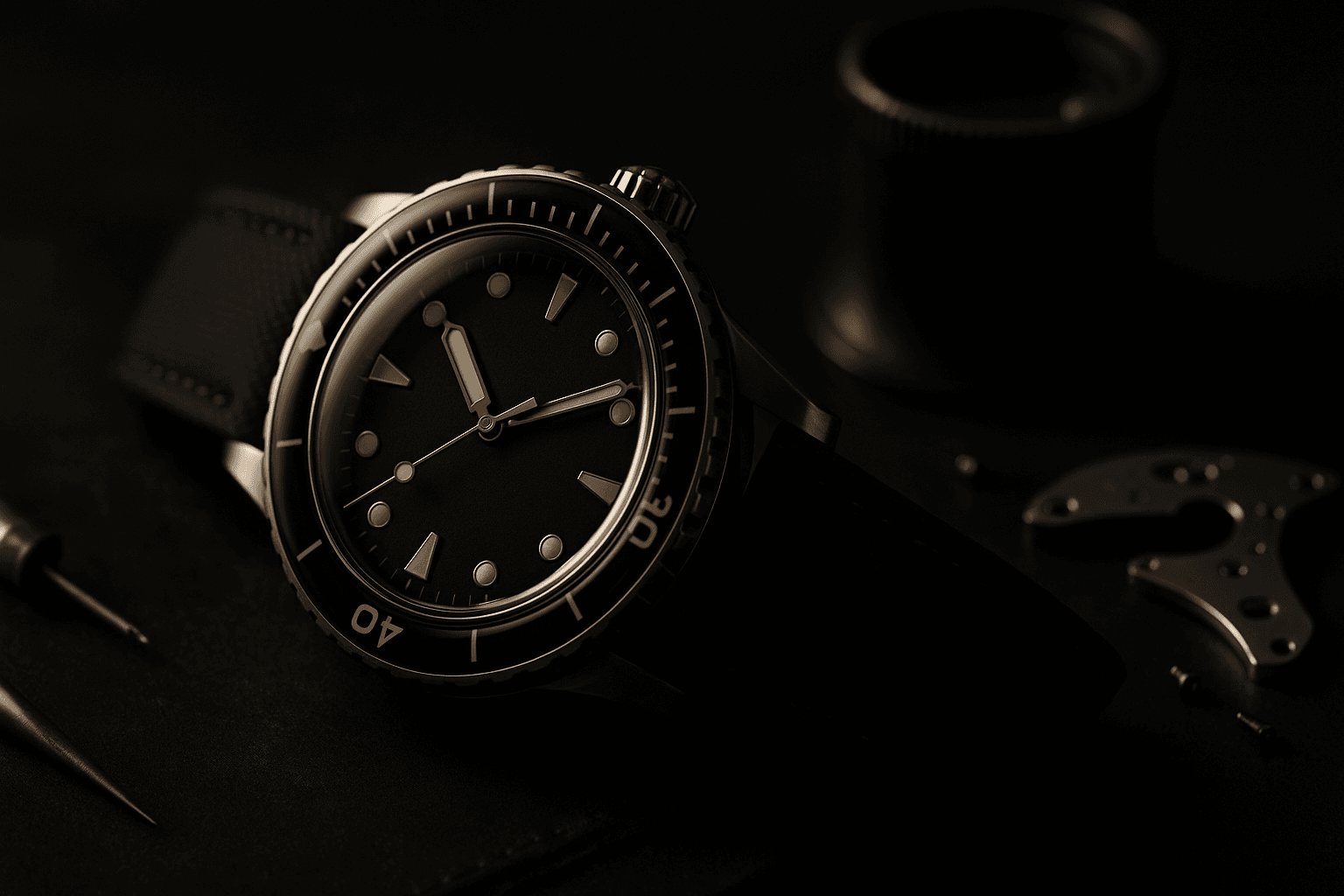
Blancpain Fifty Fathoms: Reading the Modern Collection Against Its 1953 Original
By The Subdial Editors ·
Have you ever noticed how rarely the Fifty Fathoms comes up in a conversation about dive watches, despite having a stronger claim to inventing the category than almost anything else on a collector's shortlist? If you have spent any time around vintage tool watches, you know the 1953 date, you know the Nageurs de Combat commission, and you probably know that Blancpain got there before the reference most people credit.
What you may not know is how little of that 1953 watch survives in the collection Blancpain sells today, and how much that gap should matter when you are deciding between a modern reference and a vintage one. This is the piece of the Blancpain conversation that usually goes unsaid — the heritage argument and the pricing argument are made in the same breath, and they do not always support each other.
Is the modern Fifty Fathoms the same watch as the 1953 original? No. The 1953 original was roughly 41mm with a sourced automatic caliber; the modern flagship runs 45mm with the in-house 1315. The Bathyscaphe line sits closest in size.
Why The 1953 Claim Actually Holds Up
Blancpain developed the Fifty Fathoms at the request of Captain Robert Maloubier and Lieutenant Claude Riffaud, who were assembling the French Navy's combat swimmer unit and could not find a watch that met their specification. The specification itself is the interesting part: rotating bezel with a locking mechanism, high legibility against black, automatic winding to reduce crown manipulation, and antimagnetic protection.
That list reads as the definition of a modern dive watch because it substantially became the definition. The name referenced fifty fathoms — approximately 91 meters — which was understood at the time as the practical limit of compressed-air diving.
Where collectors get sloppy is treating "first" as a single-winner category. Several manufacturers were converging on the same problem in the same window, and the honest framing is that Blancpain arrived at a complete, purpose-built solution unusually early, with a documented military commission behind it.
What does "fifty fathoms" refer to? Fifty fathoms is roughly 91 meters, understood in 1953 as the practical depth ceiling for compressed-air diving. The name described the operational limit, not a rated maximum.
The Case-Size Problem Nobody Wants To Name
The flagship modern Fifty Fathoms Automatique measures 45mm in diameter, and depending on the reference it carries roughly 15.5mm of thickness. That is a substantial watch by any standard, and it is meaningfully larger than the mid-century references it invokes.
Original 1950s and 1960s Fifty Fathoms examples generally sat in the low-40s, with variation across the Rayville-era and military-issued references. The modern watch is not a reissue in any dimensional sense — it is a contemporary interpretation wearing a historical name.
This matters commercially, not just aesthetically. A 45mm case narrows the buyer pool, and a narrowed buyer pool shows up later in time-on-market and in the spread between asking and transacting prices.
The Bathyscaphe line exists partly as the answer to this. At 38mm and 43mm depending on reference, it sits much closer to how the original wore, and it has become the entry point for buyers who want the name without the wrist presence.
Reference-By-Reference: What You Are Actually Choosing Between
The collection is easier to read once you stop treating it as one model and start treating it as three distinct propositions. Each occupies a different position on size, movement, and secondary-market behavior.
| Line | Typical case size | Caliber family | Power reserve | Positioning |
|---|---|---|---|---|
| Fifty Fathoms Automatique | 45mm | Caliber 1315 (in-house, three barrels) | ~120 hours | Flagship; largest wrist presence |
| Bathyscaphe | 38mm / 43mm | Caliber 1150 / 1315 family | ~100–120 hours | Closest to original proportions |
| Tech Gombessa | 47mm | Caliber 13P8 | Extended; 3-hour bezel scale | Purpose-built saturation tool |
| Vintage (1950s–60s) | ~41mm | Sourced automatic (era-dependent) | Era-typical | Provenance-driven; condition-gated |
The three-barrel Caliber 1315 is the technical argument for the modern collection, and it is a real one. A five-day power reserve in a dive watch is not a marketing number — it is the difference between a watch that survives a weekend in the box and one that needs resetting.
Keep in mind that movement quality and market liquidity are separate variables. Blancpain finishes and constructs at a level that rewards the owner who opens the caseback, which is a different proposition than the one you get from a watch priced by scarcity rather than by construction.
Which Fifty Fathoms wears closest to the vintage original? The 38mm Bathyscaphe. Original 1950s–60s references sat around 41mm, so the 38mm and 43mm Bathyscaphe cases track that proportion far better than the 45mm flagship.
Where The Heritage Argument And The Pricing Argument Diverge
Blancpain prices the Fifty Fathoms in territory shared with brands that hold their value more predictably on the secondary market. That is the awkward position the collection occupies: a legitimate historical claim, genuine in-house movement work, and a resale picture that does not always reward the buyer who paid retail.
The pattern is familiar to anyone tracking the broader collectible dive watch market, where a handful of references absorb most of the liquidity and everything else trades on condition and patience. Fifty Fathoms examples generally sit in the second group.
What that means practically: verify current secondary transaction data on Chrono24 or a comparable marketplace before you treat any retail figure as a value anchor. Asking prices and transacted prices diverge more here than they do on the references with deep, fast order books.
Be aware that this is not an argument against the watch. It is an argument for buying it the way you would buy any well-made piece with thin liquidity — for the object, at a price you would be comfortable holding through a soft market.
Editorial recommendation. For a first Fifty Fathoms, the 43mm Bathyscaphe on a sailcloth or NATO strap is the defensible entry: it wears in the historical proportion, carries the in-house caliber, and sits below the flagship on both retail and secondary exposure. Step to the 45mm Automatique only if you have worn one on your own wrist and the size reads as intentional rather than tolerated.
Buying Vintage: What Actually Gates The Price
Vintage Fifty Fathoms pricing is driven less by reference number than by three condition variables that most listings underdocument. Understanding them is the difference between a fair purchase and an expensive restoration project.
The first is dial condition, specifically the moisture-indicator dials found on certain military-issued examples. These are unusually vulnerable, and a compromised indicator is not something a service can restore without destroying originality.
The second is bezel insert originality. Period-correct inserts have been replaced on a large share of surviving examples, and the substitution is frequently undisclosed rather than deliberately hidden — the seller often does not know.
The third is case geometry. Decades of polishing round the lugs and thin the case flanks, and unlike a dial issue this one is invisible in a straight-on photograph. Ask for lug-profile shots at an angle before committing.
Here are the documentation items worth requiring before a vintage transaction closes:
- Full service history. Know who opened the watch, when, and what was replaced. A movement with undocumented parts swaps is a different asset than one with continuous records.
- Angled lug and case-flank photography. These reveal polishing that front-facing shots conceal entirely. Request them specifically rather than accepting the listing set.
- Movement photographs with the caseback open. Confirm the caliber matches the reference and era, and look for replaced bridges or non-period screws.
- Bezel and insert provenance. Ask directly whether the insert is original to the watch, and treat "I believe so" as a no for pricing purposes.
- Time-on-market history. A watch that has cycled through three dealers in eighteen months is telling you something the listing copy is not.
All of the above adds up to a straightforward rule: on vintage Fifty Fathoms, you are buying documentation as much as you are buying a watch. The same discipline applies across vintage pricing generally, but it bites harder here because the surviving population is small and the condition spread is wide.
What most affects vintage Fifty Fathoms value? Condition variables, not reference number — dial integrity (especially moisture-indicator dials), bezel insert originality, and case geometry that polishing has altered.
The Tech Gombessa And The Question Of Purpose
The Tech Gombessa is the one modern reference that reconnects the collection to its original logic, which was solving a specific problem for people doing a specific job. Its three-hour bezel scale exists because saturation and technical divers run dives measured in hours rather than minutes.
At 47mm it is unapologetically a tool, and it should be read that way rather than as a lifestyle purchase. If you are not diving it, you are buying a statement about what the brand can build — which is a legitimate reason, stated honestly.
What's more, the Gombessa serves a useful function within the lineup: it demonstrates that Blancpain's dive-watch competence is current rather than archival. That distinction matters when you are evaluating whether a heritage claim is being maintained or merely invoked.
Why does the Tech Gombessa use a three-hour bezel? Saturation and technical dives run in hours, not minutes. A standard 60-minute bezel cannot time them, so the Gombessa scales its bezel to a three-hour rotation.
How To Decide
The decision resolves faster than most collectors expect once it is framed correctly. Start by answering whether you want the watch as an object or as a position.
If you want it as an object — worn, serviced, kept — the modern Bathyscaphe is the strongest value in the collection and the version most people actually enjoy wearing. The in-house caliber, the extended power reserve, and the historically credible proportions arrive together at the lowest exposure point in the lineup.
If you want vintage, budget for the pre-purchase inspection and the possibility of a service before you budget for the watch. The purchase price on a vintage Fifty Fathoms is frequently the smaller number.
And if you are weighing the Fifty Fathoms against a more liquid alternative, be honest with yourself about which need you are serving. Our coverage of long-run ownership economics and the dive watch field below five thousand is a reasonable next stop if liquidity is the deciding variable rather than the movement.
The Fifty Fathoms deserves better than the two conversations it usually gets, which are an origin-story argument and a price complaint held separately. Read together, they describe a genuinely accomplished watch that asks its buyer to value construction and history more than exit velocity — and to know which of those they are actually buying.
Frequently Asked Questions
Does Blancpain offer an authorized pre-owned or certified program?
Blancpain services vintage pieces through its own restoration workshop, which is the practical equivalent for provenance purposes. Confirm current program terms directly with an authorized retailer before relying on them in a transaction.
How often should a Fifty Fathoms be serviced?
Manufacturer guidance for modern automatic dive watches generally falls in a five-to-seven-year window, with gasket and pressure testing recommended more frequently if the watch is actually dived.
Is the Fifty Fathoms water resistance rating comparable to modern dive watches?
Modern references are rated for serious recreational and technical use, with the Tech Gombessa built specifically for saturation work. Verify the rating on the specific reference, as it varies across the collection.
Are Fifty Fathoms watches difficult to buy at retail?
Generally no. Unlike references gated by allocation lists, Fifty Fathoms models are typically available through authorized retailers without extended waiting, which is itself part of the secondary-market picture.
What strap or bracelet suits the Fifty Fathoms best?
Sailcloth and NATO straps are the period-honest choices and help larger cases wear better by reducing perceived bulk. Bracelet options add weight, which is a real consideration at 45mm and above.
About This Coverage
Specifications and market observations here reflect publicly available manufacturer data and general secondary-market patterns. Verify current pricing, reference specifications, and condition claims against authoritative sources and a qualified independent watchmaker before any transaction.