Breguet: Collecting the Marque That Wrote Half the Vocabulary Everyone Else Borrows
By The Subdial Editors ·
Read enough watch writing and you start to notice how much of the vocabulary belongs to one man.
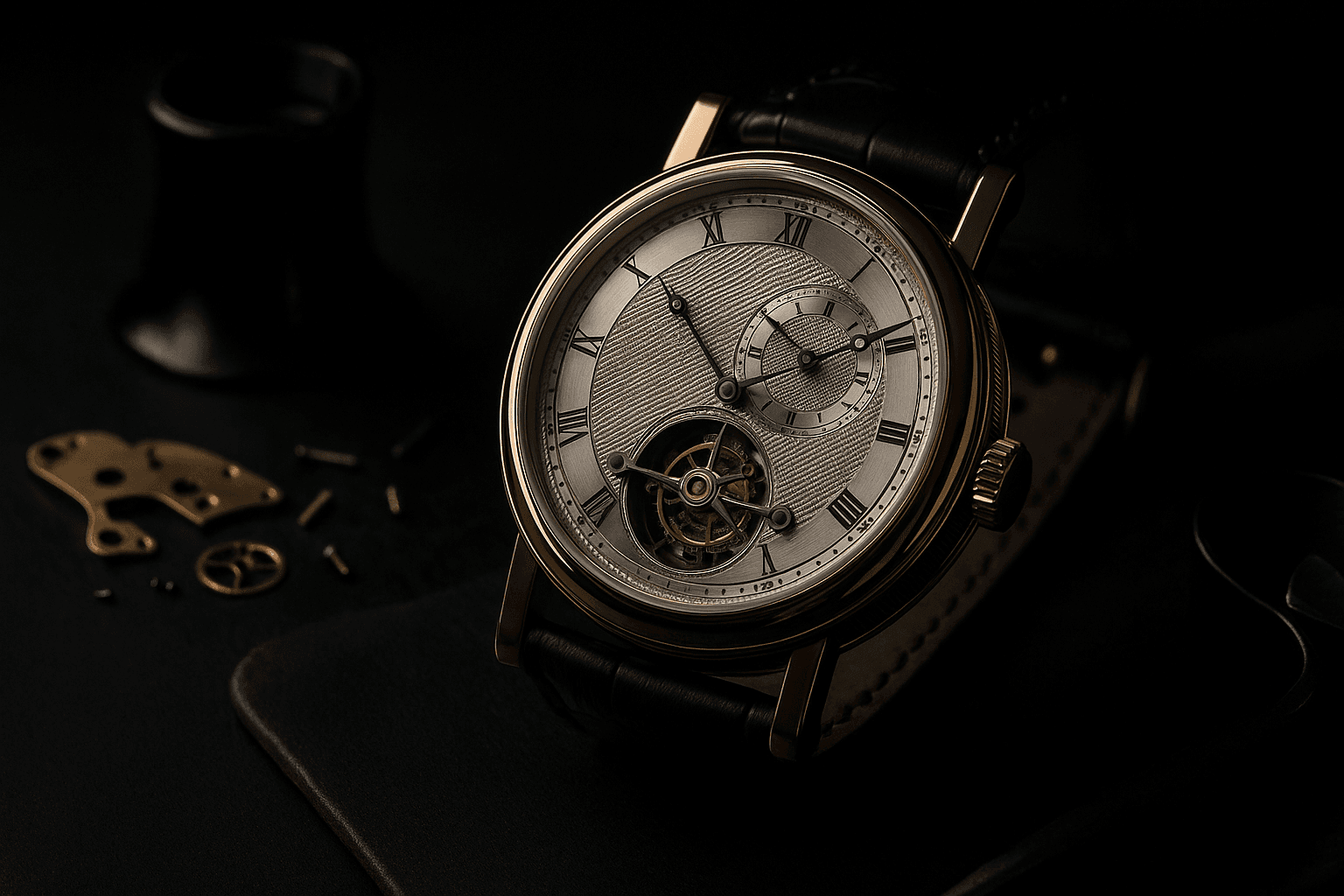
The hairspring's terminal curve is a Breguet overcoil. The numerals are Breguet numerals, the hands are Breguet hands, and the tourbillon — the complication most houses still treat as their graduation thesis — carries a patent granted to Abraham-Louis Breguet in 1801.
He also brought engine-turned guilloché to dials as a legibility device rather than decoration, and built the pare-chute shock protection that the Incabloc lineage descends from. What's more, he delivered what is generally credited as the first wristwatch — No. 2639, made for Caroline Murat, Queen of Naples, delivered in 1812.
That said, a house can write the dictionary and still lose the argument about what its watches are worth. That gap between historical weight and market position is the whole subject of this playbook.
Breguet holds the 1801 tourbillon patent, the overcoil, and the guilloché dial conventions the industry still uses. Despite that, it trades below Patek and Lange on the secondary market — which is where the opportunity sits.
The Vocabulary Problem
Most brand heritage arguments are marketing. Breguet's is grammatical — you cannot describe a fine hairspring without using his name as an adjective.
The overcoil is the clearest example. Raising the outer terminal curve of the hairspring above the body of the coil and curving it inward lets the spring breathe concentrically, which improves isochronism across positions.
Nearly every serious movement built since still uses that idea, and the industry still calls it a Breguet overcoil. Keep in mind that the vast majority of houses using it pay him nothing but the name.
The tourbillon follows the same pattern. Breguet's patent covered rotating the entire escapement to average out gravity's pull on the balance in vertical positions, and two centuries later the complication remains the standard signal that a manufacture has arrived.
Guilloché is the third. Breguet applied rose-engine and straight-line engine turning to dials so that different registers could be visually separated by texture instead of by color, and the pattern names Breguet uses today — clous de Paris, grain d'orge, vieux panier, flammé — are the ones the rest of the trade borrowed.
The overcoil, the tourbillon, the pare-chute shock system, and guilloché dial conventions all trace to Abraham-Louis Breguet's Paris workshop. The industry adopted the techniques and kept the terminology.
How Did The House That Wrote The Rules End Up Trading Below Its Students?
The honest answer is a distribution story rather than a watchmaking one. Breguet built a broad retail network and produced watches to fill it, which means supply has generally met demand instead of trailing it.
Compare that to the mechanics we covered in our analysis of Patek Philippe allocation reality, where scarcity is a managed input rather than an accident. Breguet never engineered a waitlist culture, and the market has repaid that restraint with soft residuals.
The ownership timeline explains more of it than collectors usually admit. Here is the sequence that matters:
- 1775–1823. Abraham-Louis Breguet operates from the Quai de l'Horloge in Paris, producing the souscription watches, the sympathique clocks, and the commissions that built the reputation.
- 1870. The firm passes to Edward Brown, an English watchmaker who had been running the workshop, and the family line ends.
- 1970. The Chaumet brothers acquire the name, and Breguet becomes a jeweler's asset rather than a watchmaker's.
- 1976. Production relocates from Paris to the Vallée de Joux in Switzerland — the manufacture becomes Swiss in fact as well as in supply chain.
- 1987. Investcorp takes ownership after Chaumet's financial troubles.
- 1999. Swatch Group acquires Breguet, and Nicolas G. Hayek makes it the group's flagship, funding a genuine industrial rebuild.
All of these add up to a simple market reality: a brand that changed hands four times in thirty years never accumulated the continuous collector mythology that A. Lange & Söhne manufactured from scratch after 1990. The watchmaking recovered under Swatch. The narrative never fully did.
Breguet changed ownership four times between 1970 and 1999 — Chaumet, Investcorp, then Swatch Group. The manufacture recovered under Swatch; the continuous collector narrative that props up peer pricing never did.
The Modern Collection, Read As A Collector Would
Breguet's catalog is not organized the way the secondary market values it. The lines below are ranked by collector logic rather than by retail prominence.
Tradition
Introduced in 2005 with the reference 7027, Tradition is the one modern Breguet that no other house could plausibly have made. It takes the architecture of the 1796 souscription watch — the movement laid out symmetrically around a central barrel, bridges and gear train exposed on the dial side — and builds a wristwatch out of it.
That is a defensible claim of originality, and the market treats it accordingly. The 7057 with power reserve and the 7047 Fusée Tourbillon extend the same idea upward, and the Fusée Tourbillon in particular pairs a chain-and-fusée constant-force system with a tourbillon in a way very few manufactures attempt.
Classique
Classique is where the guilloché, the Breguet numerals, the coin-edge fluted caseband, and the welded lugs with screwed bars all appear together. References like the 5177 and the extra-thin 7147 with grand feu enamel are, in build quality terms, competitive with anything at the price.
However, Classique is also the line that absorbs the steepest first-owner loss. It is the most produced, the most retail-distributed, and the most exposed to the fact that a classical round dress watch in white gold has more competition than any other category in the industry — a point we made in our look at the Lange Saxonia Thin.
Type XX and Type 20
This is the outlier, and the most liquid part of the catalog. The Type 20 lineage runs to French Aéronavale flyback chronographs of the 1950s, which gives it something the rest of Breguet's modern range does not have — documented military provenance.
The 1995 reissue era produced the 3800 Aéronavale and the 3820 Transatlantique on Lemania-based flyback calibers, and both wear at a modern-correct 39mm. Breguet relaunched the line in 2023 with an in-house integrated column-wheel flyback movement, which reset the retail price and, predictably, pulled the older references into sharper relief.
Marine
Marine is Breguet's sports-adjacent line, anchored by the 5517 three-hander and the 5527 chronograph. It carries the guilloché and the fluted case, but in a rubber-strap, wave-pattern-dial register.
Be aware that Marine competes directly with the most crowded segment in luxury watchmaking. It is well made and it discounts hard, and those two facts are related.
Reine de Naples
The Reine de Naples line descends from the 1812 Caroline Murat commission and remains the most historically literate women's watch any major house produces. It is also the least liquid part of the catalog on the secondary market, for reasons that have nothing to do with the watch and everything to do with how thin the collector market for women's mechanical watches remains.
Grande Complication and Double Tourbillon
The 5347 Double Tourbillon and the Classique Chronométrie 7727 — the 10 Hz reference with magnetically suspended balance pivots, launched in 2013 — represent genuine technical work rather than catalog filler. Breguet was also among the earliest volume adopters of silicon hairsprings and escapement components, which is a real engineering contribution and, notably, one the market gives it almost no credit for.
Taken together, these lines describe a manufacture doing serious work across three registers — historical reconstruction, classical dress watchmaking, and materials research — while being priced as though only the middle one exists.
Where The Modern Collection Is Undervalued
Undervalued here means the delta between what the watch is and what the market pays, not a prediction that the number will rise. Note that with a brand this exposed to retail distribution, a discount can persist indefinitely without ever being wrong.
The strongest cases are these:
- Pre-owned Tradition. The architecture is unrepeatable by anyone else, the finishing is manufacture-grade, and the pre-owned entry point sits meaningfully below retail. Estimated, not a quoted comp — verify current listings on Chrono24 and completed results at Phillips or Christie's before you set a number.
- Type XX references 3800 and 3820. Real Aéronavale lineage, Lemania-based flyback, 39mm, and a price that the 2023 relaunch made look more attractive rather than less. This is the most defensible entry in the catalog.
- Extra-thin Classique on enamel, second hand. If you want a grand feu enamel dial with a hand-guilloché alternative at the same reference number, the first owner has already paid for it.
- Silicon-era technical references. The 7727 and the silicon-escapement Classiques are underpriced relative to the R&D behind them, precisely because the market has no story for them.
All of the above share one trait: they are watches whose merit is legible to a watchmaker and invisible to a resale spreadsheet. That is exactly the condition under which a collector-buyer, as opposed to a flipper, gets paid.
Pre-owned Tradition and the 3800 and 3820 Type XX references are the strongest value in the Breguet catalog. Both have merit a watchmaker can see and a resale spreadsheet cannot — which is why they are cheap.
Where It Isn't
A playbook that only finds bargains is not a playbook. Three parts of the catalog are priced correctly or worse.
At retail, Classique is not undervalued. You are paying a full haute horlogerie price into the most competitive category in watchmaking, against a brand with soft residuals, and the discount arrives roughly the moment you leave the boutique.
Marine at retail is the same trade with less history behind it. If the appeal is a guilloché dial and a fluted case, Classique gives you more of the brand for the money.
Vintage Breguet — genuine nineteenth-century Paris pieces — is not undervalued either. That market is well understood by specialists, thinly traded, and priced by auction houses that know exactly what they have, which is the dynamic we described in auction estimate mechanics. The Marie-Antoinette No. 160, commissioned in 1783 and completed in 1827 after Breguet's death, is the extreme illustration of a market where the numbers are set by scholarship rather than by sentiment.
| Line | What you are buying | Retail-to-secondary behavior | Editorial read |
|---|---|---|---|
| Tradition | Souscription architecture on the wrist | Holds better than the rest of the catalog | Buy pre-owned; strongest case in the range |
| Type XX / Type 20 | Aéronavale flyback lineage | Most liquid; 2023 relaunch lifted the older refs | 3800 and 3820 are the entry point |
| Classique | Guilloché, enamel, fluted case, welded lugs | Steepest first-owner loss in the catalog | Buy second hand, never at retail |
| Marine | Sports-adjacent guilloché | Discounts hard, stays discounted | Skip unless the case wears right on you |
| Reine de Naples | The 1812 Caroline Murat lineage | Thin secondary market | Buy to keep, not to trade |
| Complications (5347, 7727) | Double tourbillon; 10 Hz magnetic pivots | Underpriced against the engineering | Real work, no narrative — buy on merit |
What Actually Drives Price Variation Within A Reference
Once you have picked a line, the spread inside a single reference is wide enough to matter more than the choice of reference did. The variables, in descending order of impact:
- Dial condition. A guilloché or grand feu enamel dial cannot be refinished without destroying the thing you bought it for. Haze, hairlines in the enamel, or a suspiciously uniform texture under magnification should end the conversation.
- Case sharpness. The fluted caseband is the tell. Over-polishing rounds the flutes and softens the lug welds, and once it's gone there is no correcting it.
- Metal. White gold and platinum trade at a discount to yellow and rose in the current cycle, which is a taste cycle rather than a permanent condition.
- Books, tools, and service history. Full set commands a real premium on a brand where authenticity questions are common enough to be worth insuring against.
- Time on market. A Breguet listed for six months is telling you something, and it is usually about the ask rather than the watch.
Remember that on a brand with soft residuals, condition premiums compress and condition penalties do not. You are rarely rewarded for buying the best example, but you are always punished for buying a poor one.
Dial condition and caseband sharpness drive more Breguet price variation than reference choice does. Guilloché and enamel cannot be refinished, and over-polishing rounds the fluted case permanently.
Pre-Purchase Inspection And Authenticity
Breguet has one authentication advantage most houses lack. Since the mid-1990s the brand has applied a laser-engraved secret signature to its dials, visible only under raking light, which gives you a first-pass check that does not require opening the case.
Here is what a competent pre-purchase inspection covers:
- The secret signature. Locate it under raking light before anything else. Its absence on a modern piece is disqualifying.
- Dial under 10x magnification. Check the guilloché for flattening at the pattern edges and the enamel for firing flaws versus impact damage.
- Hand shapes. The hollow-moon pomme tip is precise on genuine pieces and approximate on replacements — a mismatch usually means a service hand, not a fake.
- Fluted caseband and lug welds. Verify the flutes are crisp and the soldered lugs still have defined shoulders.
- Service history and parts access. Swatch Group support means genuine parts are obtainable, which is not a small thing. Factor real service intervals into the number, the way we lay out in luxury watch ownership economics.
All of these are checks a competent independent watchmaker performs in under an hour. Skipping them on a brand with this much dial-side value at stake is the single most expensive shortcut in Breguet buying.
Check the laser-engraved secret signature under raking light first, then the guilloché and enamel at 10x, then the fluted caseband for over-polishing. Swatch-era Breguet has genuine parts access.
Editorial recommendation
- First Breguet: a Type XX reference 3800 or 3820, full set, unpolished case, from the 1995 reissue era. It is the most liquid, most historically defensible, and least expensive way into the marque.
- The one to keep: a pre-owned Tradition 7027 or 7057. Nothing else in watchmaking is built this way, and the pre-owned discount is a gift the market has not corrected.
- Buy second hand, not retail: Classique 5177 or 7147. The build is exceptional and the first-owner loss is somebody else's problem.
- The technical pick: the Classique Chronométrie 7727. A 10 Hz balance on magnetic pivots is real engineering that the market has declined to price.
- Skip: Marine at retail, unless the case genuinely wears well on your wrist.
- Verify before you transact: every price band in this piece is an editorial estimate. Check current Chrono24 listings and completed Phillips, Christie's, or Sotheby's results before you make an offer.
Definitions And Background Information
Did Breguet actually invent the tourbillon?
Abraham-Louis Breguet received the tourbillon patent in 1801. The mechanism rotates the escapement to average out gravity's effect on the balance across vertical positions, and both the name and the patent are his.
What is a Breguet overcoil?
The overcoil raises the hairspring's outer terminal curve above the body of the coil and curves it inward, so the spring breathes concentrically. It improves isochronism, and high-end movements still use the idea today.
Which Breguet collection is the best starting point?
The Type XX, specifically the 3800 or 3820. Real Aéronavale lineage, a Lemania-based flyback caliber, 39mm on the wrist, and the most liquid resale market in the catalog.
Why is Breguet cheaper than Patek Philippe or A. Lange & Söhne?
Distribution breadth and a broken ownership narrative. Breguet produced to fill a large retail network, and four ownership changes between 1970 and 1999 prevented the continuous collector mythology its peers built.
What was the first wristwatch?
Breguet No. 2639, generally credited as the first wristwatch, was delivered to Caroline Murat, Queen of Naples, in 1812. The modern Reine de Naples line descends from that commission.
Is Swatch Group ownership good or bad for Breguet collectors?
Net positive. Swatch funded the manufacture rebuild, the silicon research, and guarantees parts access for service — the things that actually protect a watch you intend to keep.
Where To Read Next
Breguet rewards the collector who buys on merit rather than on momentum, which is the same instinct that pays off with the independents like Voutilainen and Akrivia and with Vacheron Constantin. If you are building a view of how these markets actually clear, our coverage of vintage market dynamics is the companion piece to this one.
We cover the marque rather than sell it, and every number here is an editorial estimate you should verify against live comps before you transact.