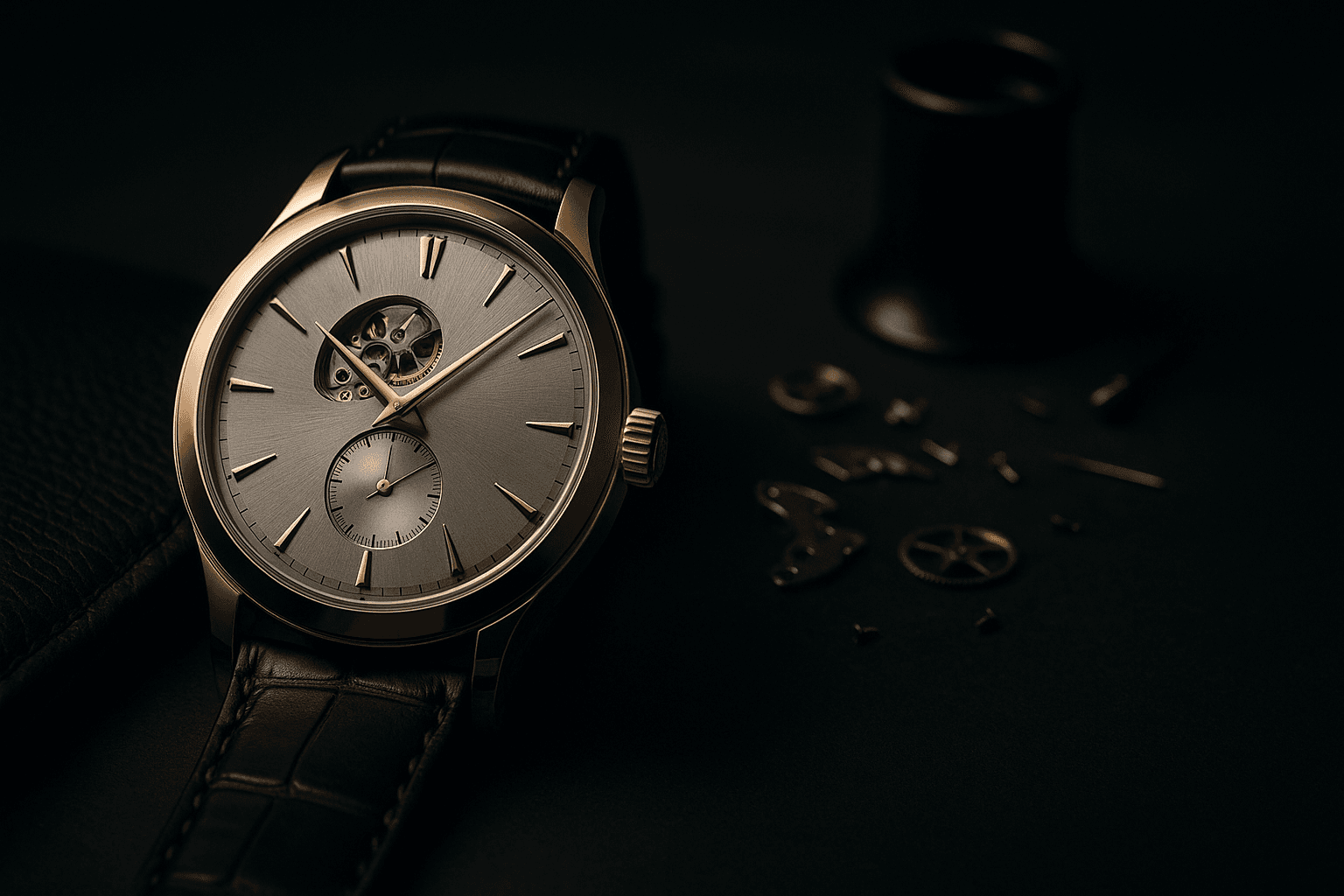
Chopard L.U.C: The Case for Geneva's Quietest Serious Movement Maker
By The Subdial Editors ·
Collectors have learned to read scarcity as a proxy for quality, and most of the time the shortcut holds — the hardest watches to buy tend to be the ones with the most watchmaking behind them. That said, the shortcut breaks at the exact point where a manufacture builds serious movements inside a house the public knows for something else entirely.
Chopard is where it breaks. The name summons Happy Diamonds, the Palme d'Or and the Cannes red carpet, and almost none of it summons the Fleurier manufacture where the company has designed, machined, finished and certified its own calibers since 1996.
The result is one of the few durable arbitrages left in modern haute horlogerie: movement quality that survives comparison with Geneva's most decorated names, sold without the queue, the premium, or the theatre. What follows is the playbook for buying it.
What Is Chopard L.U.C?
L.U.C is Chopard's in-house haute horlogerie line, produced at the Fleurier manufacture the family opened in 1996. It carries the founder's initials — Louis-Ulysse Chopard — and is engineered entirely separately from the jewellery collections.
Louis-Ulysse Chopard founded the company in Sonvilier in 1860 as a maker of precision pocket watches and chronometers, and the name spent most of the twentieth century attached to something rather different. The initials were revived in 1996, when Karl-Friedrich Scheufele opened Chopard Manufacture in Fleurier and released the L.U.C 1.96 — a micro-rotor automatic with twin stacked barrels and a 22-carat gold rotor recessed into the mainplate.
Keep in mind that L.U.C is not a badge applied to bought-in ébauches. Chopard Manufacture designs, machines, decorates and assembles its calibers in-house, and the group's Fleurier Ebauches division produces base movements — a degree of vertical integration that only a short list of Swiss houses can honestly claim.
Yes, Chopard makes its own movements. Chopard Manufacture in Fleurier designs, machines, finishes and assembles L.U.C calibers in-house, and its Fleurier Ebauches division produces base movements for the group.
Why The Jewellery Business Obscures The Watchmaking
The Scheufele family bought Chopard in 1963. They came from Pforzheim and from goldsmithing rather than watchmaking, and that heritage produced the two products that pay the bills: Happy Diamonds in 1976 and Happy Sport in 1993.
Those collections — plus the Mille Miglia partnership and the Palme d'Or that Chopard has made since 1998 — define the brand in the public mind. Accordingly, the manufacture sits behind a storefront that reads as jewellery-first, and the calibers never collect the credit they earn.
What's more, the family runs the two halves deliberately. Caroline Scheufele leads jewellery and high jewellery; Karl-Friedrich Scheufele leads watchmaking, and it was he who founded the Fleurier manufacture and, in 2015, revived Ferdinand Berthoud as a separate haute horlogerie house.
The two-trophy tell. The same watchmaking leadership took the Grand Prix d'Horlogerie de Genève's Aiguille d'Or twice inside two years — Ferdinand Berthoud's FB 1 in 2016, and the Chopard L.U.C Full Strike in 2017.
A house that wins the industry's top prize twice in that window is not a jeweller who happens to sell watches. It is a movement maker with a jewellery business attached.
The Certification Stack Almost Nobody Else Carries
Selected L.U.C references hold COSC chronometer certification, the Poinçon de Genève and Qualité Fleurier — a stack that very few manufactures carry simultaneously on the same finished watch.
Certification is the most underrated signal in watch buying, because unlike a waiting list it cannot be manufactured by marketing. Three independent bodies stand behind the L.U.C line, and each one tests a different thing.
| Certification | What it actually tests | Scope | Why it matters to a buyer |
|---|---|---|---|
| COSC | Chronometric rate over roughly 15 days across five positions and three temperatures, to a tolerance of −4/+6 seconds per day | The bare movement, before casing | Baseline proof the caliber is regulated, not merely assembled |
| Poinçon de Genève (Geneva Seal) | Finishing and construction criteria plus, since its 2011 overhaul, functional testing of the cased watch; requires assembly and adjustment within the Canton of Geneva | The finished watch | Independent verification of hand-finishing standards a photograph cannot confirm |
| Qualité Fleurier | 100% Swiss manufacture, prior COSC certification, a multi-week accelerated ageing and shock protocol, and a 24-hour wearing simulator requiring −0/+5 seconds per day | The finished watch, in simulated real-world wear | The only mainstream certification that tests the watch as it behaves on a wrist |
Note that Chopard was a co-founder of the Fleurier Quality Foundation in 2004, alongside Parmigiani Fleurier, Bovet and Vaucher Manufacture. Of course a founder-member certification invites scepticism — but the protocol is administered independently, and the number of watches that pass it each year is small enough that the brand cannot be accused of rubber-stamping its own volume.
All of this adds up to a straightforward proposition. When you buy a Geneva-Sealed, COSC-certified L.U.C, you are buying finishing and chronometry that a third party has physically inspected — not a brand narrative you are asked to take on faith.
The Calibers Worth Knowing
L.U.C is not a single movement family but a spread of them, and the spread is what makes the line credible rather than decorative. The ones that matter to a collector include:
- The L.U.C 96 micro-rotor family. A 22-carat gold micro-rotor set into the mainplate rather than stacked on top of it, paired with Chopard's twin stacked barrels for roughly 65 hours of reserve. This is the engine inside the thin XP and XPS references, and it is the reason those watches wear like dress pieces rather than sandwiches.
- The L.U.C Quattro. Four stacked barrels driving a nine-day — approximately 216-hour — hand-wound reserve, which remains one of the more serious pieces of spring-barrel engineering in production. Several Quattro references have carried both the Geneva Seal and Qualité Fleurier.
- The L.U.C Lunar One. An orbital moon-phase perpetual calendar; Chopard's own figure for the moon-phase deviation is roughly one day in 122 years, and that figure should be treated as the manufacturer's claim rather than an independently audited result.
- The L.U.C Full Strike. A minute repeater whose gongs are machined from the same sapphire block as the crystal, so the crystal itself becomes the sound-transmitting element. It won the Aiguille d'Or in 2017, which is the industry's own verdict on whether Chopard belongs in the conversation.
- The flying tourbillon references. Flying-tourbillon L.U.C models carrying COSC certification and the Geneva Seal, which is a rarer combination than the tourbillon itself.
Read that list against what the market pays for it and the mispricing becomes hard to explain on technical grounds. Indeed, the only explanation that survives scrutiny is a commercial one.
Why The Market Underprices L.U.C
L.U.C competes for attention inside a house famous for jewellery, so it never built the waiting-list scarcity that inflates secondary prices. Buyers here pay for finishing and chronometry, not for queue position.
Scarcity premiums are a function of distribution, not of watchmaking. The mechanics are well documented in our reading of Patek Philippe allocation reality and of Rolex retail dysfunction, and neither dynamic touches L.U.C.
There is no allocation game at a Chopard boutique, no purchase history to build, and no grey-market bid sitting above list. Accordingly, an L.U.C leaves the boutique and enters the secondary market with nothing propping up its price except the object itself.
The second drag is associative. A buyer spending in the mid-five figures wants the name on the dial to be legible to the three other people in the room who care, and Chopard reads to most of them as a jewellery house — the same structural discount that long suppressed Grand Seiko collecting despite finishing that embarrassed its price bracket.
The third drag is liquidity. L.U.C listings sit on dealer inventory far longer than a steel sports watch, the bid-ask spread widens accordingly, and sellers eventually meet the market where the market is.
On the numbers. Chopard has described annual L.U.C output in the low thousands of pieces against a group watch business many times larger; treat that as an estimate, not an audited disclosure. Likewise, pre-owned L.U.C examples in precious metal commonly trade at a substantial discount to list — call it roughly 45–65% of original retail for clean, complete pieces, an estimated range you should verify against live Chrono24 comps before you transact.
Where L.U.C Sits Against The Obvious Alternatives
The honest comparison set is not Rolex or Omega. It is the finishing-forward end of the market, where the question is how much hand-work and certification a given sum of money buys.
| House | Finishing register | Certification posture | Secondary-market behaviour |
|---|---|---|---|
| Chopard L.U.C | Geneva-school: anglage, Côtes de Genève, gold micro-rotor | COSC + Geneva Seal + Qualité Fleurier on selected refs | Steep initial depreciation, then flat; wide spreads |
| A. Lange & Söhne | Glashütte-school: German silver, hand-engraved cock — see the Saxonia Thin | In-house standard, no external seal | Firm; brand premium well established |
| Vacheron Constantin | Geneva-school, comparable register — covered in our Vacheron Constantin playbook | Geneva Seal across much of the range | Softer than Patek, firmer than L.U.C |
| F.P. Journe | Independent, rose-gold movements — the premium is analysed in our Journe piece | None external; reputation carries it | Trades above retail; scarcity-driven |
| Voutilainen / Akrivia | Peak hand-finishing, per the independents brief | None external | Multiples of retail; effectively unbuyable at list |
The pattern is consistent across the row. Every house that trades at or above retail does so on scarcity and reputation, and the one house carrying three independent certifications is the one the market pays least for.
What To Look For When Buying
A pre-owned L.U.C XPS or XP in precious metal, with box, papers and documented service, is the cheapest honest route into a Geneva-Seal micro-rotor movement. Verify current comps on Chrono24 before committing.
Start with the reference number and the metal, because both drive price variation far more than condition does at this end of the market. Precious-metal L.U.C references carry the finishing story; the steel-cased pieces are pleasant but they surrender the argument you are buying the watch to make.
Next, confirm the certification actually applies to the reference in front of you. Not every L.U.C carries the Geneva Seal, and Qualité Fleurier applies to a narrow subset — check the dial text, the movement markings and the papers rather than assuming the line-level claim covers the specific watch.
Then treat completeness as a hard filter. Box, papers, a documented service history and the original bracelet or strap materially widen your buyer pool on exit, and in a thin market the exit is the part you should be planning first.
Finally, price the servicing before you price the watch. Manufacture calibers with micro-rotors and multi-barrel architectures cost real money to overhaul, and the arithmetic in our guide to the ownership economics of mechanical watches applies here with force — a bargain acquisition followed by a full service is not a bargain.
Be aware that time-on-market is your friend in this segment. L.U.C listings sit, dealers know they sit, and a patient buyer with comps in hand has more leverage than the same buyer would have anywhere near a sports-watch waiting list.
The Case Against L.U.C
L.U.C does not hold value the way a steel sports watch does. It depreciates hard from list and then flattens — which is the buying opportunity, provided you buy at the flat part and not at retail.
The argument against is real and you should hear it before you act. Exit liquidity is genuinely thin, the discount you enjoy as a buyer becomes the discount you concede as a seller, and buying new at boutique list means absorbing the entire first-owner depreciation yourself.
Recognition is the second cost. You will explain this watch, repeatedly, to people who believe Chopard makes bracelets — and if the point of the purchase is to be understood across a boardroom table, that cost is not trivial.
Design conservatism is the third. Much of the L.U.C line is deliberately restrained round dress watchmaking, which is exactly what a certain buyer wants and exactly what will bore another.
Remember that none of these objections touch the movement. They are objections to the market's opinion of the movement, and a collector who buys for the object rather than the opinion is being paid to hold a different view.
Editorial Recommendation
For a first serious L.U.C, the publication's position is specific rather than general:
- Entry. A pre-owned L.U.C XPS or XP in rose or white gold, running a 96-family micro-rotor caliber, bought complete with box and papers at the flat part of the depreciation curve.
- The connoisseur's pick. An L.U.C Quattro — hand-wound, four barrels, nine days — where the engineering argument is legible on the movement side and the certification stack is at its strongest.
- The complication. An L.U.C Lunar One perpetual calendar, bought only with a full service record, since perpetual-calendar servicing is where inattentive ownership becomes expensive.
- Avoid. Buying at boutique list on the assumption of residual support. The residual support does not exist, and the discount you are hunting is created by the first owner, not by you.
- Verify. Every price in this piece is a range, not a point. Confirm current retail with Chopard and current comps with Chrono24 before any transaction.
Frequently Asked Questions
Does Chopard make its own watch movements in-house?
Yes. Chopard Manufacture in Fleurier, opened in 1996, designs, machines, decorates and assembles L.U.C calibers in-house, and the group's Fleurier Ebauches division produces base movements.
What does L.U.C stand for?
Louis-Ulysse Chopard, who founded the company in Sonvilier in 1860 as a maker of precision pocket watches. The initials were revived in 1996 for the manufacture line.
Which certifications do L.U.C watches carry?
Selected references carry COSC chronometer certification, the Poinçon de Genève, and Qualité Fleurier. Not every L.U.C carries all three — confirm against the specific reference and its papers.
Is Chopard L.U.C a good investment?
Treat it as a purchase, not an investment. L.U.C depreciates sharply from list and then stabilises, so value is captured by buying pre-owned at the flat part of the curve rather than by expecting appreciation.
How does L.U.C compare with A. Lange & Söhne or Vacheron Constantin?
The finishing sits in credible company, and the certification stack is arguably stronger. The gap is market reputation, which is what you are being compensated for when you buy at a discount.
What is the best entry-level L.U.C to buy?
A pre-owned XPS or XP in precious metal with a 96-family micro-rotor caliber, complete with box, papers and service history. Verify current comps on Chrono24 before you commit.
Where To Go Next
L.U.C rewards the collector who reads movements rather than waiting lists, and that discipline transfers. If you want the framework behind the price behaviour described here, start with how the vintage market actually prices scarcity, then work through the rest of the Subdial brand playbooks.
And if you are shortlisting a purchase in this bracket, price the exit before the entry. The watch will be excellent either way — your position in it is the part you still control.