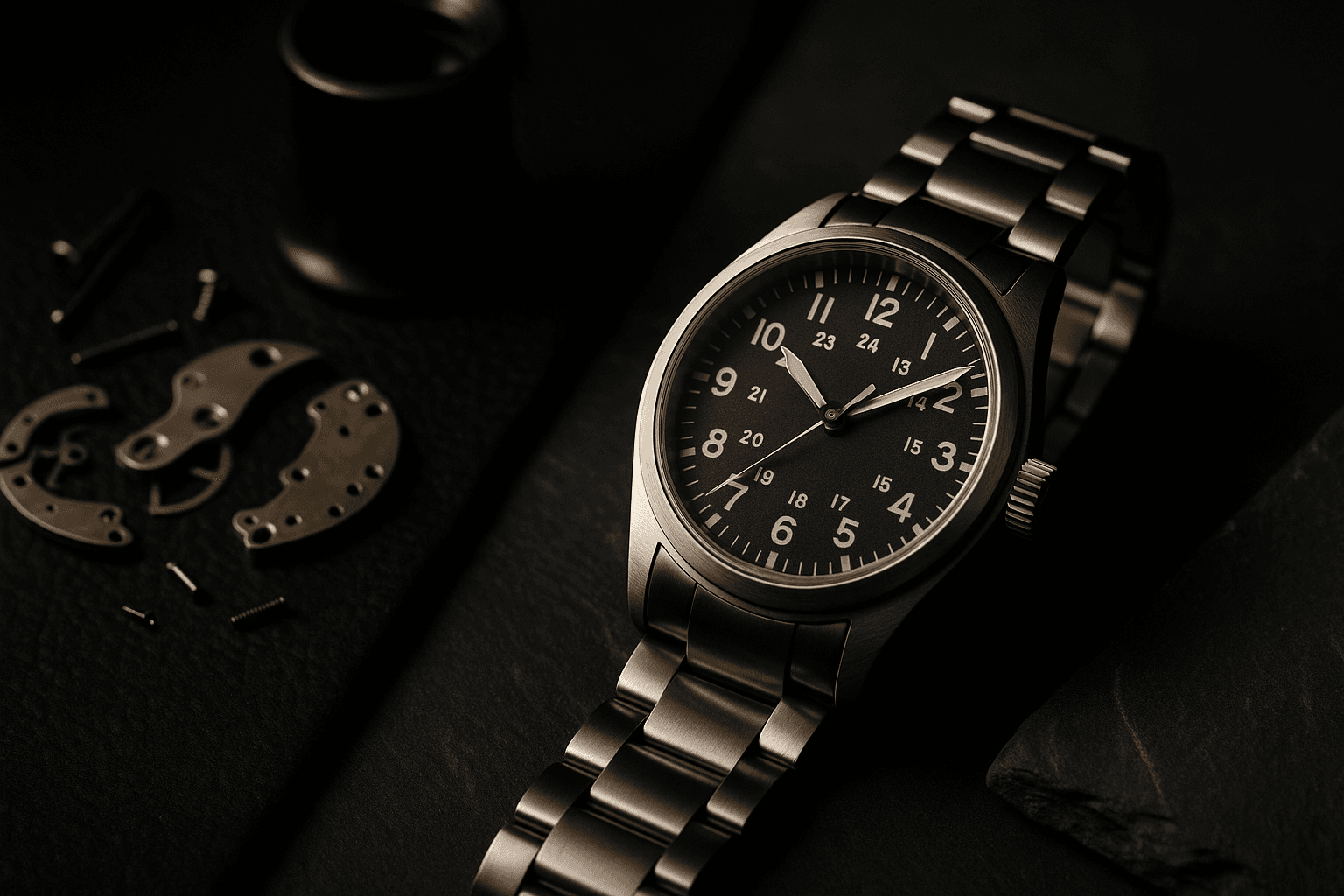
Best Field Watches Under US$500: What You Actually Get at the Entry Tier
By The Subdial Editors ·
Under US$500, the field watch is the most rationally-specified category in watchmaking — the design brief was written by military procurement officers, and the constraints they imposed still shape what you can buy today. Legibility, durability, and serviceability came first, and none of those three require a large budget.
Below are the references that define the tier, with prices as listed by the manufacturer or authorized dealers. Read the table first; the reasoning behind each trade-off follows underneath.
What is the best field watch under US$500? The Hamilton Khaki Field Mechanical (US$595 MSRP, often under US$500 at authorized dealers) is the benchmark hand-wind. The Seiko 5 Sports SRPG35 and Timex Expedition North cover automatic and quartz.
The References That Define The Tier
Every watch below is currently in production and available through authorized channels rather than the gray market. Prices are manufacturer list or authorized-dealer list as of September 2026 and move with dealer discounting, so verify before you transact.
| Reference | Movement | Crystal | Price (source) |
|---|---|---|---|
| Hamilton Khaki Field Mechanical 38mm | H-50 hand-wind, 80h reserve | Sapphire | US$595 MSRP; commonly US$450–500 at authorized dealers |
| Seiko 5 Sports SRPG35 “Field” | 4R36 automatic, hacking + hand-wind | Hardlex mineral | US$295 Seiko US list |
| Timex Expedition North Field Post | Quartz or Miyota automatic depending on variant | Sapphire (North line) | US$139–229 Timex list |
| Citizen Promaster Tough (BN0211 series) | Eco-Drive solar quartz | Sapphire | US$395–450 Citizen US list |
| Marathon General Purpose Mechanical | Sellita SW200-1 automatic | Sapphire | US$450–550 Marathon list depending on variant |
| Vaer C5 Field / A5 Dive-Field | Miyota 9039 or Sellita, US-assembled | Sapphire | US$299–499 Vaer direct list |
Two names on that table carry actual military supply history rather than styling cues — Hamilton, which supplied the US forces through the twentieth century, and Marathon, which still holds NATO stock numbers for issued watches. That provenance does not make them better watches at this price, but it does explain why their case proportions and dial layouts feel less arbitrary than the rest.
If you want the broader view of what US$500 buys across every category rather than field watches specifically, the under-US$500 tier page covers divers, dress watches, and chronographs alongside these, and the watches-by-budget hub maps how the tiers relate to one another.
Hand-Wind Versus Automatic: The Real Trade
The hand-wind versus automatic question is usually framed as romance versus convenience, which misses what actually differs. A hand-wound movement removes the rotor and its bearing, which makes the case thinner, the movement quieter, and one common failure point disappear entirely.
Is a hand-wind or automatic field watch better? Hand-wind runs thinner and removes the rotor as a failure point; automatic suits rotation between several watches. Hamilton's H-50 hand-wind carries an 80-hour reserve, so it survives a weekend off-wrist.
The Hamilton H-50 inside the Khaki Field Mechanical is an ETA-derived hand-wind with an 80-hour power reserve, which is the specification that settles the argument for most buyers. Wind it Friday morning and it is still running Monday, which removes the only genuine inconvenience hand-winding used to carry.
Automatics earn their place when the watch is one of several in rotation and you would rather not think about winding order. The Seiko 4R36 and the Sellita SW200-1 both hack and hand-wind, so they behave predictably when you set them after a week in a drawer.
Accuracy expectations should be set honestly at this tier. A 4R36 is specified at roughly −35 to +45 seconds per day, a Sellita SW200-1 in standard grade at approximately ±12 to ±30 seconds per day, and neither is chronometer-certified unless the listing explicitly says so.
That spread is wider than it sounds in practice, because a movement's actual rate usually lands well inside its specified window. What the specification protects is the worst case, not the typical one — and the typical one is frequently within ten seconds a day.
Sapphire Versus Mineral: Where The Money Goes
Crystal choice is the single clearest place where a price difference shows up in daily ownership. Sapphire sits at roughly 9 on the Mohs hardness scale, mineral glass around 5 to 6, and the everyday abrasives that scratch watches — quartz-bearing sand, concrete dust, stone countertops — sit between the two.
Does a field watch need a sapphire crystal? Sapphire rates roughly 9 on the Mohs scale against mineral's 5–6, and common grit sits between them. Mineral resists shattering better; sapphire resists the scratches you will actually accumulate.
The counter-argument for mineral is real but narrower than its advocates suggest. Mineral glass absorbs a sharp impact with more deformation before it fails, which is why some tool-watch makers still specify it, but the failure mode you will actually meet is a hundred small scratches rather than one decisive blow.
Seiko's Hardlex is the notable holdout on this table, and it is a deliberate cost decision rather than an oversight. At US$295 list, the SRPG35 spends its budget on the automatic movement instead, and a Hardlex crystal is replaceable for a modest sum by any competent watchmaker.
Be aware that “sapphire-coated” and “sapphire” are not the same claim. A coated mineral crystal has a thin hardened layer that wears through; when a listing does not say solid sapphire, assume it is not.
Lume: The Specification Nobody Lists Honestly
Lume is where marketing language diverges most sharply from what you get. The relevant variable is the compound grade and how much of it was applied, and almost no brand at this price publishes either figure.
Super-LumiNova and Seiko's LumiBrite are both strontium-aluminate phosphors, which charge quickly under bright light and decay on a predictable curve. The grades that matter are roughly C3 (green, brightest), BGW9 (blue-white), and the various vintage-tinted C1 and Old Radium variants, which trade a meaningful amount of brightness for a warmer daytime dial color.
Which lume is brightest on a field watch? C3 green Super-LumiNova is the brightest common grade, with BGW9 blue-white close behind. Vintage-tinted C1 and Old Radium variants trade real brightness for warmer daylight dial color.
Here is the practical test to apply before you buy. Look for photographs of the dial taken thirty minutes or more after charging rather than in the first few seconds, because every lume compound looks impressive in the opening moments and only the well-applied ones are still legible at hour six.
Application thickness matters as much as grade. A thinly-printed C3 dial will underperform a generously-filled BGW9 one, which is why two watches citing the same compound can behave entirely differently on a night hike.
Seiko's LumiBrite on the 5 Sports line is consistently among the strongest at this price, a consequence of Seiko applying it in genuine depth rather than as a surface print. Hamilton's application on the Khaki Field Mechanical is competent rather than exceptional, which is a reasonable trade for the movement you are getting.
Case Size, Lug-To-Lug, And The Measurement That Matters
Field watches are the category where stated case diameter misleads most often. The dimension that determines whether a watch fits is lug-to-lug — the distance across the case from lug tip to lug tip — because that is what overhangs a wrist, not the bezel diameter.
The 38mm Khaki Field Mechanical measures approximately 47mm lug-to-lug, which suits wrists from about 6.25 inches upward. The 42mm version pushes past 52mm and genuinely requires a 7-inch wrist or larger to sit correctly.
Thickness is the second under-reported figure. A hand-wind field watch typically lands between 9mm and 11mm, an automatic between 11mm and 13mm, and that two-millimeter gap is the difference between a watch that slides under a shirt cuff and one that catches.
Before you buy: ask the dealer for lug-to-lug and case thickness in millimeters, not just the diameter. Both figures are published by every brand on this table and both predict wearability better than the number in the model name.
Water Resistance And What The Rating Means
Field watches are rated for water resistance in a way that reflects their original brief rather than swimming. Most of the references here carry 50m or 100m ratings, which are static pressure tests conducted in a laboratory rather than statements about activity.
A 50m rating survives rain, handwashing, and an accidental submersion but is not a swimming specification. A 100m rating covers swimming and surface water sport, and if you want a watch for genuine underwater use, the dive watch category is where that engineering lives.
Gaskets age regardless of how the watch is used. A watch that has been in a drawer for five years has the same hardened seals as one worn daily, and pressure-testing during a routine service is inexpensive relative to a water-damaged movement.
Straps, Serviceability, And The Long View
The field watch's standard 18mm or 20mm lug width with drilled or undrilled spring bars is one of its quiet advantages. Straps are abundant and cheap, and a US$40 strap change alters the character of the watch more than most US$400 upgrades would.
Serviceability deserves more attention than it typically gets at this price. The movements on this table — the ETA-derived H-50, the Sellita SW200-1, the Seiko 4R36, the Miyota 9039 — are all high-volume calibers with broad parts availability, which is precisely the situation that keeps a watch repairable twenty years out.
That availability question is not academic, and it becomes far more consequential as budgets rise. The relationship between a caliber's ubiquity and its long-term serviceability is explored in more detail in our coverage of watch parts access, and the economics of keeping a mechanical watch running are laid out in ownership economics.
Expect a full service on a mechanical field watch to cost roughly US$200 to US$400 at an independent watchmaker, which is a meaningful fraction of the purchase price. That ratio is the honest reason many buyers at this tier choose solar quartz, and it is not a lesser choice.
What Changes Above US$500
The next meaningful step is not a better field watch but a differently-engineered one. Between US$500 and US$1,000 you gain chronometer certification, in-house movements with longer reserves, and finishing that survives close inspection rather than merely passing it.
What you do not gain is legibility, which is the field watch's entire purpose and which is fully solved at US$300. The under-US$1,000 tier is worth reading if you want to understand exactly what the additional US$500 buys before you spend it.
Value retention behaves differently here than it does at the upper end of the market. Entry-tier mechanical watches generally settle at a meaningful discount to list on the secondary market and stay there, which our analysis of watch value retention examines in detail — buy at this tier because you want to wear the watch, not because you expect to recover the outlay.
Editorial Recommendation
Three specifications, three different buyers. Each recommendation names the reference rather than gesturing at a category.
- The default. Hamilton Khaki Field Mechanical 38mm, sapphire, H-50 hand-wind with an 80-hour reserve, US$595 MSRP and frequently US$450–500 at authorized dealers. Nothing at this price is better-proportioned or better-provenanced.
- The automatic. Seiko 5 Sports SRPG35 at US$295 Seiko US list. Accept the Hardlex crystal in exchange for a hacking, hand-windable automatic and the best lume on this table.
- The one you never think about. Citizen Promaster Tough, Eco-Drive solar quartz with sapphire, US$395–450 Citizen US list. No winding, no service interval for a decade or more, and a case designed to be ignored.
Whichever you choose, buy from an authorized dealer rather than a gray-market listing at this tier. The discount is small, the warranty is real, and the difference in recourse when something is wrong is the entire value of the transaction.
For a broader survey of what the publication covers across price points and categories, the index is the place to start.