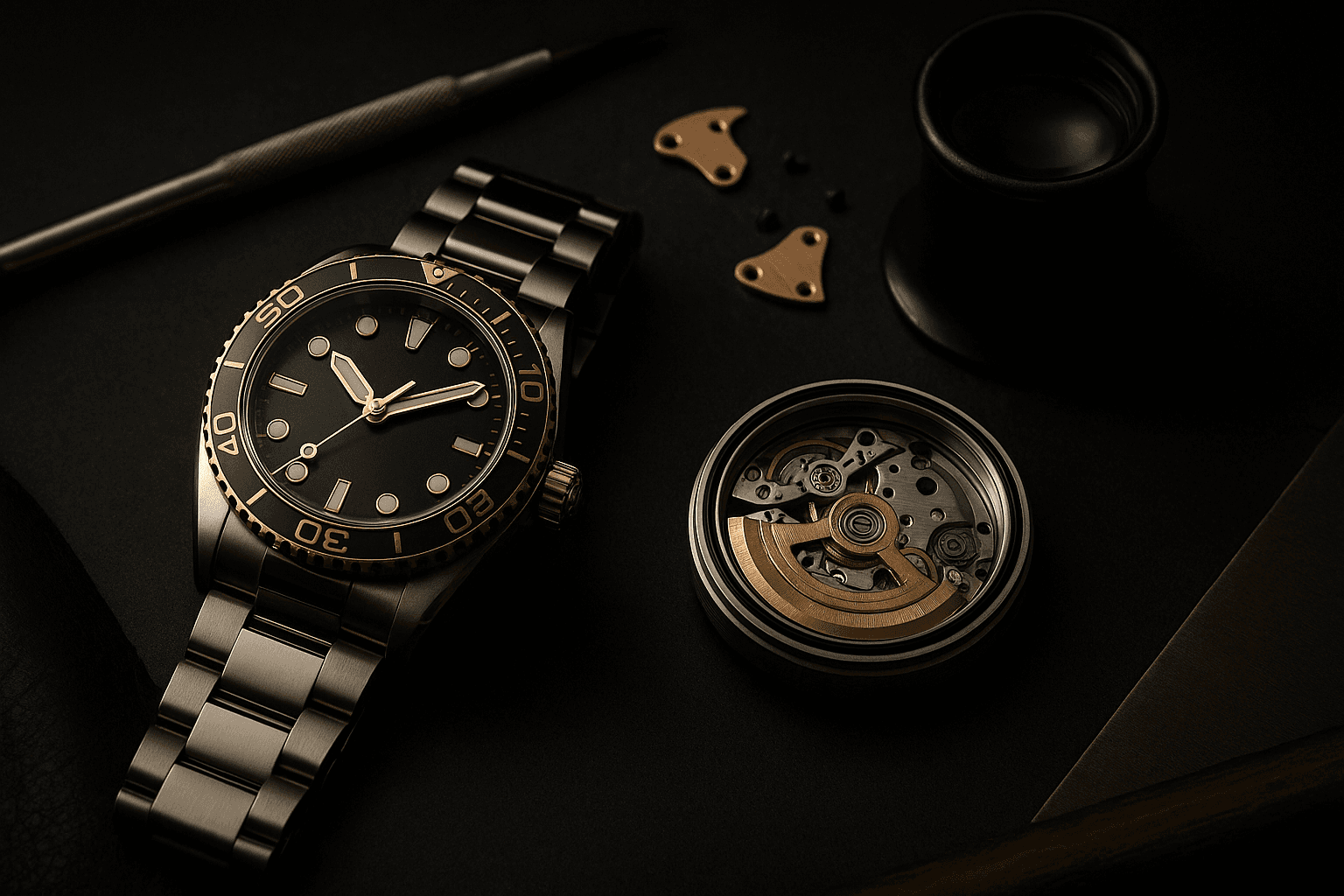
Which Luxury Watch Holds Value Best? Retention by Reference, Not by Marque
By The Subdial Editors ·
A steel Rolex Daytona reference 116500LN left an authorized dealer at an estimated $14,000 to $15,000 in its final production years, and changes hands today in an estimated $28,000 to $34,000 range. A steel Rolex Air-King reference 126900 left the same counter at roughly $7,400 and changes hands at an estimated $6,000 to $7,500.
Both are Rolex, both are steel, and both were current in the same catalogue year. One retains roughly double its list price and the other retains slightly less than list.
That spread is the answer to the question, and it is why marque-level guidance fails the reader who is about to spend real money. Retention is a property of the reference — the specific model, case material, dial, and production window — and only loosely a property of the maison that built it.
No single marque holds value best. Retention concentrates in individual references — steel sports Rolex, discontinued Nautilus and Royal Oak, a few independents — at an estimated 150–400% of list. Most catalogue watches retain 55–85%.
Why The Marque-Level Answer Fails
Ask which watch holds value and the answer that comes back is almost always a brand name. Rolex, Patek Philippe, Audemars Piguet — as if every reference inside those catalogues behaved identically.
Those catalogues do not behave uniformly. Rolex produces an estimated one million watches per year across dozens of references, and retention within that single output ranges from well above list to meaningfully below it.
The same is true one tier up. A Patek Philippe Calatrava in white gold and a Patek Philippe Nautilus 5711/1A were sold by the same salon, in the same year, under the same warranty — and they have diverged by a factor of four on the secondary market.
What's more, the marque-level answer is stable in exactly the wrong way. Brand reputation moves over decades, while reference-level retention moves in months, driven by allocation decisions, discontinuation announcements, and dial variants that never appear in a brand summary.
This is why we track retention at the reference level throughout our coverage, including in our analysis of Rolex retail dysfunction and the reality of Patek Philippe allocation. The badge tells you who made the watch; the reference number tells you what the market will pay for it.
How Retention Is Actually Measured
Before comparing numbers, it is worth being precise about what those numbers describe, because retention figures circulate widely without a stated denominator. A watch quoted at "180% of retail" means nothing unless you know which retail, in which currency, in which year.
Our figures rest on four inputs, and any credible retention claim should disclose the same four. Here is what each one contributes:
- Baseline list price. The manufacturer's most recent published list price in a single currency, at a single stated date. Swiss maisons revise list prices annually, and a 2019 baseline produces a flatteringly high retention figure against a 2026 secondary price.
- Secondary median, not asking price. Dealer asking prices on aggregators run above transacted prices, often materially. Median completed transactions — from platforms that publish sold data, and from auction results including buyer's premium — are the honest number.
- Condition tier. Retention quoted without a condition tier is unusable. A concours-grade example with full set, unpolished case, and complete service history can command an estimated 20–40% premium over a driver-grade example of the identical reference.
- Time on market. A price achieved after nine months of listing is a different fact from a price achieved in eleven days. Liquidity is part of retention, and it is the part most often omitted.
All of these matter because retention is a transaction outcome rather than a listing. Accordingly, the references discussed below are quoted with a stated baseline, a range rather than a point, and an explicit condition assumption.
A credible retention figure needs four disclosures: the list-price baseline and its year, median transacted price rather than asking price, a stated condition tier, and time on market. Missing any one makes the percentage unusable.
The References That Hold Value Best
The table below ranks selected references by estimated retention against last published list price, using aggregated secondary-market listing and transaction data alongside published auction results. Every figure is an estimate expressed as a range, and every figure requires verification against current market data before you transact.
| Reference | Approx. last list (USD) | Est. secondary range (USD) | Est. retention vs list | Primary driver |
|---|---|---|---|---|
| F.P. Journe Chronomètre Bleu (tantalum) | $26,000–$30,000 | $90,000–$140,000 | ~320–470% | Hard output ceiling |
| Audemars Piguet Royal Oak 15202ST | ~$34,000 | $95,000–$150,000 | ~280–440% | Discontinuation + jumbo case |
| Patek Philippe Nautilus 5711/1A | ~$34,900 | $90,000–$130,000 | ~260–370% | Discontinuation |
| Rolex Cosmograph Daytona 116500LN | ~$14,500 | $28,000–$34,000 | ~190–235% | Demand above allocation |
| Rolex GMT-Master II 126710BLRO | ~$11,000 | $16,000–$20,000 | ~145–180% | Waiting-list gatekeeping |
| Rolex Submariner Date 126610LN | ~$10,500 | $12,500–$15,500 | ~120–150% | Waiting-list gatekeeping |
| A. Lange & Söhne Datograph Up/Down (Pt) | ~$100,000 | $68,000–$88,000 | ~68–88% | List already captures scarcity |
| Omega Speedmaster Professional (Hesalite) | ~$7,000 | $4,800–$6,200 | ~70–88% | Unconstrained supply |
| Jaeger-LeCoultre Reverso Tribute (steel) | ~$8,700 | $5,500–$7,200 | ~63–83% | Unconstrained supply |
| Grand Seiko SBGA211 "Snowflake" | ~$6,400 | $3,600–$4,600 | ~56–72% | Retail discount culture |
| Cartier Tank Louis (yellow gold) | ~$13,500 | $7,500–$10,500 | ~55–78% | Metal floor, thin premium |
All figures above are editorial estimates compiled from aggregated secondary-market data, dealer inventory, and published auction results, expressed as ranges rather than points. List prices vary by market and by year, and secondary values move weekly — verify against current Chrono24, WatchCharts, and auction-house records before any purchase or sale.
Two patterns fall out of the table immediately. The references above 150% are almost entirely steel, almost entirely sports or integrated-bracelet designs, and almost entirely either discontinued or supply-constrained at authorized retail.
The references below 90% are, with one exception, freely available at retail. That exception — the A. Lange & Söhne Datograph — is instructive, because a genuinely scarce watch can still retain poorly when the list price already captures most of what the market believes it is worth.
The strongest retention sits in steel sports and integrated-bracelet references that are discontinued or supply-constrained at retail. Freely available catalogue models, regardless of maison, typically settle at 55–85% of list.
Why Retention Concentrates In A Handful Of References
The concentration is not an accident of taste. Four mechanisms produce it, and they compound — a reference that satisfies all four is where the outlier numbers live.
Supply Discipline Against Demonstrated Demand
Retention above list requires that the manufacturer produce fewer units than the market will absorb at list. That is a deliberate commercial policy at several maisons and a structural constraint at others, where hand-finishing capacity caps annual output regardless of the order book.
F.P. Journe produces an estimated 900 to 1,000 watches per year across the entire collection. That ceiling, rather than any marketing decision, is why the F.P. Journe premium has held through multiple market cycles.
Allocation Architecture
Where supply is constrained, the authorized dealer becomes a gatekeeper and the waiting list becomes a queue with an implicit price. The secondary premium is, in plain economic terms, the price of skipping that queue.
Keep in mind that this premium is fragile in a specific way. It contracts the moment allocation loosens, which is precisely what happened to several steel Rolex references between 2022 and 2024.
Design Continuity Across Generations
A reference that resembles both its predecessor and its successor inherits demand from both. The Submariner case profile, the Royal Oak bezel, the Nautilus porthole — each has survived enough generations that a buyer in 2026 is buying into a design with fifty years of accumulated visual equity.
Continuity also protects against obsolescence. A radically restyled generation orphans the one before it, while an evolutionary update makes the outgoing reference collectible on the day it is discontinued — a dynamic we work through in the heritage of the Royal Oak.
The Discontinuation Premium
Discontinuation converts an open-ended supply into a fixed one, and the market reprices against that fixed number. The Nautilus 5711/1A is the clearest modern case: the 2021 announcement that production would end moved the secondary price by a multiple rather than a percentage.
Note that this effect is highly selective. Most discontinued references do nothing at all, because discontinuation only matters where demand already exceeded supply.
Taken together, these four mechanisms explain why retention clusters rather than distributes. A reference needs constrained production, gatekept allocation, design continuity, and ideally a discontinuation event — and only a small number of watches in any maison's catalogue satisfy more than two.
Four mechanisms drive retention: production capped below demand, dealer-gatekept allocation, design continuity across generations, and discontinuation. Few references in any catalogue satisfy more than two at once.
Where Retention Breaks Down
The inverse of the pattern is equally consistent, and it is where most money is lost. Certain characteristics reliably predict retention below 70% of list, irrespective of the name on the dial.
The categories that consistently underperform include but are not limited to:
- Precious-metal versions of steel icons. A gold Submariner or gold Royal Oak carries a list price two to four times its steel sibling without a proportional secondary premium. The metal content sets a value floor; it does not set a ceiling.
- Factory gem-setting. Aftermarket setting destroys value outright, and even factory diamond work typically returns an estimated 30–50% of its list surcharge on resale. The buyer pool for a set bezel is a fraction of the pool for a plain one.
- Models routinely discounted at retail. Where an authorized network habitually discounts 15–25%, the secondary market prices against the street price rather than the list price. This is the single largest factor in Grand Seiko retention, despite finishing quality that outclasses many watches holding twice as much value.
- Oversized and era-specific cases. Case diameters above 44mm from the 2008–2014 period retain poorly, because the design language dated far faster than the mechanics. Size fashion is the most reliable destroyer of retention in modern watchmaking.
- High complications with thin buyer pools. A minute repeater or perpetual calendar from a niche maison may be objectively superior horology and still retain 40–60%. The pool of buyers at that price point is measured in dozens, and dozens do not make a market.
Of course, none of this makes those watches poor purchases. It makes them purchases that should be underwritten as consumption rather than as stores of value, and priced into the ownership economics of servicing, insurance, and eventual resale accordingly.
Retention breaks down on precious-metal versions of steel icons, factory gem-setting, models routinely discounted at retail, oversized 2008–2014 cases, and complications with thin buyer pools. Expect 40–70% of list.
What The 2022 Correction Revealed
Between roughly March 2022 and mid-2024, aggregate secondary-market indices for luxury watches declined by an estimated 30–40% from their peak. That correction was the most useful stress test the modern market has produced.
What it revealed is that retention rankings held while retention levels fell. The references at the top of the table above lost more in absolute dollars than the references at the bottom, yet almost none of them changed places relative to one another.
In other words, the drawdown repriced the speculative premium rather than the underlying desirability. A Daytona that traded at an estimated 320% of list in early 2022 and an estimated 200% of list today is still a Daytona trading above list.
Be aware of the second lesson, which concerns liquidity. Time on market for the strongest references stretched from days to weeks, while weaker references stopped clearing at any credible price — a pattern visible in the auction room as well, where estimate-setting mechanics turned conservative through 2023.
Vintage behaved differently again, and more defensively. Genuinely scarce vintage pieces with documented provenance corrected less than modern hype references, which is consistent with the longer-run vintage market dynamics we track.
The 2022–2024 correction cut aggregate watch indices an estimated 30–40%, but rankings barely moved. Top references lost more in dollars while staying above list; the drawdown repriced speculation, not desirability.
How To Test A Retention Claim Before You Buy
Retention claims are easy to make and hard to falsify, which is why a short verification routine is worth more than any single published figure. Here is the sequence we apply before quoting a number in our own coverage:
- Establish the correct baseline. Pull the manufacturer's list price for the reference in your buying market and record the year of that price. Retention measured against a stale baseline overstates performance by whatever the maison has raised prices since.
- Separate asking from transacted. Filter aggregator data to sold listings, then cross-check against at least one auction result including buyer's premium. Asking-price medians typically overstate transacted values by an estimated 8–15%.
- Fix the condition tier. Decide whether you are comparing full-set, unpolished, service-documented examples or ordinary trade stock, and hold that constant across every comparison. Mixing tiers is the most common source of inflated retention claims.
- Check the float. Count how many examples of the reference are publicly listed at any given moment. A reference with three hundred open listings behaves very differently from one with twelve, whatever the headline percentage says.
- Read the time on market. Note listing dates wherever the platform exposes them, and treat repeated relistings as a price signal. A watch that has sat since spring at an unchanged price is not worth its asking price.
Run that sequence and most published retention claims collapse into a range considerably wider — and generally lower — than the headline. That is not a reason to distrust the concept, but a reason to insist on the disclosure.
Editorial Recommendation
For a buyer whose primary objective is capital preservation rather than acquisition of one specific object, the evidence points to a narrow set of characteristics rather than a list of brands. Our standing guidance follows.
- Buy the reference, not the maison. Prioritise steel sports or integrated-bracelet references with a production run of five years or more and an unbroken design lineage.
- Buy at list where allocation permits. The entire premium on a supply-constrained reference accrues to whoever bought at authorized retail, which makes the dealer relationship the highest-return element of the transaction.
- Buy full-set or take the discount. Box, papers, service records, and original bracelet links are worth an estimated 10–20% at resale and cost far less than that to preserve.
- Avoid the surcharge categories. Precious-metal versions of steel icons, factory gem-setting, and oversized cases each carry a structural retention penalty that no maison overcomes.
- Underwrite a five-to-seven-year hold. Round-trip friction — dealer spread, auction commission, and time on market — consumes an estimated 10–25%, and that takes time to earn back.
Overall, the question of which luxury watch holds value best resolves to a shortlist of perhaps two dozen references across the entire industry. Everything else in the catalogue should be bought to be worn, and priced accordingly.
Frequently Asked Questions About Watch Value Retention
Does buying at authorized retail guarantee better value retention?
No, but on supply-constrained references it is the largest single determinant. The entire secondary premium accrues to whoever bought at list, which is why allocation matters more than model choice on those references.
Is a precious-metal watch a safer store of value than steel?
Generally no. Gold and platinum versions of steel icons carry list prices two to four times higher without proportional secondary premiums, so the metal sets a value floor rather than a ceiling and retention typically lands at 40–65%.
How much do box and papers affect a watch's resale value?
A full set — box, papers, service records, and spare bracelet links — is worth an estimated 10–20% over a watch-only example. On vintage references with documented provenance, the gap can be considerably wider.
Does service history change what a watch retains?
Yes, in both directions. Documented manufacturer service supports value, while an over-polished case from a careless service can remove an estimated 15–30% from a vintage example that would otherwise be unpolished.
Are limited editions better at holding value than regular production?
Only where the underlying reference was already in demand. Limitation alone does not create a buyer pool, and heavily marketed limited editions frequently retain less than the standard production model they are based on.
How long should I plan to hold a watch before reselling?
Plan on five to seven years. Round-trip friction — dealer spread, auction commission, and time on market — consumes an estimated 10–25% of value, and that needs time to earn back at typical appreciation rates.
Where To Go From Here
Retention is one input into a purchase, and it is rarely the deciding one. Our reference-level coverage of the major Swiss marques, the Omega Speedmaster, and Patek and Tudor vintage pricing works through the same evidence for individual collections.
If you are weighing a specific reference, start with the relevant model analysis in the Subdial archive before you commit. Every number in this piece is an estimate expressed as a range, and every one of them should be checked against live market data before you transact.