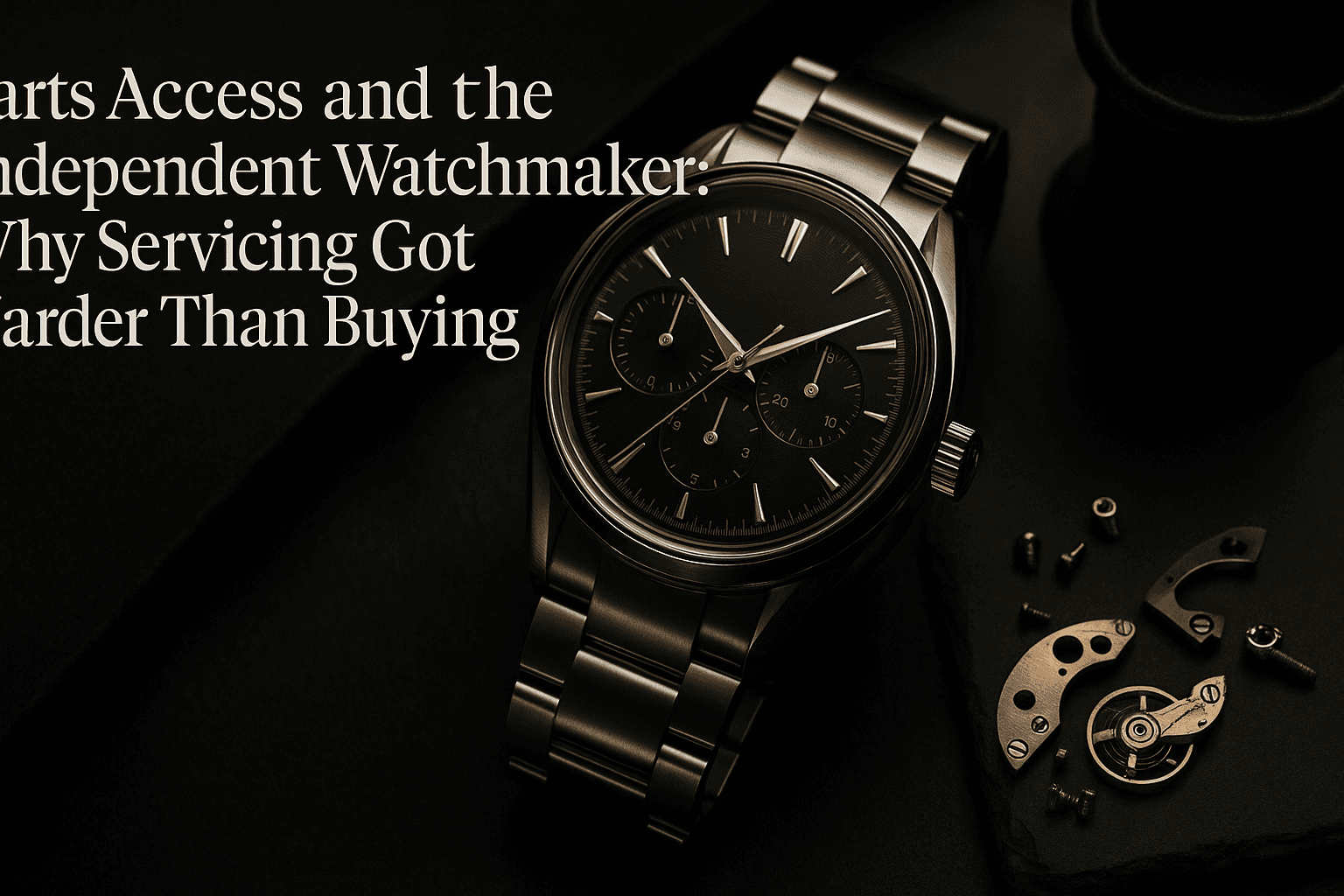
Parts Access and the Independent Watchmaker: Why Servicing Got Harder Than Buying
By The Subdial Editors ·
A mechanical watch is one of the few luxury purchases that assumes a second relationship after the sale, this one with whoever opens the caseback a decade later. Every automatic caliber in a collection carries a service obligation the buyer agreed to without reading, and the terms of that obligation have been rewritten several times over the past twenty years.
Collectors track allocation, secondary premiums, and dial variants with genuine rigour. Far fewer track which watchmakers are permitted to buy the components a given reference needs, and that omission stays invisible until a rotor starts slipping or an amplitude reading comes back low.
Watch parts restriction is a manufacture policy limiting spare-part sales to authorised or accredited service channels. It does not change what a watch costs to buy. It changes who may repair it, and how long you wait.
What Parts Restriction Actually Means
A parts-restriction policy is a supply decision rather than a legal prohibition on repair. The manufacture declines to sell mainsprings, balance staffs, rotors, gaskets, crystals, and bracelet links to accounts outside a defined network, and without those components no watchmaker can complete an authentic overhaul regardless of skill.
The distinction matters because the debate is usually framed as a competence question. The constraint is commercial: an independent with forty years at the bench and a complete tool set is stopped by a closed purchasing account, not by ability.
Restriction also operates in degrees, which is why blanket statements about it tend to be wrong. Some brands sell freely to any registered trade account, some sell only to watchmakers who pass a certification programme and maintain brand-specified equipment, and some sell to nobody outside their own service centres.
How The Restrictions Came About
The modern shape of the problem starts with movements rather than spare parts. Swatch Group announced in 2002 that it intended to wind down supply of ETA ebauches to third-party brands, and after intervention by the Swiss Competition Commission a negotiated phase-down agreed in 2013 ran through 2019.
That decision reset the industry's assumptions about supplier neutrality. Brands that had built entire catalogues on bought-in calibers moved to in-house or Sellita-based movements, and vertical integration became the default strategic posture rather than a marketing line.
Spare parts followed the same logic on a parallel track. Through the 2000s and 2010s, group after group narrowed the list of accounts eligible to order components, and the Swiss regulator ultimately accepted a staged reduction rather than compelling open supply.
Rolex formalised the middle path instead of closing the door entirely, building a certification programme under which qualified independents retain parts access by meeting the brand's training and equipment standards. Several other manufactures now run comparable schemes, and the practical result is a permissioned tier sitting between the open market and the brand-only counter.
Europe's competition authorities examined the question and declined to force the issue. A complaint brought by the European association of independent watch repairers was rejected by the European Commission, and the EU courts upheld that rejection on appeal.
Swiss and EU competition authorities reviewed parts restriction and largely permitted it. Regulators treated brand-controlled aftersales as lawful, which makes the constraint structural and durable rather than a passing policy phase.
Vertical integration tightened the screw a second time. When a group owns the hairspring supplier as well as the brand, the chokepoint moves upstream to the regulating organ itself, and no amount of aftermarket ingenuity produces a compliant replacement.
The Case The Manufactures Make
The manufacture position rests on three claims, and each carries some substance. Dismissing them as pure rent-seeking misreads what the brands are actually managing.
The first is counterfeit suppression: an open parts market moves genuine components into fake cases, and a convincing counterfeit assembled around authentic bridges and a real dial is materially harder to detect. Anyone who has worked through a vintage watch authentication checklist understands why loose genuine parts read as a liability from inside the brand.
The second is calibration. Modern escapements, silicon hairsprings, and proprietary lubricants require brand-specific tooling and training, and a poorly executed service on a co-axial or silicon-regulated caliber can leave the watch worse than untouched.
The third is warranty liability, which is the least contested of the three. A brand that guarantees timekeeping to within a few seconds a day wants control of the hands that set it, particularly where that guarantee now runs five years or more.
The commercial motive sits alongside those claims rather than replacing them. Aftersales is a recurring, high-margin revenue stream attached to an installed base that only grows, and keeping it inside the network is sound business independent of any quality rationale.
Manufactures cite counterfeit suppression, calibration standards, and warranty liability. The commercial effect is that aftersales work, recurring and high-margin, stays inside the brand's own service network.
What It Costs The Independent Bench
The independent watchmaking trade has been contracting for reasons that predate parts policy, including an ageing workforce and thin apprenticeship pipelines. Restriction accelerated that contraction by removing the most profitable work, the servicing of modern high-value references, from benches that had built their businesses on it.
What remains for the unaccredited independent is vintage work, generic-caliber servicing, and the growing category of repairs the brands themselves have abandoned. That is skilled and satisfying work, and it does not sustain the density of shops the market supported in the mid-1990s.
The consequences compound in a way the industry is only now pricing in. Fewer independent shops means fewer training positions, and fewer training positions means a smaller pool of watchmakers for the brands to hire into the very service centres now absorbing all the volume.
The Gray Zone Of Generic Parts
A restriction policy does not eliminate demand for repair; it redirects it. Where genuine components are unavailable, some portion of the work migrates to generic gaskets, aftermarket crystals, and unbranded functional parts of highly variable quality.
For a caseback gasket or a mineral crystal on a modest watch, that trade-off is defensible and always has been. For a balance complete or a chronograph column wheel on a five-figure reference, a non-genuine substitution is a disclosure item that will follow the watch through every subsequent sale.
What It Costs You: Turnaround And Tariff
The owner feels restriction as time first. Brand service centres commonly quote something in the range of six to twelve weeks for a standard overhaul on a current reference, with complications such as perpetual calendars, minute repeaters, and column-wheel chronographs quoted considerably longer; treat those figures as indicative and confirm the current estimate with the brand before you commit.
Brand service centres commonly quote roughly six to twelve weeks for a standard overhaul, and longer for complications. Confirm the current estimate directly with the brand, since queues move with workload.
Cost follows time. Published service tariffs generally scale with complication rather than with the watch's market value, so a three-hand automatic and a chronograph from the same house sit in visibly different bands; most manufactures now publish those tariffs, and they are the only figures worth planning against.
The third cost is the one collectors consistently underweight, which is optionality. In an open-parts world you choose between the brand's centre, a specialist independent, and a restorer with a particular reputation for your caliber, while in a closed one you take the queue you are given at the price posted.
Service economics belong in the same spreadsheet as insurance, straps, and winding boxes. Our treatment of watch ownership economics handles overhaul intervals as a recurring line item precisely because they behave like one.
The Four Serviceability Tiers
References fall into four practical tiers, and knowing which tier a watch occupies tells you more about the next twenty years of ownership than the movement's finishing does. Here is how they break down:
| Tier | Who can source genuine parts | Practical effect on the owner |
|---|---|---|
| Open-supply calibers | Most competent independents, via general trade suppliers | Short queues, competitive pricing, real choice of watchmaker |
| Accredited-independent channel | Brand service centres plus certified independents meeting brand standards | Genuine choice if an accredited bench is near you; otherwise a shipping exercise |
| Brand-only aftersales | The manufacture's own network exclusively | No choice of hands; turnaround and tariff are whatever the brand sets |
| Discontinued or orphan references | No official supply; components marked no longer available | Donor movements, new-old-stock, or fabrication, each with originality consequences |
The tiers are not a quality ranking, and reading them as one leads to bad purchases. A tier-three watch is frequently the better watch, and the point of the framework is to price the consequence rather than to avoid it.
Vintage, Obsolescence, And The Parts Bin
Restriction bites hardest where policy meets time. Once a reference has been discontinued long enough, the brand's own stock of a given component runs out and the part becomes unavailable at any price through any channel, at which point the closed system offers the owner nothing at all.
Restriction bites hardest on discontinued references, where components are no longer available at any price. Watchmakers then rely on donor movements or fabricated parts, and both choices affect originality.
The watchmaker's remaining options are a donor movement, a new-old-stock part sourced through the trade, or fabrication on a lathe. Each is legitimate craft, and each carries consequences for a watch whose value rests on originality; a fabricated balance staff is invisible to a future buyer, while a service dial or replacement handset is not.
This is where serviceability and collectability intersect uncomfortably. The forces described in our analysis of vintage watch market dynamics reward untouched, correct examples, which means the most valuable vintage pieces are exactly the ones where a routine service decision carries real financial weight.
Certain long-running families fare better than others because the brand maintained continuity of parts across decades of production. The manual-wind lineage discussed in our Omega Speedmaster collecting guide is the standard example of a caliber whose sheer production volume kept components circulating long after the reference changed.
Where The Small Independents Sit
Small independent manufactures occupy an unusual position here, because their scale makes closed aftersales both natural and personal. A house producing double-digit or low-triple-digit annual volumes services its own work as a matter of course, and buyers accept from the outset that the watch returns to the maker.
The risk profile differs from the groups'. The constraint is continuity rather than policy, and the relevant question is whether the atelier, its tooling, and its records survive the founder.
That question deserves an answer before the wire clears, not after. Buyers drawn to independent watchmakers such as Voutilainen and Akrivia should treat succession planning and documented service protocols as part of what they are paying for.
How This Should Change What You Buy
Restriction is a poor reason to avoid the brands that impose it. The groups with the tightest parts policies also operate the most capable service networks in the industry, and a watch you do not want to wear is a worse purchase than a watch with a long service queue.
What restriction should change is diligence. Serviceability is a specification, and it deserves the same scrutiny you already give a power reserve figure or a bracelet taper.
Before buying, ask which service channel supports the reference, whether parts reach accredited independents, and what the brand quotes for a full overhaul. Serviceability is a specification, not a footnote.
The questions worth asking before purchase include but are not limited to the following:
- Which channel services this reference? Establish whether the watch is brand-only, accredited-independent, or open-supply before you negotiate, because the answer determines your options for the whole holding period.
- What does the published tariff say? Most manufactures now post service pricing by movement type, and that document is more reliable than any forum estimate.
- Is the caliber still in current production? A movement the brand is actively building today has a far longer parts horizon than one retired two generations ago.
- How proprietary is the regulating organ? Silicon hairsprings, co-axial escapements, and in-house shock systems narrow the field of benches that can legitimately touch the watch.
- Does the seller hold the service history? Dated invoices from the brand or an accredited watchmaker establish both condition and the parts provenance a future buyer will ask about.
- What is the realistic turnaround where you live? A regional service centre and a shipment to Switzerland are materially different propositions for a watch you intend to wear weekly.
Answering those six questions takes an afternoon and changes the character of the purchase. It converts a vague future obligation into a known cost and a known wait.
The asymmetry at work here is the same one that shapes the point of sale. The dynamics we examine in Rolex retail dysfunction and Patek Philippe allocation reality reappear at the service counter, where the brand again controls both the queue and the terms.
Serviceability also feeds resale directly. A reference with documented, in-channel service history and a live parts supply commands a cleaner sale than an equivalent example with an unexplained decade, which is one of the quieter mechanisms behind long-term watch value retention.
Editorial Recommendation
Our position for collectors buying with a twenty-year horizon rather than a twenty-month one:
- Favour current-production calibers for long holds. Parts horizons track production status more closely than they track prestige, and an in-production movement is the single strongest serviceability signal available.
- Treat accredited-independent access as a real feature. A brand that certifies outside benches gives you a second opinion, a second queue, and pricing pressure the brand-only tier cannot offer.
- Budget the overhaul at purchase, not at failure. Price a full service from the brand's published tariff into your acquisition cost and the eventual invoice becomes an expense rather than an event.
- For vintage, buy the service history along with the watch. On discontinued references the paperwork is doing the work the parts supply no longer can.
- Get the service pathway in writing from the dealer. Ask where the watch goes, who opens it, and what the current quoted turnaround is, and keep the reply.
Frequently Asked Questions
Can an independent watchmaker still service a modern Rolex?
Yes, where they hold current accreditation from the brand, which grants parts access under defined training and equipment standards. Unaccredited watchmakers can perform some work but cannot order genuine replacement components.
Does servicing outside the brand network void a warranty?
Generally yes for the manufacture warranty on a current watch. Once that warranty has expired, the practical risk shifts to parts availability and to how a future buyer reads non-brand service records.
How often does a mechanical watch actually need servicing?
Most manufactures suggest intervals of roughly five to ten years, varying by caliber and by use. Symptoms such as poor amplitude, moisture ingress, or a slipping rotor matter more than the calendar does.
What does no longer available mean for a watch part?
It means the manufacture has exhausted its stock of that component and will not produce more. The watchmaker's remaining options are a donor movement, new-old-stock from the trade, or fabricating the part by hand.
Are vintage watches harder to service than modern ones?
Often yes, because components for discontinued references are no longer supported by the brand. Simple mid-century calibers remain widely serviceable, while complicated or short-run vintage movements are the difficult cases.
Should parts access change which watch I buy?
It should inform the decision rather than decide it. Prefer current-production calibers for long holds, confirm the service channel before purchase, and budget a full overhaul into your total cost of ownership.
Before You Buy, Ask Who Opens It
The parts question is settled policy rather than an open controversy, and the regulators who might have reopened it have declined twice. That leaves the diligence with the buyer, which is where informed collectors have always preferred it anyway.
Subdial covers aftersales with the same attention we give acquisition, because the second decade of ownership is where most of the surprises live. Browse our watch collecting guides for reference-level analysis, and speak with the watchmaker who will actually open your case before you commit to the reference.