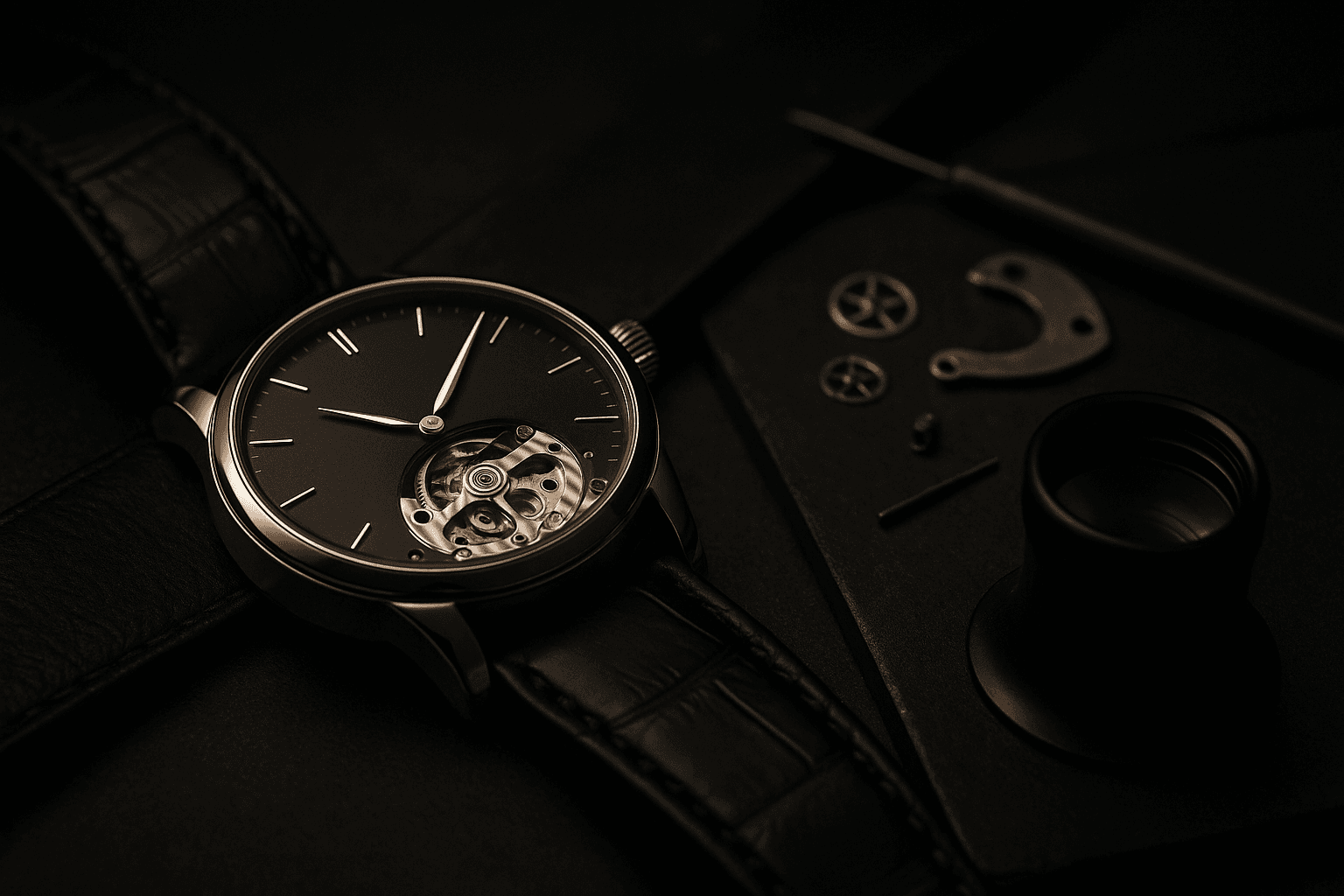
Glashütte Original: Collecting Saxony's Other Serious Manufacture
By The Subdial Editors ·
Glashütte is a town of about seven thousand people in the Ore Mountains of Saxony, and it has produced precision watches since Ferdinand Adolph Lange opened his workshop there in 1845. Few places on earth carry that much horological weight in that little square footage.
Most collectors who say "Glashütte" are thinking of one house, and it is not the one that employs the most watchmakers in the valley. Glashütte Original builds its own calibers, presses its own dials, and produces its own balance springs, all within a short walk of the neighbour that absorbs most of the attention.
That gap between capability and recognition is where the collector opportunity sits. What follows is a reference-level read on which Senator, Sixties, Pano and SeaQ variants hold their value, and which ones take the deepest discounts the moment they leave the boutique.
Glashütte Original is a vertically integrated Saxon manufacture that makes its own calibers, dials and balance springs. Clean pre-owned examples typically trade at an estimated 50–65% of retail.
The Manufacture Behind The Name
The modern company descends from GUB, the Glashütter Uhrenbetriebe, the state combine that East Germany assembled in 1951 out of the town's nationalized workshops. That lineage matters, because the tooling, the training, and the three-quarter-plate architecture never actually left Glashütte during the divided decades.
GUB was privatized in 1994 and acquired by the Swatch Group in 2000, which gave the manufacture something most independents never get, namely patient capital. Since then the house has added a dial manufactory in Pforzheim, acquired in the mid-2000s, which puts one of the most failure-prone components in watchmaking under its own roof.
Vertical integration is easy to claim and expensive to prove. Glashütte Original produces its own balance springs — a capability perhaps a dozen houses worldwide can honestly assert — and its Swatch Group parentage places Nivarox inside the same corporate walls as a backstop.
The visual grammar follows the Saxon tradition rather than the Swiss one. Expect three-quarter plates, Glashütte ribbing, blued screws, skeletonized 21k gold oscillating weights, and duplex swan-neck fine regulation on the higher calibers — the same vocabulary that runs through any serious discussion of movement hand-finishing.
The company descends from GUB, the East German state combine formed in 1951, was privatized in 1994, and has been owned by the Swatch Group since 2000. Its Pforzheim dial manufactory was added in the mid-2000s.
Why It Trades Below Its Saxon Neighbour
Be aware that the discount is real, and that its causes are commercial rather than technical. A. Lange & Söhne hand-engraves every balance cock, assembles twice, and prices accordingly, and the market has spent three decades learning to pay for that.
Three forces set the spread. Lange's distribution is tighter and its boutique network more controlled, Lange's finishing budget per watch is visibly higher, and Lange carries the founding name of the town, which is a marketing asset no amount of engineering closes.
Production estimates for both houses circulate widely and agree with each other rarely, so treat any specific annual figure quoted without a source as unreliable. What can be observed directly is listing behaviour, and pre-owned Glashütte Original inventory sits longer and clears lower than comparable Lange Saxonia Thin references.
For a buyer, the practical translation is straightforward. You are paying for the movement rather than for the auction narrative, which is a good trade if you intend to wear the watch and a mediocre one if you intend to flip it.
The gap comes from commercial factors. Lange controls distribution more tightly, spends more per watch on finishing, and carries the town's founding name — advantages that sit outside the caliber.
How To Read A Glashütte Original Reference Number
Glashütte Original references run as a string of two-digit blocks, and the block after the leading digit names the caliber family. A reference opening 1-39- carries a caliber 39 automatic, one opening 1-36- carries the long-reserve caliber 36, and one opening 1-90- carries a PanoMatic automatic.
This is the fastest specification check available to a buyer scanning listings. If a seller describes a Senator Excellence but the reference opens with a block that does not correspond to the 36 family, the listing is wrong about something, and you should establish what before you wire funds.
Keep in mind that the later blocks also encode case material, dial, and strap or bracelet, and that the manufacturer's own configurator is the authority on any given string. Confirm the full reference against the movement number and the warranty card rather than against the seller's prose.
Read the block after the leading digit: 1-39- indicates a caliber 39 automatic, 1-36- the 100-hour caliber 36, 1-90- a PanoMatic. Match that block against the model the seller claims.
Which Senator Variants Hold
The Senator line is the manufacture's dress register, and it splits cleanly by caliber. Caliber 36, introduced in 2015 for the Senator Excellence, runs a silicon balance spring, a stated 100-hour power reserve, and an in-house certification regime of twenty-four days across six positions.
Within that family, the Senator Excellence Panorama Date and the Panorama Date Moon Phase are the variants that hold. Steel cases at or near 40 mm with white lacquer or blue dials clear fastest on the secondary market, while 42 mm precious-metal examples take the deepest haircuts.
The Senator Chronometer sits above them, with a hand-engraved balance cock and certification to the German chronometer standard. It is the most collectible regular-production Senator, and it is also the one where you should insist on complete papers, because the certification is part of what you are buying.
The Senator Cosmopolite deserves separate mention for its world-time caliber, from the 89 family, which handles zones offset by half and quarter hours. Its market is thin, and that cuts both ways: patient buyers do well and impatient sellers do not.
All of these share the Panorama Date, the house signature, with two date discs sitting on a single plane and no dividing bar between the numerals. Once you have seen it next to a framed outsize date, the difference is difficult to unsee.
Caliber 36 powers the Senator Excellence with a silicon balance spring, a stated 100-hour reserve, and a 24-day, six-position in-house certification. Steel examples near 40 mm hold best.
Which Sixties Variants Hold
The Sixties is the entry point and, on the evidence of listing behaviour, the firmest holder in the catalogue. The standard version runs roughly 39 mm on caliber 39-52, with a domed dial under a domed sapphire that produces a warmth no flat dial reproduces.
The Sixties Panorama Date enlarges the case to about 42 mm and swaps in caliber 39-47 for the big date. It is the better-value proposition on paper and the weaker holder in practice, because the smaller version is what buyers actually queue for.
What's more, the Annual Edition releases, with their graduated degradé dials produced at the Pforzheim manufactory on historic tooling, behave like limited editions because they are. Certain colours have cleared close to retail on the secondary market while others sit, and the dial rather than the caliber sets that spread.
Steel over gold is the rule across the whole Sixties family. A gold Sixties is a lovely object and an expensive way to buy the same movement.
The Pano Family And The SeaQ
The Pano watches — PanoMaticLunar, PanoReserve, PanoInverse — use an off-centre dial architecture laid out on classical proportions, with small seconds, main dial, and Panorama Date arranged asymmetrically. They are the most distinctive thing the house makes and the least understood by the wider market.
The PanoMaticLunar on caliber 90-02 is, in our reading, the sleeper of the modern catalogue, offering a moon phase, a big date, and a manufacture automatic in a steel case at a level the equivalent Swiss complication does not approach. The PanoInverse, which flips the movement to display the duplex swan-neck regulation dial-side, is the connoisseur's pick and the harder resale.
The SeaQ, launched in 2019, draws on the Spezimatic Typ RP TS 200 that GUB built for East German divers in 1969. The standard SeaQ runs roughly 39.5 mm on caliber 39-11, while the SeaQ Panorama Date runs larger on caliber 36-13 with a higher depth rating, per the manufacturer's published specifications.
Bracelet examples carry a meaningful premium over rubber-strap examples, and the bracelet is difficult and expensive to source separately. If you are cross-shopping the category, our survey of collectible dive watches covers where the SeaQ sits against its Swiss competition.
The SeaQ debuted in 2019 on the 1969 Spezimatic Typ RP TS 200. The standard version runs about 39.5 mm on caliber 39-11, and bracelet examples resell well above rubber-strap ones.
What The Secondary Market Actually Looks Like
The bands below are editorial estimates drawn from observed listing behaviour rather than from transaction records, and they move with currency, condition, and time on market. Treat them as a starting frame and verify every figure against current Chrono24 listings and authorized-dealer pricing before you transact.
| Model | Caliber | Approx. retail (est.) | Pre-owned band (est.) | Editorial note |
|---|---|---|---|---|
| Sixties, ~39 mm steel | 39-52 | $8,000–$9,000 | 55–70% of retail | Highest liquidity in the range; the domed dial does the work |
| Sixties Annual Edition | 39-52 / 39-47 | $8,000–$10,000 | 60–80% of retail | Limited runs; dial colour sets the spread |
| Senator Excellence Panorama Date | 36-04 | $11,000–$13,000 | 45–60% of retail | Steel and white lacquer clear fastest |
| PanoMaticLunar, ~40 mm steel | 90-02 | $14,000–$16,000 | 50–65% of retail | The sleeper of the modern catalogue |
| SeaQ, ~39.5 mm steel | 39-11 | $9,000–$11,000 | 55–70% of retail | Bracelet carries a premium over rubber |
| Precious-metal Senator, 42 mm | varies | $25,000 and up | 35–50% of retail | Deepest discounts in the marque; buy pre-owned |
All of the above points the same direction, in that steel, smaller diameters, and complications that read as engineering hold their value while precious metal and large diameters do not. That pattern is consistent with what we see across the category in our work on watch ownership economics.
Every price band on this page is an editorial estimate rather than a quoted transaction. Verify against current Chrono24 listings, authorized-dealer pricing, and auction records before making an offer, and treat any unsourced production figure with suspicion.
What To Check Before You Buy
Start with the dial, because Glashütte Original dials are made in-house and a replaced dial is both detectable and value-destroying. Look for even lacquer, correct printing weight, and, on Panorama Date models, two discs sitting flush on the same plane with no step between them.
Next, confirm the date change, since the Panorama Date should switch both discs cleanly at midnight and a lazy or partial jump points to a mechanism that needs attention. Service through the Swatch Group network is available and competent, and it is also priced like Swatch Group service.
Then verify service history and papers. Full sets matter more here than in brands with deep dealer records, precisely because the market is thinner, and the same discipline we lay out in our guide to vintage watch authentication applies directly.
Finally, be aware of the distinction between modern Glashütte Original and GUB-era vintage. Spezimatic-era GUB pieces are historically interesting and mechanically modest, and they should be priced as vintage curiosities rather than as ancestors carrying modern-manufacture value.
Editorial Recommendation
For a collector entering the marque with a single purchase, our recommendations run by intent rather than by budget. Each entry names the specification we would actually pursue:
- First Glashütte Original. Sixties, roughly 39 mm, steel, caliber 39-52, standard domed dial. Highest liquidity in the catalogue and the easiest to sell if the marque does not stick.
- Best-value manufacture complication. PanoMaticLunar in steel on caliber 90-02, pre-owned, with box and papers. Moon phase, big date, and an in-house automatic at a level the Swiss equivalent does not reach.
- Dress-watch endgame. Senator Excellence Panorama Date Moon Phase, steel, near 40 mm, white lacquer, caliber 36. Buy the 100-hour reserve and the six-position certification, and skip the precious metal.
- Sports. SeaQ on caliber 39-11 at roughly 39.5 mm, on bracelet. Pay the bracelet premium up front rather than hunting one later.
- Collector's pick. Senator Chronometer with full papers, or a PanoInverse if you want the regulation on display. Both are harder resales and better watches to own.
Note that every one of these is a steel recommendation, and that is deliberate. In this marque, precious metal buys presence and costs residual, while the movement inside remains the same either way.
Where It Sits In A Collection
Glashütte Original rewards the buyer who reads specification sheets and discounts marquee names, which is a narrow but well-defined kind of collector. If you are weighing it against the broader field, our survey of Swiss watch marques and our study of Grand Seiko collecting map the two nearest comparisons, one on prestige and one on vertical integration.
Have you been circling a Senator or a Sixties without committing? Read the reference block, confirm the dial and the date jump, verify the current market against live listings, and buy the steel one.