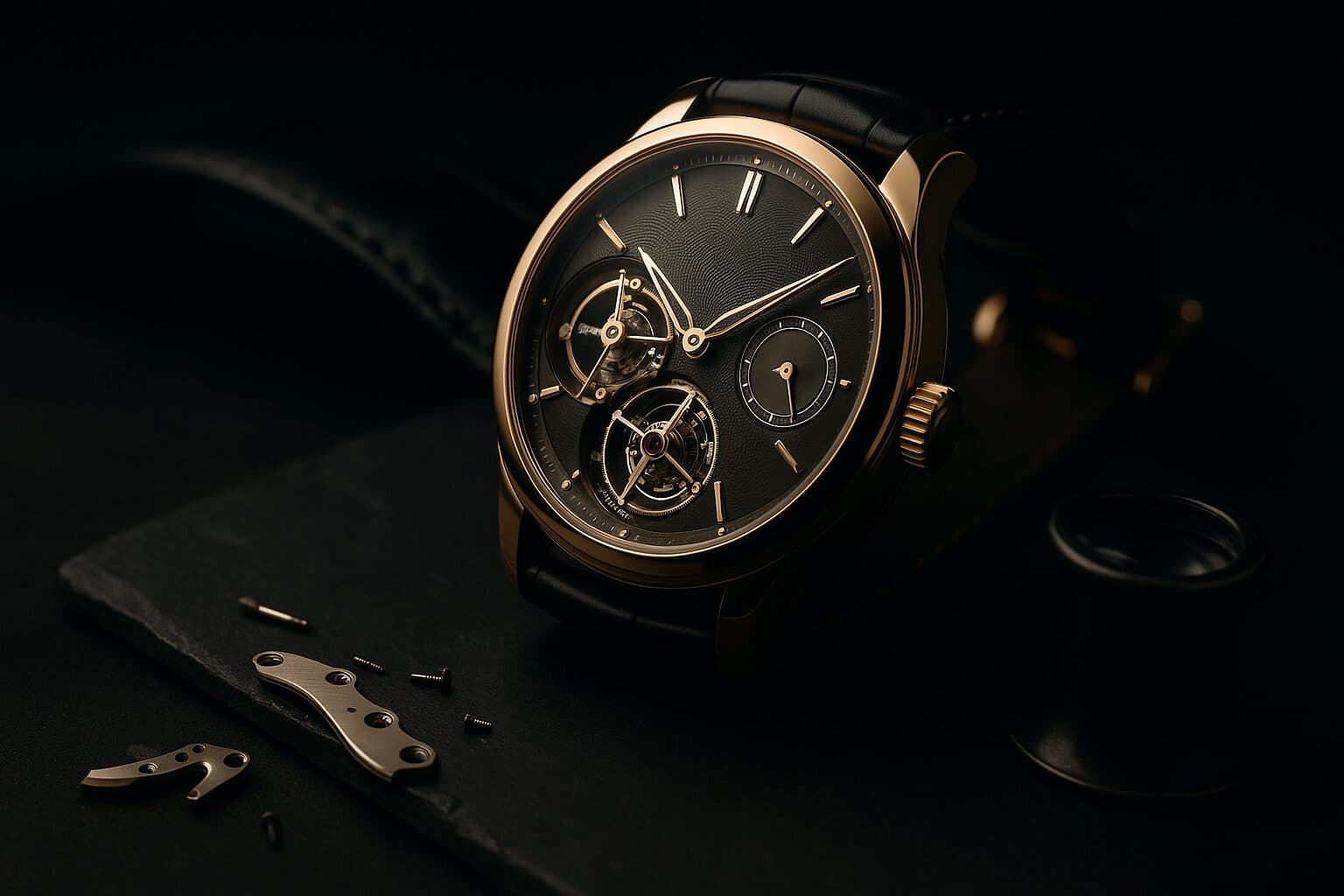
Modern watchmaking has spent two decades chasing one prize: an escapement that keeps better time in the positions a wrist actually occupies, not just the ones a timing machine prefers.
That said, few houses have pursued the problem as literally, or as expensively, as Greubel Forsey, the La Chaux-de-Fonds maison founded by Robert Greubel and Stephen Forsey to treat chronometric accuracy as an engineering thesis rather than a marketing line.
The result is a catalogue where six-figure retail is the entry point, not the ceiling. Understanding why starts with the tourbillon itself.
Greubel Forsey commands six-figure prices because it builds inclined multi-tourbillon movements with hundreds of hours of hand-finishing, in an estimated output of only the low hundreds of pieces per year. Low volume and high complexity compound.
What Makes Greubel Forsey's Watchmaking "Extreme"?
A conventional tourbillon rotates the escapement in a single plane parallel to the dial, which averages out gravity's effect when the watch stands vertical but does comparatively little when it lies flat.
Keep in mind that a watch spends much of its resting life dial-up or dial-down on a nightstand, precisely the orientations a flat tourbillon helps least.
Greubel Forsey's founding insight was to tilt the cage. Their Double Tourbillon 30° nests a fast inner cage, inclined at 30 degrees, inside a slower outer cage, so the balance is continuously carried through a wide spread of positions including the flat ones.
The Tourbillon 24 Secondes takes a different route to the same goal, spinning a single inclined cage once every 24 seconds so positional errors are averaged out quickly rather than over a leisurely minute.
What's more, the Quadruple Tourbillon links two complete double-tourbillon systems through a spherical differential, effectively running four cages at once.
Each of these is what the company calls a Fundamental Invention, and each adds parts, tightens tolerances, and demands hand-assembly that a flat one-axis tourbillon simply does not.
An inclined tourbillon tilts the rotating escapement cage — 30 degrees in the Double Tourbillon, 25 in the 24 Secondes — so it averages gravity across the flat resting positions a wrist watch actually spends most of its time in.
Why Does an Inclined Tourbillon Cost More to Build?
Inclining a cage is not a cosmetic change; it forces the entire gear train and poising process onto a harder geometry.
A tilted, fast-rotating cage must be balanced in three dimensions and driven through angled wheels, which raises the parts count and the assembly skill required at every step.
For example, a multi-tourbillon Greubel Forsey movement can carry several hundred components, many of them finished and adjusted by hand before final timing.
As a result, throughput collapses, because a workshop that could turn out volume with a simpler movement instead spends weeks of skilled labour on a single caliber.
Furthermore, the talent required is itself scarce, since the watchmakers capable of poising an inclined cage and finishing it to this standard cannot be trained or hired quickly.
This is the first half of the price story: the engineering itself is expensive before anyone has polished a single bridge.
The Hand-Finishing Premium
The second half is finish, and here Greubel Forsey sits at the far end of the craft spectrum even among high horology.
Their bridges carry hand-beveled edges with both inward and outward angles, frosted and circular-grained surfaces, and steel parts taken to a mirror "black polish" that reads as black at certain angles, all done by hand.
Indeed, the house pushed this idea to its logical extreme with the Hand Made 1, a watch in which the company says roughly 95% of components are produced in-house using traditional hand tools rather than modern automated machining.
Greubel Forsey has described that project as requiring thousands of hours of work per watch, which is reflected in a retail figure widely reported around the seven-figure mark; treat that as an estimate and confirm against current sources.
The Hand Made 1 is Greubel Forsey's statement piece: the company says about 95% of its parts are made by hand with traditional tools, taking thousands of hours per watch and priced, by widely reported figures, near seven figures.
Note that hand-finishing of this depth cannot be rushed or outsourced without losing the very quality being sold, so it acts as a hard ceiling on how many watches can ever leave the building.
How Small Is Greubel Forsey's Output?
Scarcity at Greubel Forsey is structural rather than manufactured, a by-product of the labour each watch demands.
Estimates of annual production commonly land in the low hundreds of pieces, with some figures cited closer to roughly one hundred per year; these are estimates and should be verified against authoritative sources before any transaction.
By comparison, a mainstream luxury brand can produce in a single day what Greubel Forsey makes in a year, which reframes what "limited" actually means here.
Of course, that tiny float is exactly what keeps the maison positioned alongside the rarest independents rather than the volume houses.
Estimates put Greubel Forsey's annual output in the low hundreds of pieces, with some figures near one hundred. These are estimates — verify against authoritative sources, since the brand does not publish exact volumes.
Is the Inclined Tourbillon Actually More Accurate?
The engineering only matters if it delivers, and this is where Greubel Forsey's thesis is meant to be tested rather than asserted.
By carrying the balance through inclined and constantly changing positions, the design aims to shrink the rate variation between flat and vertical orientations that limits conventional regulators.
In fact, the maison has built its identity on submitting its chronometry to scrutiny, and independent reviewers generally report strong positional rate stability from the inclined-cage calibers.
That said, accuracy in absolute terms is not the whole pitch; much of the value lives in the visible, three-dimensional choreography of the mechanism and the finishing that surrounds it.
The inclined tourbillon aims to reduce rate variation between flat and vertical positions, and reviewers generally report strong positional stability. Much of the value, though, is in the visible mechanism and finishing, not just timekeeping.
Why Six-Figure Pricing Is the Floor, Not the Ceiling
Put the two halves together and the math becomes legible.
Hundreds of hand-finished parts, three-dimensional tourbillon poising, and an output measured in the low hundreds of watches mean fixed costs and master-watchmaker hours are spread across very few units.
This is why entry-level references reportedly open in the mid-six figures while the most complicated multi-tourbillon and hand-made pieces climb well beyond, with flagship figures widely reported in the high six figures and above.
Treat every one of those numbers as an estimate and confirm current retail and secondary pricing against sources such as the manufacturer, Chrono24, and the major auction houses before transacting.
Where Greubel Forsey sits among its peers is worth mapping directly.
The maison occupies a different lane from the kinetic, sculptural school of MB&F's Horological Machines, the hand-finished classicism we covered in Voutilainen and Akrivia, and the brand-driven secondary strength documented in the F.P. Journe premium.
| Maison | Signature thesis | Reported secondary posture (verify current comps) |
|---|---|---|
| Greubel Forsey | Inclined multi-tourbillon chronometry | Has frequently been reported trading below original retail on the gray market |
| F.P. Journe | Resonance and inventive purism | Often reported at or above retail, especially early and steel pieces |
| MB&F | Kinetic, sculptural "machines" | Strong demand for hot references; varies sharply by model |
| Voutilainen / Akrivia | Hand-finished classicism | Thin float and long waitlists; comps scarce and model-specific |
How Does Tiny Output Shape the Secondary Market?
This is where Greubel Forsey turns counter-intuitive.
Despite the engineering pedigree, the brand has historically been one of the more surprising names on the resale market, with pieces frequently reported trading below their original retail on the gray market, an unusual posture for a sought-after independent.
However, that pattern is a market characteristic, not a law, and current spreads should be verified against live Chrono24 listings and recent auction records rather than assumed.
The drivers are structural, since extreme absolute prices compress demand to a narrow pool of collectors, mainstream brand recognition trails the crown names, and so few examples change hands that resale liquidity is genuinely thin.
Greubel Forsey has historically been reported to trade below original retail on the secondary market, unlike many independents. Extreme prices, a narrow buyer pool, and thin liquidity drive it — but verify current comps before assuming any spread.
Thin liquidity cuts both ways, though, and these are dynamics we explore more broadly in our look at vintage market dynamics.
With so small a float, a single motivated buyer can move the price of a specific reference, and the most iconic or unique pieces behave very differently from the broader catalogue.
Reading those spreads correctly is its own discipline, much as we laid out in auction estimate mechanics, where the gap between hammer, estimate, and retail tells the real story.
The lesson for a buyer is that a Greubel Forsey is best understood as a horological object first and a financial instrument a distant second.
Editorial recommendation. Buy a Greubel Forsey because you want to own a high point of mechanical finishing, not because you expect appreciation; the secondary discount that frustrates flippers is precisely what can reward an end-user collector.
For value, weight the established Tourbillon 24 Secondes and Double Tourbillon 30° families, and insist on full books, box, and service history with a pre-purchase inspection. Confirm all pricing against the manufacturer, Chrono24, and auction records before you transact.
Greubel Forsey is, in the end, a study in what happens when a workshop refuses to compromise on either engineering or hand-craft and lets the price fall where it may.
Frequently Asked Questions
What is an inclined tourbillon?
It is a tourbillon with a tilted rotating cage — 30 degrees in Greubel Forsey's Double Tourbillon and 25 in the 24 Secondes — so it averages gravity across the flat positions a wrist watch rests in most.
How many watches does Greubel Forsey make per year?
Estimates put annual output in the low hundreds of pieces, with some figures near one hundred. The brand does not publish exact volumes, so verify against authoritative sources before transacting.
Do Greubel Forsey watches hold value on the secondary market?
Historically they have often been reported trading below original retail, unusual for a sought-after independent. Extreme prices, a narrow buyer pool, and thin liquidity drive it; verify current comps.
What is the Greubel Forsey Hand Made 1?
A statement watch in which the company says roughly 95% of parts are made by hand with traditional tools. It reportedly takes thousands of hours per piece and is widely reported priced near seven figures.
How does Greubel Forsey compare to F.P. Journe or MB&F?
Greubel Forsey focuses on inclined-tourbillon chronometry and extreme finishing, MB&F on kinetic sculpture, and Journe on inventive purism. Journe more often trades at or above retail; verify all current comps.