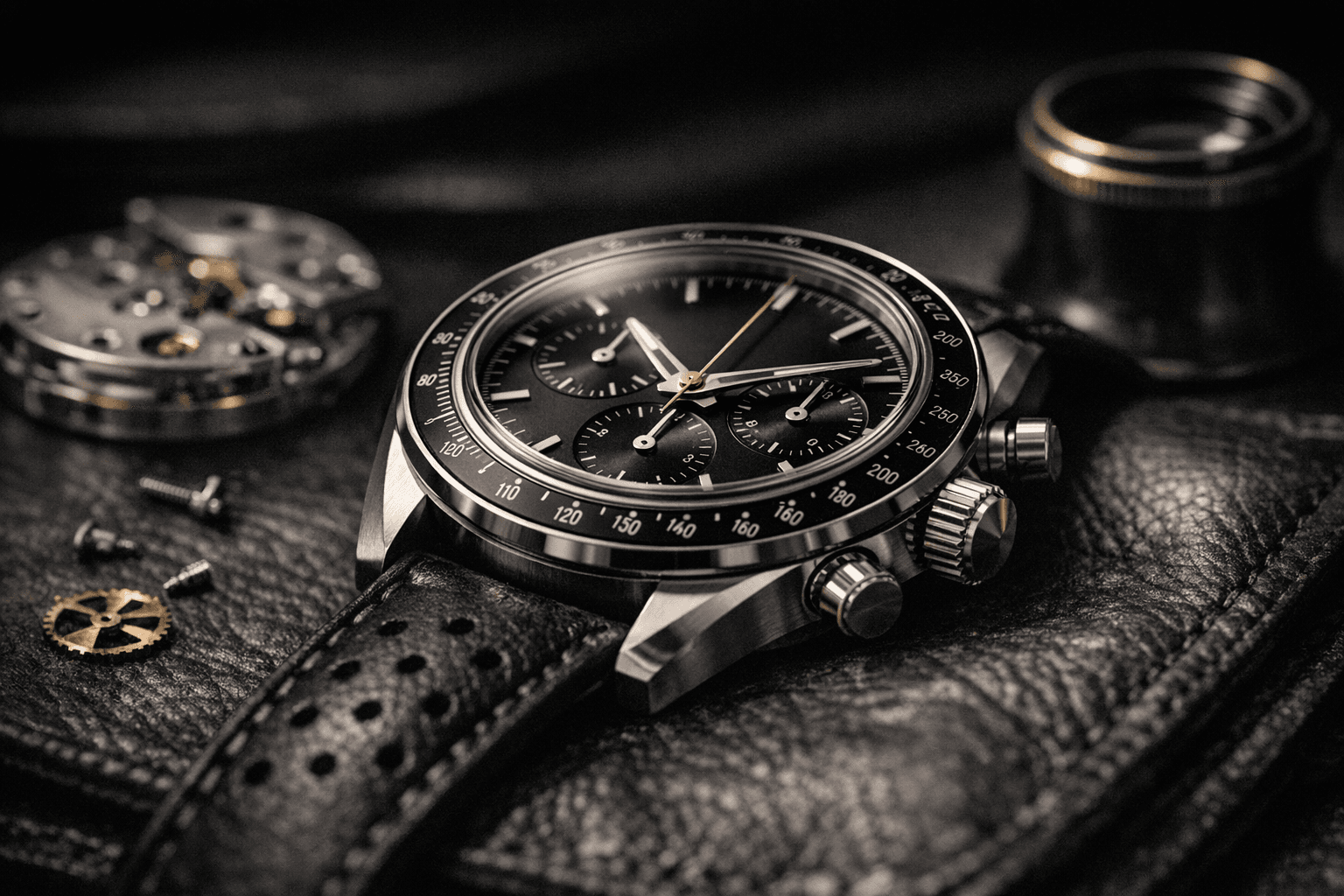
Best Chronographs Under US$1,000: Mechanical and Meca-Quartz References Worth Owning
By The Subdial Editors ·
The best chronographs under US$1,000 in November 2026 split into two honest camps: hand-wound mechanical references built on Sea-Gull calibers, and meca-quartz references built on the Seiko Instruments VK64 hybrid. Every price below names its source in the same line — verify it at checkout, because microbrand pricing moves with each production run.
| Reference | Movement | Price and source | Buy it for |
|---|---|---|---|
| Sea-Gull 1963 (42mm, sapphire) | Sea-Gull ST19, hand-wound, column wheel | US$325, Long Island Watch list price, November 2026 | The entry ticket to a true mechanical chronograph |
| Sea-Gull 1963 Times 60th Anniversary Reissue | Sea-Gull ST19, hand-wound | US$789 sale / US$989 regular, Sea-Gull official store, November 2026 | Factory-direct provenance on the original design |
| Baltic Bicompax 003 | Sea-Gull ST1901, hand-wound | €540 at introduction, per Fratello | Smaller case, French-design restraint |
| Studio Underd0g 01SERIES (third generation) | Sea-Gull ST1901, hand-wound | US$675 at launch, per Worn & Wound | Colour-led dials on a serious caliber |
| Furlan Marri permanent chronograph trio | Seiko VK64 meca-quartz | US$550 at introduction, per Worn & Wound | Geneva-designed dial work at a meca-quartz price |
| Dan Henry 1962 Racing Chronograph | Seiko VK64 meca-quartz | US$260 at launch, per Gear Patrol | The lowest-cost route to a convincing vintage racing look |
The best mechanical chronograph under US$1,000 is the Sea-Gull 1963, listed at US$325 by Long Island Watch in November 2026. Its hand-wound ST19 column-wheel caliber is the movement the rest of this tier is measured against.
For the full spread of watches at this ceiling — divers, field watches, and dress pieces alongside chronographs — the best watches under US$1,000 tier page collects every category in one place. The wider watch buying guide by budget walks the same logic up through each price tier.
How We Chose These Chronographs
Every reference here passes three tests: a named, documented movement, a price that a buyer can confirm against a primary listing or published launch coverage, and a design that holds its own without leaning on a borrowed logo. We also excluded anything that only clears US$1,000 through a temporary discount, because a sale price is not a ceiling.
Keep in mind that this guide deliberately sits below our chronographs under US$5,000 guide, which covers the Swiss automatic and in-house references this tier cannot reach. That said, the gap between the two tiers is smaller in wearing terms than the price difference suggests.
Meca-quartz is a hybrid movement: a quartz oscillator keeps the time, while a mechanical module runs the chronograph. The pushers click like a mechanical chronograph and the hands snap back to zero, at quartz cost and accuracy.
The Mechanical References
A hand-wound mechanical chronograph under US$1,000 almost always means a Sea-Gull movement from Tianjin. This is a strength rather than a compromise, provided you know which caliber you are buying and who will service it.
Sea-Gull 1963
The 1963 descends from a chronograph Tianjin produced for the Chinese air force, and its ST19 caliber traces its architecture to the Swiss Venus 175, whose tooling Sea-Gull acquired in the 1960s. What you get on the wrist is a column-wheel, hand-wound chronograph with a 30-minute counter — the same architecture that powers far more expensive pieces.
The 42mm sapphire-crystal version is listed at US$325 by Long Island Watch as of November 2026, which makes it the lowest-cost genuine mechanical chronograph in this guide. Sea-Gull's own official store lists the Times 60th Anniversary Reissue Edition at US$789 on sale against a US$989 regular price in November 2026, and that factory-direct route is the one to take if box, papers, and a clean provenance chain matter to you.
Be aware that the 1963 has been reproduced by many sellers of varying quality, and Sea-Gull's official listings themselves show inconsistent sale and regular prices across category pages. Buy from Sea-Gull directly or from an established dealer, and treat any listing without a clear caliber reference with caution.
Baltic Bicompax 003
Baltic, the Paris-based brand, built its chronograph reputation on the Bicompax, and the 003 is the smaller, bolder third iteration. It uses the hand-wound Sea-Gull ST1901, a column-wheel caliber that reviewers describe as a modern rendition of the Venus 175 lineage.
Fratello reported the Bicompax 003 at €540 at its introduction, which converts comfortably below the US$1,000 ceiling even after shipping and duties. What's more, the 003's reduced case size suits wrists that find most vintage-inspired chronographs oversized — readers in that position will also want our small-wrist watches under US$1,000 guide.
Note that the original Bicompax 001 is discontinued and now trades secondhand, with forum asking prices for black gilt-dial examples between US$400 and US$499 per WatchPatrol listings. Those are asking prices rather than recorded sales, so use them as a ceiling for negotiation, not a valuation.
Studio Underd0g 01SERIES
Studio Underd0g is the London microbrand that made the ST1901 fashionable, pairing it with dials named for desserts and fruit. Worn & Wound reported the third-generation 01SERIES at US$675 on pre-order through the brand's website.
The playful dials sit on a serious movement, and the brand's contract with Sea-Gull for ST1901 supply was significant enough that Monochrome covered Sea-Gull's minimum-order policy in the context of that deal. Accordingly, the 01SERIES is a mechanical chronograph with genuine collector traction rather than a novelty.
Remember that popular colourways have traded above retail on the secondary market — one eBay listing for a Watermelon pink-dial example asked US$1,195. If the reference you want has sold out, waiting for the next production run is usually the better value than paying a premium for a microbrand watch.
The Sea-Gull ST1901 is a hand-wound, column-wheel chronograph caliber from Tianjin. Baltic, Studio Underd0g, and others use it because it delivers classic chronograph architecture at a price no Swiss caliber can match.
The Meca-Quartz References
The Seiko Instruments VK64 is the engine of the meca-quartz category, and it explains why so many design-led microbrands have built chronographs on it. A quartz oscillator handles timekeeping, while a mechanical chronograph module gives the pushers a tactile click and the hands an instant snap-back reset.
The practical benefits are real: no winding, quartz accuracy, a thinner case than most mechanical chronographs allow, and a battery change rather than a full service when the time comes. Of course, the trade-off is that you are not buying a mechanical movement, and collectors who value the sweep of a balance wheel should stay in the section above.
Furlan Marri Chronograph
Furlan Marri, the Geneva brand founded by Andrea Furlan and Hamad Marri, launched on Kickstarter with a VK64 chronograph whose sector dials and stepped details read like a 1940s Swiss reference. Worn & Wound reported the brand's permanent-collection chronograph trio at US$550, and Oracle of Time listed the same trio at CHF 555.
The Mr. Grey, reference 1041-A, is listed by the GPHG at CHF 495 including VAT, which gives a useful anchor for the brand's core pricing. In addition, the dial finishing is what you pay for here — Oracle of Time placed the trio at the top end of meca-quartz pricing while judging the dial and case work to justify it.
Keep in mind that limited editions such as the Meteorite Octa sit higher, at CHF 720 per Oracle of Time. Early discontinued references have also traded well above their launch prices, which Time+Tide noted can exceed £1,500 for the original chronographs.
Dan Henry 1962 Racing Chronograph
Dan Henry is a collector-founded brand whose references reinterpret pieces from the founder's own vintage collection. The 1962 Racing Chronograph launched at US$260 sold direct, per Gear Patrol, with Time+Tide citing US$270 — a difference that likely reflects configuration or timing.
It is the lowest-cost reference in this guide, and the panda-dial racing aesthetic is executed with more care than the price suggests. For instance, used examples have been listed between roughly US$210 and US$299 on WatchPatrol and eBay, which means the 1962 holds its value well relative to its retail price.
Choose mechanical if you value a hand-wound caliber and the ritual of winding. Choose meca-quartz if you want quartz accuracy, a thinner case, and a crisp chronograph feel without the service cost of a mechanical movement.
One Solar Alternative Worth Naming
The Seiko Prospex Speedtimer SSC813 falls outside the mechanical and meca-quartz brief, because it runs on a solar quartz chronograph caliber. That said, it carries a US$675 MSRP per US authorized dealers including NY Watch Store and Belmont Watches, and it gives you the Seiko 1969 chronograph lineage with no battery changes at all.
If Japanese design is the priority rather than the movement type, our Japanese watches under US$1,000 guide covers the wider Seiko, Citizen, and Orient lineup at this price.
What Sits Just Above The Ceiling
The Baltic Tricompax is the reference most buyers at this tier eventually look at, and it is worth knowing why it is excluded. Its launch price was €1,585 on leather and €1,645 on bracelet, per Time+Tide, which puts it clearly over US$1,000.
What the extra money buys is the Sellita SW510-M, a hand-wound Swiss caliber derived from the Valjoux 7750 family with a 63-hour power reserve, per Time+Tide. This is the first step into Swiss chronograph architecture, and it is covered alongside the Omega and Zenith references in our guide to chronographs under US$5,000.
For context on where that ladder eventually leads, our profiles of the Omega Speedmaster and the Zenith El Primero explain the two chronograph lineages that most of the references in this guide quietly reference.
Servicing And Ownership At This Price
A hand-wound Sea-Gull chronograph needs periodic service like any mechanical movement, and the cost of that service can approach a meaningful share of the watch's purchase price. Before you buy, confirm whether the brand services its own watches or can refer you to a watchmaker familiar with the ST19 or ST1901.
Parts availability is the other variable, particularly for microbrands whose production runs are finite. Our piece on watch parts access explains why this matters more than most buyers expect, and why a brand with a stated service policy deserves a small premium.
A hand-wound chronograph under US$1,000 should be serviced like any mechanical watch. Ask the brand who services its caliber before you buy, because finding a watchmaker for a microbrand movement can take time.
Meca-quartz ownership is simpler: a battery change every few years and occasional gasket replacement if you rely on water resistance. Furthermore, because the VK64 is widely used, a competent independent watchmaker can usually source the movement itself if a replacement is ever needed.
Editorial Recommendation
Our recommendations at this tier are structurally consistent with how we approach every price point: name the movement first, then the design, then the price. Here is how we would spend US$1,000 on a chronograph:
- For a first mechanical chronograph. The Sea-Gull 1963 from an established dealer at US$325 per Long Island Watch, or factory-direct from Sea-Gull's official store if provenance matters.
- For a smaller wrist. The Baltic Bicompax 003, reported at €540 by Fratello, on its hand-wound ST1901.
- For colour with substance. A Studio Underd0g 01SERIES at its US$675 launch price per Worn & Wound, bought at retail rather than on the secondary market.
- For dial finishing above its price. A Furlan Marri from the permanent trio, US$550 per Worn & Wound.
- For the lowest cost of entry. The Dan Henry 1962 Racing Chronograph, launched at US$260 per Gear Patrol.
All of these share one trait: they deliver a recognisable chronograph silhouette with a documented movement and nothing pretended. Overall, the US$1,000 chronograph is a mature category, and a careful buyer can own a genuinely good one without stretching to the next tier.
Prices at this tier change with every production run and exchange-rate move. Treat each figure above as a dated reference point, confirm the current price with the manufacturer or an authorized dealer before purchase, and browse our full tracked catalogue in The Index.