Zenith and the El Primero: Collecting the High-Frequency Chronograph and Its A386 Lineage
By The Subdial Editors ·
Three self-winding chronograph movements reached the market in 1969, and only one of them ran at 36,000 vibrations per hour. Zenith announced the El Primero on January 10, 1969 — the name is Spanish for "the first" — and the caliber has outlasted both of its rivals from that year, albeit with an interruption in the 1970s that nearly ended it permanently.
That history carries an unusual commercial consequence. The most consequential automatic chronograph of the twentieth century still changes hands well below the vintage Rolex and Patek Philippe chronographs it outranks on horological significance alone.
Why does the El Primero matter to collectors? The El Primero was the first integrated automatic chronograph to run at 36,000 vph, giving it tenth-of-a-second resolution, and Rolex later built the Daytona's caliber 4030 on that base.
What Made The El Primero Different In 1969
The 1969 race produced three different engineering answers to the same problem: Zenith's caliber 3019 PHC was a fully integrated chronograph with a column wheel, horizontal clutch and central rotor, the Chronomatic consortium's Caliber 11 stacked a Dubois Dépraz chronograph module onto a micro-rotor base, and Seiko's 6139 took a third route with a vertical clutch. Only Zenith's approach put the chronograph and the automatic winding into a single, purpose-built architecture.
The frequency is the part that still matters commercially. At 36,000 vph — 5 Hz — the balance completes ten beats per second, which is what allows the chronograph to resolve a tenth of a second rather than the fifth of a second a 2.5 Hz movement manages.
Zenith also gave the caliber a date aperture at 4:30 and roughly 50 hours of running autonomy, which made it a usable daily chronograph rather than a technical showpiece. Keep in mind that a high-frequency escapement asks more of its lubrication and wear surfaces, and service intervals on vintage examples reflect that.
The 1969 Reference Set: A384, A385 And A386
Three first-series references define the vintage market, and they are not interchangeable in either design or value. Collectors treat them as three separate propositions rather than variants of one watch.
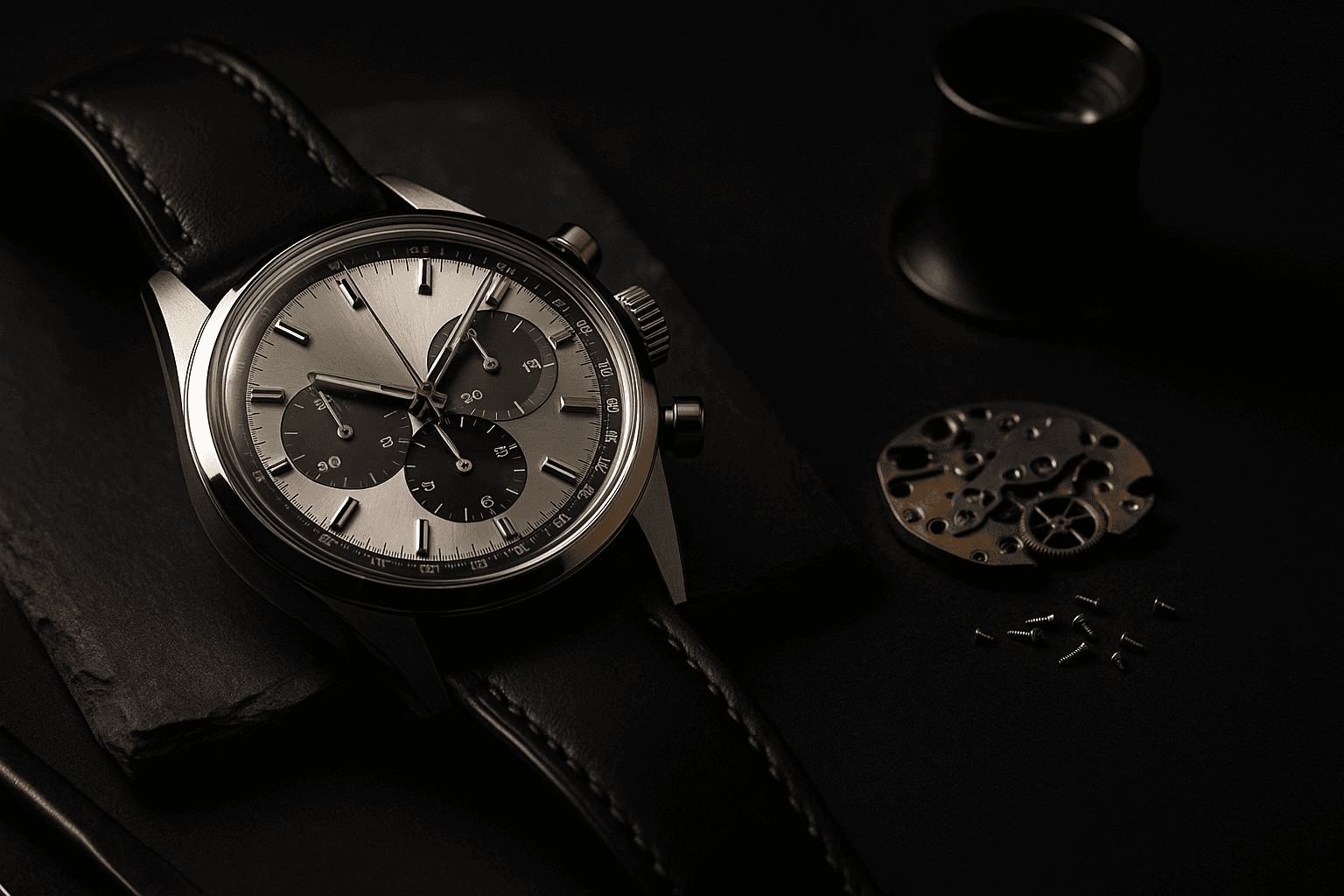
- A386. The round 38mm case with faceted lugs and three overlapping registers in light grey, anthracite and blue. This is the design benchmark of the line, the reference Zenith returns to for its Revival and Chronomaster Original dials, and consistently the most sought-after of the first-series steel watches.
- A384. The tonneau, or cushion, case of roughly 37mm with a white dial, black registers and a tachymeter scale on the dial flange. Its geometry reads as more overtly of its period than the A386, which is precisely why a certain buyer prefers it.
- A385. The A384 case carrying a smoked brown gradient dial, among the earliest fumé dials fitted to a production chronograph. Condition sensitivity is highest here, because gradient dials show restoration and moisture damage far more plainly than flat ones.
Beyond that trio sits a longer tail of Defy-cased and Movado-signed watches from the caliber's first period, including the blue-dialed A3818 that collectors call the "Cover Girl." All of these are thinner-market references, which cuts both ways — less competition when you buy, longer time-on-market when you sell.
Which 1969 El Primero reference should a first-time buyer target? The A386 in steel is the safest entry. It is the design benchmark, the most liquid of the first-series references, and the easiest to authenticate against published examples.
The Attic In Le Locle And Why The Caliber Survived
In 1975, Zenith's American parent ordered the mechanical movement tooling scrapped so the Le Locle factory could pivot to quartz. Charles Vermot, a watchmaker at the works, catalogued the presses, cams, cutters and plans for the El Primero and walled them into an attic room rather than watch them destroyed.
That single decision is the reason the caliber has a second act at all. When demand for mechanical chronographs returned in the 1980s, Zenith recovered the tooling and restarted production instead of re-engineering the movement from nothing.
Ebel became an early external customer, fitting the caliber to its 1911 chronograph. Rolex followed with the far more consequential order.
Why was the El Primero tooling hidden? Zenith's American owner ordered the mechanical tooling destroyed in 1975 in favor of quartz. Watchmaker Charles Vermot hid the presses and plans, which enabled the 1980s restart.
How The Rolex Connection Shapes Value
From 1988 until roughly the turn of the century, the Rolex Daytona reference 16520 ran caliber 4030 — an El Primero base reworked to Rolex's requirements. Rolex dropped the frequency to 28,800 vph, removed the date and substituted its own escapement and free-sprung balance, but the architecture underneath came from Le Locle.
The market prices those two watches on brand rather than on architecture. Both trade in five figures, and while condition and provenance move individual results substantially, the Rolex carries the deeper bid pool — treat any specific figure as an estimate and check it against Chrono24 sold records and published Phillips, Christie's and Sotheby's results before transacting.
Accordingly, the El Primero occupies a narrow and interesting niche: significance without the brand tax. That is the whole argument for buying one, and it is also why it pays to be realistic about how vintage chronograph values actually move across a holding period.
The Modern Lineage: Caliber 400 To Caliber 3600
Zenith joined LVMH in 1999, and the El Primero has since been developed into two distinct modern families. Which caliber sits inside a modern Chronomaster matters more than the case diameter or the dial color.
- El Primero 400 series. The direct descendant of the 3019 PHC, running at 36,000 vph with a 60-second chronograph hand and roughly 50 hours of reserve. Tenths are read from a printed dial scale rather than displayed directly.
- El Primero 3600. Introduced at the end of the 2010s, it holds 5 Hz but sweeps the chronograph hand once every 10 seconds for a direct tenth-second read, with a power reserve in the region of 60 hours.
- Defy 21 and Defy Extreme. A separate architecture with two escapements — one for timekeeping and one running far faster for the chronograph — measuring a hundredth of a second. Treat these as a different collecting proposition rather than an El Primero variant.
On the case side, the Chronomaster Original returned to 38mm with the A386 tri-color register layout, a plain bezel and the 3600 caliber, while the Chronomaster Sport put the same movement into a 41mm case with a ceramic bezel graduated to a tenth. The A384, A385 and A386 Revival pieces, built from scanned original plans, sit alongside them as faithful reissues rather than reinterpretations.
How do the Chronomaster Original and Chronomaster Sport differ? Both use caliber 3600. The Original is a 38mm A386 homage with a plain bezel; the Sport is 41mm with a ceramic tenth-second bezel. Confirm current MSRP with Zenith.
What Drives Price Variation Across El Primero References
Price on a vintage El Primero turns on four variables that a listing photograph rarely settles: dial originality, register color integrity, case sharpness, and whether the chronograph functions to specification. The table below maps where each part of the lineage sits and what to interrogate.
| Reference / Family | Era | Caliber | Signature | Primary Value Driver |
|---|---|---|---|---|
| A386 | 1969 to early 1970s | 3019 PHC | 38mm round, tri-color overlapping registers | Unrestored register hues; intact case facets |
| A384 | 1969 to early 1970s | 3019 PHC | 37mm tonneau, white dial, flange tachymeter | Original dial printing; sharp case flanks |
| A385 | 1969 to early 1970s | 3019 PHC | Tonneau case, smoked gradient dial | Gradient integrity; no moisture bloom |
| Rolex Daytona 16520 | 1988 to c. 2000 | Rolex 4030, El Primero base | 40mm acrylic-era Daytona | Brand liquidity; dial series and patina |
| 1990s Zenith chronographs | 1990s | 400 series | Rainbow Flyback, De Luca and Class families | Condition and completeness over rarity |
| Chronomaster Original / Sport | 2021 to present | 3600 | 38mm A386 homage / 41mm ceramic bezel | Retail-versus-secondary delta |
Broad market observation, offered as estimates rather than quotations: honest first-series steel references have traded from the mid-five figures downward depending on reference and condition, gold cases command a premium over steel, and 1990s El Primero chronographs remain a low-four-figure route into the caliber. Verify every one of those bands against Chrono24 sold listings and the published results of Phillips, Christie's and Sotheby's, and remember that auction estimates are set with their own internal logic rather than as neutral appraisals.
Is a 1990s El Primero a sensible entry point? Yes. The 1990s 400-series chronographs deliver the same 36,000 vph architecture at low four figures, and both parts availability and service support are far easier than on 1969 references.
Authenticity, Service And What A Pre-Purchase Inspection Must Cover
The El Primero is a serviceable movement with factory support, which removes the single largest risk that haunts most fifty-year-old chronographs. What remains is cosmetic and documentary, and that is where the money is actually lost.
A competent pre-purchase inspection on a first-series reference should settle each of the following, and a seller who resists any of it is telling you something useful:
- Caliber and reference agreement. The movement should be a 3019 PHC in a first-series case, with the date aperture at 4:30 and the case reference consistent with the dial layout. Mismatches between Defy-cased and round-cased parts turn up regularly in rebuilt examples.
- Dial and register originality. On the A386, the three registers should read as three distinct, evenly aged tones; patchy or uniformly fresh color suggests a redial. Service dials are legitimate, but they should be priced as service dials.
- Chronograph function. Start, stop and reset should feel crisp, and all three hands should snap back to zero without hesitation. Sticky pushers are a service item, whereas a chronograph that will not zero is the beginning of a parts hunt.
- Case geometry. The faceted lugs and the transitions between polished and brushed surfaces are the first casualties of overpolishing, and they cannot be recovered. Compare against documented original examples rather than against other live listings.
- Books, tools and service history. Documentation moves price at the margin on vintage Zenith more than it does on Rolex, simply because it is scarcer. A file of Zenith service invoices is worth real money at resale.
Of course, none of that removes the running cost of a high-frequency vintage chronograph. Budget for a service cycle in the four figures and treat the ownership economics of the watch as part of the purchase price rather than as a later surprise.
Can a 1969 El Primero still be serviced? Yes. Zenith retained the original tooling and continues to support the caliber, though period-correct dials, hands and pushers are the genuine scarcity rather than mechanical parts.
Where The El Primero Sits Against Other Chronograph Icons
The comparison collectors reach for first is the Speedmaster, and it is instructive precisely because the two watches earned their standing by different routes. The Speedmaster's collector market rests on mission provenance and an enormous, well-documented owner base, while the El Primero's rests on having solved the automatic chronograph problem first and at the highest specification.
In fact, the El Primero's closest analogue in market behavior is not another chronograph but the under-bid high-horology names that trade below their engineering merit. What's more, the pattern that governs those names — thin bid pools, wide spreads, long time-on-market and sharp rewards for buying the best example rather than the cheapest — governs the El Primero in the same way, which is worth reading alongside our work on long-term value retention across the luxury watch market.
Be aware that thin markets punish impatience in both directions. Overpaying for a mediocre A386 is recoverable across a long hold, while selling a good one into a quiet quarter is not.
Editorial Recommendation
Our position on the El Primero has been consistent: buy for the movement's history and the dial's originality, not for the case diameter or the anniversary packaging. Specifically:
- Best overall vintage buy. A386 in steel, unpolished case, original tri-color registers with even aging, running a correct 3019 PHC, with a documented service inside the last five years.
- Best value within the first series. A384 in steel with original dial printing and sharp tonneau flanks — the same caliber and year as the A386 at a lower entry, in a case that flatters the wrist rather than the photograph.
- Best low-cost route to the caliber. A 1990s 400-series chronograph, complete with box and papers, bought as a wearing watch rather than as an appreciation play.
- Best modern buy. Chronomaster Original at 38mm with caliber 3600, acquired on the secondary market where the retail-to-secondary delta favors the buyer.
- Skip. Redialed first-series examples, over-polished cases at any asking price, and gold cases bought on metal content rather than on condition.
Overall, the El Primero rewards a particular temperament — the buyer who prices horological significance above brand liquidity and is prepared to hold through quiet markets. Note that this is close to the opposite of the temperament that succeeds in the dysfunctional Rolex retail market.
Frequently Asked Questions
Which El Primero reference is the A386?
The A386 is the 1969 round 38mm El Primero with three overlapping registers in grey, anthracite and blue. It is the design benchmark of the line and the most sought-after of the first-series steel references.
Did Rolex use the Zenith El Primero movement?
Yes. Rolex based caliber 4030, used in the Daytona 16520 from 1988 to around 2000, on the El Primero, retiming it to 28,800 vph, removing the date and fitting its own escapement and free-sprung balance.
How much does a vintage El Primero A386 cost?
Honest steel A386 examples have generally traded in the five figures, with gold cases and concours-grade pieces above that. Treat any figure as an estimate and verify against Chrono24 sold data and published Phillips results.
What is the difference between caliber 400 and caliber 3600?
Both run at 5 Hz. Caliber 400 reads tenths from a printed dial scale with a 60-second chronograph hand, while caliber 3600 sweeps that hand once every 10 seconds for a direct tenth-second display and adds roughly 60 hours of reserve.
Can a 1969 El Primero still be serviced today?
Yes. Zenith kept the original tooling that Charles Vermot hid in 1975 and still supports the caliber, though period-correct dials, hands and pushers are the real scarcity rather than mechanical parts.
What should a pre-purchase inspection cover on a vintage El Primero?
Confirm the caliber matches the reference, that the registers show even unrestored color, and that all three chronograph hands snap back to zero. Redialed dials and over-polished cases are the most common value traps.
Zenith's caliber remains the most historically defensible chronograph purchase available at five-figure money, provided you buy condition first and story second. For more on how these markets price condition, provenance and patience, read our coverage of the Swiss watch marques and our reference work on vintage pricing.