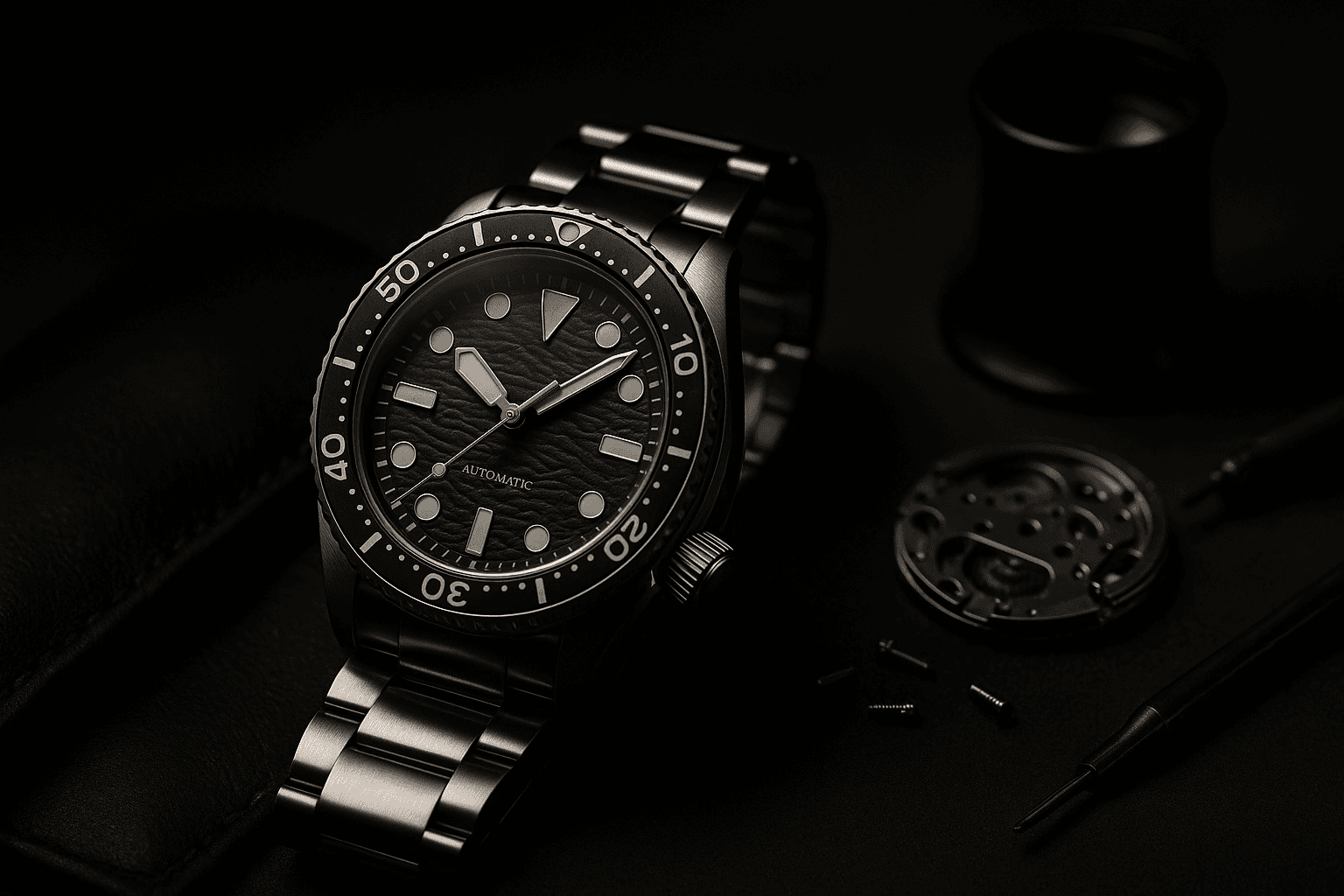
Best Automatic Dive Watches Under US$1,000: ISO 6425 Specs at the Entry Tier
By The Subdial Editors ·
The strongest automatic ISO dive watches under US$1,000 are the Seiko Prospex SRPE93 at $525 (Seiko USA MSRP), the Citizen Promaster NY0159-57E at $625 (Citizen MSRP), and the Certina DS Action Diver at CHF 895 (Certina list).
The Shortlist: Five ISO Divers Under US$1,000
Every reference below is automatic, rated to at least 200 meters, and declared compliant with the ISO 6425 diver's-watch standard by its manufacturer. Each price appears with its source and, where it comes from the secondary market, the month we checked it.
| Reference | Price and source | Movement | Rating | Crystal | Case |
|---|---|---|---|---|---|
| Seiko Prospex “Turtle” SRPE93 | $525, Seiko USA MSRP | 4R36 automatic, approx. 41-hour reserve | 200m, ISO diving standard per Seiko | Hardlex | 45mm |
| Citizen Promaster Dive Automatic NY0159-57E | $625, Citizen USA MSRP | Caliber 8204 automatic | 200m, ISO compliant per Citizen | Sapphire | 44mm |
| Seiko Prospex “King Turtle” SRPE03 | $650, regular price at Arizona Fine Time (September 2026) | 4R36 automatic | 200m, Diver's 200m dial | Sapphire | 45mm |
| Certina DS Action Diver 43mm Powermatic 80 | CHF 895, Certina list price; $860 new on Chrono24 (September 2026) | Powermatic 80.611, 80-hour reserve | 300m, ISO 6425:2018 per Certina | Sapphire | 43mm |
| Citizen Promaster Automatic Diver NY0040-09E | $198 market price, WatchCharts (September 2026) | Miyota 8200-family automatic | 200m, ISO 6425 | Mineral | 41.5mm |
For the wider field across every watch category at this ceiling, our best watches under $1,000 tier page covers dress, field and GMT references as well. The full budget hub for watch buying maps every price tier from entry level to haute horlogerie.
Two References That Sit Just Outside the List
Two watches come up often in this conversation, and both earn a note on why they are not in the table above. The reasons are specific, and neither is a judgment on the watch itself.
- Tissot Seastar 1000 40mm (T120.807.11.051.00). Tissot lists this Powermatic 80 diver at $875 on its US site, rated to 300 meters with a sapphire crystal and a Nivachron balance spring. However, its US specification page does not cite ISO 6425, so it falls outside an ISO-first shortlist.
- Citizen Promaster Fujitsubo NB6021-68L. Citizen lists this Super Titanium diver at $1,075 on its US site, with the in-house caliber 9051 and a 42-hour power reserve. It is ISO compliant per Citizen, but at that list price it sits above the ceiling this guide observes.
Both remain credible watches for a buyer who does not need the ISO marking or can stretch past the tier. Keep in mind that a dealer discount on the Fujitsubo may bring it under $1,000, though that is a negotiation rather than a list price.
What Does ISO 6425 Actually Require?
ISO 6425 is the international standard that separates a diver's watch from a watch that merely tolerates water. It was first published in 1982, and the current edition is the 2018 revision that Certina cites on its DS Action Diver.
ISO 6425 is the international standard for diver's watches. It requires tested water resistance, a time-preset bezel, legibility in darkness, magnetic and shock resistance, and a dial marked with the rated depth.
The core requirements, as the standard sets them out, include but are not limited to:
- Water resistance with margin. Watches are pressure-tested beyond their marked rating, at 125% of the stated depth. A 200-meter diver is therefore tested to the equivalent of 250 meters.
- A time-preset device. In practice this is a unidirectional bezel with minute markings, built so an accidental knock can only shorten the recorded dive time and never extend it.
- Legibility in darkness. The time, the preset elapsed time, and a signal that the watch is running must all be readable at 25 centimeters in total darkness.
- Magnetic and shock resistance. The watch must keep running after exposure to defined magnetic fields and after a specified shock test.
- Strap and fitting strength. The strap and its attachments must survive a pull test, because a diver's watch lost at depth is a timing device lost at depth.
Additionally, the standard calls for testing some properties on every individual watch rather than on a sample batch — water resistance and the condensation test among them. That per-piece discipline is part of why an ISO marking carries real weight at any price.
Note that ISO publishes the standard but does not certify watches itself. The manufacturer tests to it and declares compliance, which is why Seiko, Citizen and Certina each phrase the claim slightly differently on their own pages.
Reading the Five References
Each watch in the table answers a different version of the same brief. Here is how we read them, from the most affordable upward.
Citizen Promaster Automatic Diver NY0040-09E
The NY0040 is the value floor of the entire ISO category, and it has been a quiet favorite among working divers for years. WatchCharts puts its market price at $198 as of September 2026, within a recorded range of $147 to $249.
It runs on a Miyota 8200-family automatic caliber, with an offset crown and a 41.5mm case that wears smaller than the numbers suggest. The trade-off is a mineral crystal and a movement that is simple rather than refined — which, for a watch meant to be dived, is arguably the right priority.
The best-value ISO diver here is the Citizen NY0040-09E, at a $198 WatchCharts market price in September 2026. It pairs a 200m ISO 6425 rating with a Miyota automatic and a compact 41.5mm case.
Seiko Prospex “Turtle” SRPE93
The SRPE93 is the current reference for Seiko's cushion-cased Turtle, a shape that traces back to the brand's 6309 divers of the 1970s and 1980s. Seiko USA lists it at $525, powered by the 4R36 automatic with an approximately 41-hour power reserve, day-date display and hand-winding.
Seiko describes it as following ISO standards for scuba diving to 200 meters, and its Lumibrite dial is among the most legible in the tier. That said, the Hardlex crystal is the clearest place where the price shows, and the 45mm case wants a wrist of at least moderate size.
Citizen Promaster Dive Automatic NY0159-57E
Citizen's current Promaster Dive Automatic is the brand's modern answer to the NY0040, with a sapphire crystal and a steel bracelet. Citizen lists the NY0159-57E at $625 on its US site, powered by the caliber 8204 and described as ISO compliant with a screw-down crown.
At 44mm it is a substantial piece, so try it on before buying if your wrist runs small. What's more, sapphire at this price moves the watch from a tool you tolerate scratching to one you can wear daily without much thought.
Seiko Prospex “King Turtle” SRPE03
The King Turtle takes the SRPE93's case and movement and upgrades the two components collectors most often replace on their own. It adds a sapphire crystal and a ceramic bezel insert, and Arizona Fine Time lists it at a regular price of $650 as of September 2026.
The waffle-pattern dial and cyclops magnifier over the date divide opinion, and that is a matter of taste more than quality. For a buyer committed to the Turtle shape, the extra $125 over the SRPE93's Seiko USA MSRP is the most efficient upgrade on this list.
Certina DS Action Diver 43mm Powermatic 80
The Certina is the only Swiss-made watch in the table and the only one rated to 300 meters. Certina lists the 43mm reference at CHF 895 and states compliance with ISO 6425:2018, while a new example was listed on Chrono24 at $860 in September 2026.
The Swiss ISO diver under US$1,000 is the Certina DS Action Diver, listed at CHF 895 by Certina. It offers 300m, ISO 6425:2018 compliance, an 80-hour Powermatic 80 caliber and a Nivachron hairspring.
The Powermatic 80.611 offers an 80-hour reserve and a Nivachron balance spring for magnetic resistance, a genuine step up in specification from the Japanese calibers above. Be aware that US dealer prices vary by variant, with Juwelier Steiner listing some 43mm references between $950 and $1,082 in September 2026 — so the specific reference and seller matter here more than anywhere else on the list.
How to Choose Between Them
Once the ISO box is checked, the decision comes down to four practical variables. Each one maps to a real difference in the table, not a marketing distinction.
- Crystal. Sapphire resists scratching far better than mineral or Hardlex glass, although mineral glass is less prone to shattering on a hard impact. If the watch will be worn daily, sapphire is worth paying for.
- Movement. The Seiko 4R36 and Citizen 8200-family calibers are robust and inexpensive to service, while the Powermatic 80 roughly doubles the power reserve. For a watch that rotates with others, that 80-hour reserve means it can sit for a weekend and still be running on Monday.
- Case size. Four of the five references measure 43mm or more, and the Turtle cases wear broad. The NY0040 at 41.5mm is the most forgiving option for a smaller wrist.
- Depth rating. 200 meters is already far beyond recreational scuba limits, which top out around 40 meters. The Certina's 300 meters is a real specification, but it rarely changes how the watch is used.
All of these add up to a straightforward rule of thumb. Choose the crystal and case size first, then let the movement decide between whatever remains.
For a smaller wrist, the Citizen NY0040-09E at 41.5mm is the most compact ISO diver in this tier. Every other reference here measures 43mm or more, and the Seiko Turtle cases wear broader still.
Ownership, Service and Value Retention
An entry-tier diver is bought to be worn, and ownership costs matter as much as the purchase price. Keep in mind that a diver's watch is only as water-resistant as its gaskets, and gaskets age with time as well as use.
The Japanese calibers here are widely serviced by independent watchmakers, which keeps long-term costs predictable. Our guide to watch parts access and serviceability explains why brand parts policies shape what ownership costs a decade in.
Value retention works differently at this tier than at the top of the market. Entry-level divers are bought to be used, and our analysis of watch value retention sets out why residual logic rarely decides a purchase under US$1,000.
Of course, the NY0040's secondary-market range is itself a useful signal. A well-used example still commands a meaningful share of what a new one costs, which says a great deal about how the market regards the reference.
Editorial Recommendation
Our recommendations name the specific reference, because at this price the reference is the whole decision. Here is how we would allocate a budget of up to US$1,000:
- If you will actually dive. Buy the Citizen NY0040-09E at its $198 WatchCharts market price, then spend part of the difference on a pressure test and a spare strap.
- If you want one diver for daily wear. Buy the Citizen NY0159-57E at its $625 Citizen MSRP for sapphire and a bracelet from a current catalog, with full warranty support.
- If the Turtle shape is the draw. Buy the SRPE03 King Turtle at the $650 Arizona Fine Time price rather than upgrading an SRPE93 yourself.
- If Swiss manufacture and specification matter most. Buy the Certina DS Action Diver 43mm, confirming the exact reference and US dealer price before you commit, since listings ranged from $860 to $1,082 in September 2026.
Our pick for most buyers is the Citizen Promaster NY0159-57E at $625 Citizen MSRP. It combines sapphire, a bracelet, ISO compliance and current warranty support well inside the US$1,000 ceiling.
Prices in this guide were checked against manufacturer sites, authorized-dealer listings and dated secondary-market data in September 2026. Watch pricing moves with currency and supply, so verify the current figure with the seller before purchase.
Where to Go Next
If your budget has more room, our guide to dive watches under $5,000 moves into in-house calibers and heritage references from Tudor, Omega and Longines. For divers bought as much for history as for function, collectible dive watches covers the references that hold collector interest.
Readers weighing a second complication at the same ceiling may prefer our look at GMT watches under $1,000. Meanwhile, the dive watches section gathers all of our coverage of the category in one place, from entry tier to haute horlogerie.
Frequently Asked Questions
Does “ISO compliant” mean ISO certified the watch?
No. ISO publishes the 6425 standard but does not certify individual watches. The manufacturer tests to the standard and declares compliance, then marks the dial as a diver's watch with its rated depth.
Is a 200-meter rating enough for recreational diving?
Yes. Recreational scuba limits sit around 40 meters, and ISO 6425 tests a 200-meter watch at 125% of its rating. That leaves a wide margin for any sport dive.
Why is the Tissot Seastar 1000 not on the shortlist?
Tissot lists the Seastar 1000 40mm at $875 on its US site and rates it to 300 meters. However, its US specification page does not cite ISO 6425, so it falls outside an ISO-first shortlist.
What is the difference between Hardlex and sapphire crystal?
Hardlex is Seiko's hardened mineral glass: tougher against shattering but easier to scratch than sapphire. The SRPE03 adds sapphire and a ceramic bezel for $125 more than the SRPE93 at the prices cited here.
How often should a dive watch be pressure-tested?
If it goes in the water, test it once a year and after any service that opens the case. Gaskets age whether or not the watch is worn, so a yearly test before dive season is the conservative practice.
A dive watch under US$1,000 should be judged by the same standard as one costing ten times as much: a verified rating, a legible dial and a movement you can service. For more coverage across every tier, the Subdial index lists everything we publish, reference by reference.