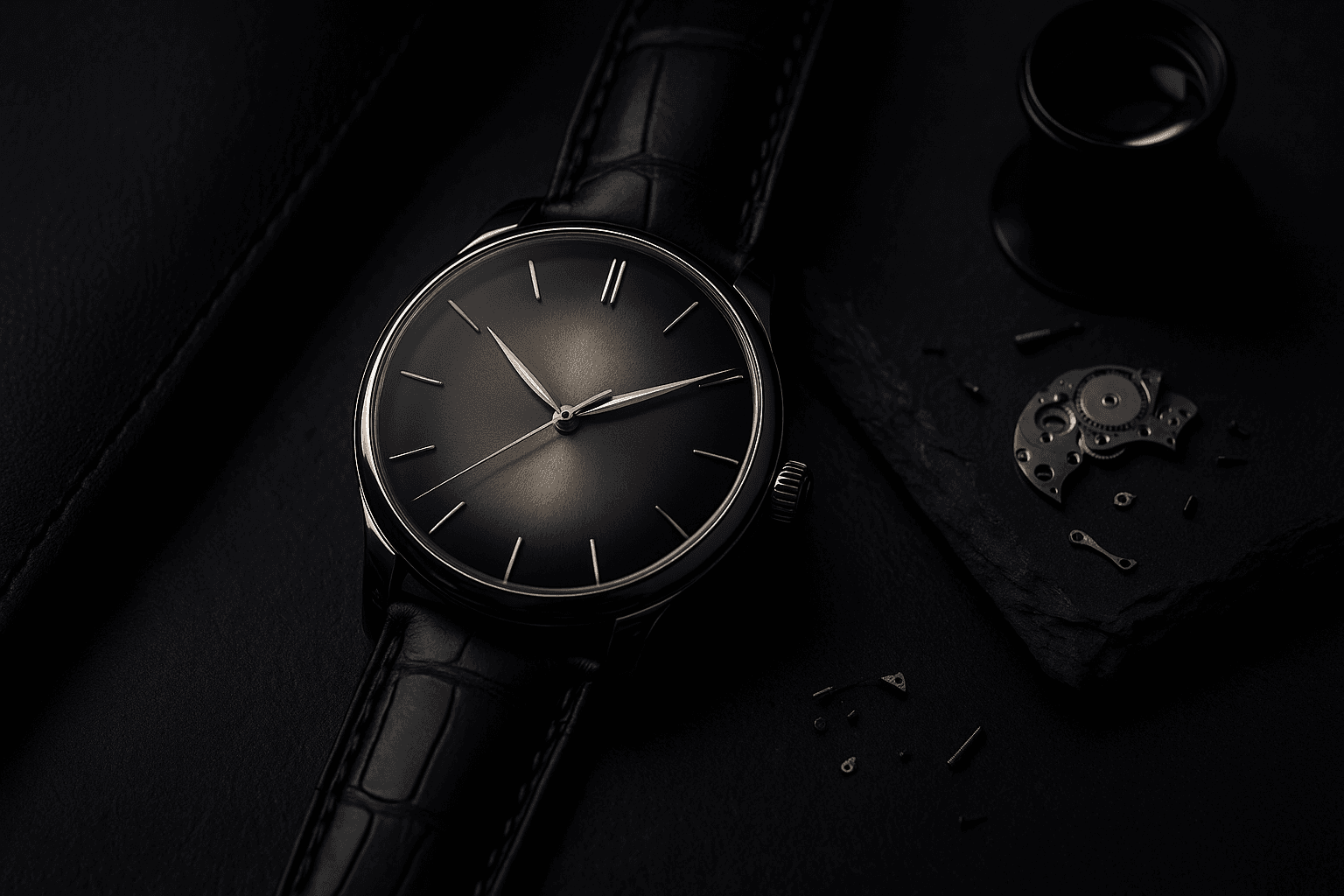
H. Moser & Cie and the Fumé Dial: Collecting an Independent With a House Style
By The Subdial Editors ·
Independent watchmaking asks its buyers to pay for things that are difficult to see. Escapement geometry, hairspring metallurgy, and the decision to machine a component in-house rather than buy it from a supplier are all real, all expensive, and all invisible from across a room.
H. Moser & Cie. sits at an unusual intersection of that problem. The house does some of the hardest in-house work in Swiss watchmaking — it manufactures its own balance springs, which almost nobody does — and it is publicly best known for a dial gradient that is identifiable at conversational distance.
That combination raises a question worth settling before you buy rather than after. When a brand is famous for a look rather than for a finish, does the look hold value the way finishing does?
Is H. Moser & Cie. worth collecting?
Moser pairs genuinely rare in-house work — its sister company produces hairsprings and escapement components — with the fumé dial, a house style collectors recognise instantly. The technical base carries the value.
Who H. Moser & Cie. Actually Is
Heinrich Moser was born in Schaffhausen in 1805 and founded the company that carries his name in St. Petersburg in 1828, building a substantial watch business serving the Russian market. The name then went quiet through much of the twentieth century, as a great many nineteenth-century Swiss houses did.
The brand was revived in Schaffhausen in 2005 with the involvement of a Moser descendant and relaunched as a small-volume mechanical house. In 2012 it was acquired by MELB Holding, the vehicle of the Meylan family, and Edouard Meylan took over as chief executive the following year.
That ownership detail matters more than most brand-history paragraphs do. MELB also owns Precision Engineering AG, and that single fact is the reason Moser can make a claim most independents cannot.
Production is small by any measure. The company does not publish audited output figures, so treat any specific annual number you encounter — in a forum post, a listing, or an article — as an estimate rather than a confirmed volume.
Overall, Moser is best understood as a family-owned independent that solved a supplier problem by buying the supplier. Keep that structure in mind through the rest of this piece, because it explains both the pricing and the positioning.
What Precision Engineering Changes
The hairspring is the hardest component in a mechanical watch to manufacture well. It governs rate stability, it is sensitive to temperature and magnetism, and for most of the last century the Swiss industry bought it from a very short list of specialists.
Rolex produces its own in the Parachrom alloy, and Patek Philippe produces silicon Spiromax springs. The Swatch Group's Nivarox operation has historically supplied much of the remainder of the industry.
Precision Engineering AG puts Moser on that list at a fraction of the scale. The company produces balance springs and escapement components for Moser and for third parties, which means the regulating organ inside a Moser is not a bought-in commodity.
Does H. Moser make its own hairsprings?
Yes. Precision Engineering AG, a sister company under the same MELB Holding ownership, produces Moser's hairsprings and escapement components — a capability only a handful of Swiss houses hold.
What's more, Moser designs and assembles its own calibers across the Endeavour, Pioneer and Streamliner lines, in both hand-wound and automatic families. Power reserve commonly runs around three days, though it varies by reference and should be checked against the specific caliber rather than assumed from the collection.
Moser has also designed its movements around an escapement that can be handled as a module during service. That is an ownership consideration rather than a marketing one, and it is the sort of detail that separates a functioning independent from a name on a dial.
The finishing, by contrast, is deliberately restrained. It is clean and modern rather than hand-anglage theatre, which is a positioning choice and a fair point of contrast with Greubel Forsey's finishing-led argument.
All of this adds up to a technical case that does not depend on decoration at all. That is unusual among independents, and it is the foundation everything else here rests on.
How The Fumé Dial Is Made And Why It Reads
Fumé — smoked, in the trade's French — describes a gradient that runs from a bright centre to a near-black periphery. The effect is built up through graduated galvanic and lacquer treatments across the dial blank, then sealed under a protective clear coat.
Many Moser dials lay that gradient over a sunburst base, which is why the surface does two things at once. The colour darkens toward the rim while the brushing throws light along a radius, and the two effects together are what make the dial appear to move as the wrist moves.
What is a fumé dial?
A fumé dial is a gradient, or smoked, finish running from a bright centre to a near-black edge. Moser applies it across nearly every collection, in named colours such as Funky Blue and Cosmic Green.
Consistency is the difficult part of the process. Two examples of the same reference can differ in how tightly the dark ring closes at the edge and in how evenly the transition runs, and experienced collectors do notice.
Be aware that this variability cuts both ways on the secondary market. A dial with an even, deep burn is genuinely more desirable than a washed-out one, which is why a listing photographed under a single flat light source is close to useless for judging the thing you are buying.
Note also that Moser has never made the same in-house claim for its dials that it makes for its regulating organs. Dial production at this level is commonly handled by Swiss specialists, and the fumé technique itself is not proprietary — other houses use gradients too.
Overall, what Moser owns is not the technique but the consistency of its application across an entire catalogue over more than a decade. That distinction becomes important the moment you start thinking about resale.
Does A House Style Hold Value The Way Finishing Does?
This is the question a Moser buyer should actually be asking. Hand finishing is a labour input with a defensible cost, whereas a visual signature is a brand asset, and the two behave differently when a watch changes hands.
Finishing tends to hold because it cannot be replicated cheaply. The premium attached to F.P. Journe's movement work and to the anglage on a Voutilainen or an Akrivia rests on hours that nobody has found a way to compress.
A house style holds on different terms. It depends on the brand remaining desirable, because a distinctive dial with no brand equity behind it is simply an unusual dial.
Moser's position is that it holds both cards at once. The hairspring capability is a hard technical moat, and the fumé signature is the commercial layer that gets the watch noticed in the first place.
The market has priced that combination unevenly. Moser has commonly traded below retail on the secondary market, which is typical for an independent without a decade-long waiting list behind it, and it is a fundamentally different dynamic from the allocation reality at Patek Philippe.
The clearest exception has been steel Streamliner references, where an integrated-bracelet sports watch from a small independent found a receptive audience. Verify the current spread yourself against live listings and recent auction results rather than trusting any figure quoted in an article, this one included.
Do H. Moser watches hold their value?
Moser commonly trades below retail, with steel Streamliner references the firmest exception. Check current spreads against live listings and recent auction results before transacting.
Keep in mind that a discount to retail is not automatically a warning sign. It is frequently the entry point that makes an independent worth owning at all, provided you buy at the market rather than at the boutique, and provided you understand the ownership economics that follow the purchase.
All of this points to one conclusion. The dial is what gets you interested and the escapement work is what you are actually paying for, so choose the reference whose movement and format you want and treat the colour as a preference rather than an investment thesis.
The Collections, And Where The Money Sits
Moser's catalogue is smaller than almost any comparable house and divides cleanly into four core lines plus a complications tier. Here is how they compare on format, intended role, and approximate retail positioning.
| Collection | Format | Role | Retail positioning (estimated) |
|---|---|---|---|
| Pioneer | Larger steel case, higher water resistance | Daily wear, usual entry point | Low five figures |
| Endeavour | Around 40mm, precious metal, thin bezel | Dress and classic wear | Low to mid five figures |
| Streamliner | Cushion case, integrated bracelet | Sports-luxury, launched 2020 | Mid five figures, higher for the chronograph |
| Heritage | Vintage-inspired, small runs | Enthusiast niche | Varies widely by reference |
| Complications | Perpetual calendar, tourbillon, minute repeater | Collector tier | High five figures and above |
Every figure in that table is an estimate of positioning rather than a quoted price. Confirm current retail against the manufacturer's own price list, and confirm market levels against live listings and published auction results before you make an offer.
The complications tier deserves a separate note. The Endeavour Perpetual Calendar is the house's signature complication and indicates the month with a small central arrow hand rather than a subdial, which leaves the dial nearly as clean as a time-only watch.
The Streamliner Flyback Chronograph is the other reference collectors track closely, with central chronograph registers developed in collaboration with Agenhor. Both are the strongest evidence that Moser's design thinking runs considerably deeper than a colour gradient.
The Colours Collectors Track
Moser gives its fumé dials proper names, and those names have become part of the collecting vocabulary in a way few brands manage. Colours that recur across the catalogue include but are not limited to:
- Funky Blue. The most recognisable dial in the range and effectively the house's calling card. It runs from a bright electric centre to near-black, and it is the colour most often used on hero references.
- Cosmic Green. A deep, cool green that reads almost black indoors and opens up in daylight. It has appeared across Endeavour and Streamliner references and tends to hold attention on the secondary market.
- Burgundy. The most conservative of the signature colours, and the easiest to wear with formal dress. It suits the thinner Endeavour cases better than the sportier lines.
- Ice Blue. A pale, cold gradient that shows the transition more subtly than Funky Blue does. It is the choice for buyers who want the technique without the announcement.
- Purple Haze. A limited-run colour that trades thinly and inconsistently. Buy it because you want it, not because you expect a defined comp set.
- Matrix Green. Associated primarily with Streamliner references, and closely tied to the integrated-bracelet audience. Availability has been irregular.
Remember that colour desirability moves faster than reference desirability. A gradient that is scarce this year can be a catalogue staple two years later, and the reverse happens just as often, which is why the underlying reference and caliber should drive the purchase.
Which Moser fumé colour should you buy?
Funky Blue is the house signature and the most liquid; Burgundy and Ice Blue wear most conservatively. Limited colours trade thinly, so buy those for the dial, not the comp set.
The Concept Watches And The Provocations
Moser's Concept models remove the logo, the indices and every line of printed text, leaving only hands over a gradient. It is the purest test of the house-style argument, because a watch with no branding at all is identifiable solely by its dial.
The house has also used product as commentary. The Swiss Alp Watch of 2016 put a mechanical movement in a case shaped like a smartwatch, and the Swiss Mad Watch of 2017 used a case incorporating Swiss cheese as a comment on how loosely a Swiss Made designation can be earned.
Those pieces were produced in very small numbers and trade thinly and irregularly. Treat them as collector curiosities with unpredictable liquidity rather than core holdings, and read how auction estimates are actually constructed before bidding on one.
The Concept line is a different proposition. It is the most coherent thing Moser makes, and it is the reference point for anyone arguing that a house style can carry a watch on its own.
What To Check Before You Buy
A Moser purchase on the secondary market has a specific inspection profile, driven almost entirely by the dial. Here is what a pre-purchase inspection should cover:
- Dial condition under angled light. Ask for photographs at several angles and under different light sources, checking for lacquer haze, hairline scratches, and any inconsistency in the gradient. Fumé dials are difficult and expensive to replace, and a compromised one is very hard to resell.
- Reference and caliber match. Confirm the reference on the caseback against the caliber visible through the sapphire, and against the manufacturer's published specification. Case size and power reserve both vary across the catalogue.
- Service history. Establish when the watch was last serviced and by whom, since independent servicing on an in-house escapement is not universally available. Factory service adds cost and time to ownership.
- Box, papers and time on market. A full set narrows the discount, and a listing that has sat for months usually indicates the asking price is above the market. Both are negotiating information.
- Bracelet and case sharpness. On Streamliner references especially, check that the case flanks and bracelet links retain their original edges. Polishing damage on an integrated-bracelet watch is effectively permanent, a pattern well documented in broader vintage market dynamics.
What should a pre-purchase inspection check on a used Moser?
Inspect the dial under angled light for haze, scratches and gradient inconsistency, because fumé dials are hard to replace. Then confirm service history, full set, and the caseback reference.
Taken together, these checks are less about authenticity than about condition. Moser is not a heavily counterfeited brand at present, but dial condition is the single variable that most affects what you can recover on resale.
Editorial Recommendation
Editorial recommendation
- Entry position. Pioneer Centre Seconds in steel, bought pre-owned with a full set. It carries the same in-house regulating organ as the dress references at the lowest cost of entry.
- The considered buy. Endeavour Centre Seconds in a conservative gradient — Burgundy or Ice Blue — for buyers who want the thin case and the classical proportions.
- The strongest market position. Steel Streamliner Centre Seconds, which has been the most liquid line in the catalogue. Verify the current spread to retail before committing.
- The collector piece. Endeavour Perpetual Calendar, for the central month hand and the discipline of the dial layout. It is the reference that best justifies the in-house claim.
- Approach with caution. Limited-colour and provocation pieces, where thin trading makes both entry and exit unpredictable.
Frequently Asked Questions
Is H. Moser & Cie. an independent brand?
Yes. It is privately held by MELB Holding, the Meylan family vehicle, which also owns Precision Engineering AG. It is not part of any of the large Swiss watch groups.
Why do some Moser watches have no logo?
The Concept line omits the logo, indices and text entirely, leaving only hands over the fumé gradient. It began as a statement about brand noise and has become one of the house's signatures.
How large is Moser's annual production?
The company does not publish audited output figures. Production is understood to be small by industry standards, but treat any specific annual number as an estimate and verify it against authoritative sources.
Which Moser collection suits a first-time buyer?
Pioneer is the usual starting point, with a steel case and higher water resistance at the lowest retail of the core lines. Endeavour suits dress wear, and Streamliner suits integrated-bracelet buyers.
Can a fumé dial be restored or replaced?
Replacement generally means a factory dial ordered through service, which is costly and subject to availability. Restoration of a damaged gradient is not practical, which is why dial condition dominates the inspection.
Where This Leaves The Moser Buyer
Moser is one of the few independents whose technical claim survives scrutiny without needing a decorated movement to sell it. The hairspring capability is real, the calibers are its own, and the complications are designed rather than assembled from convention.
The fumé dial is the reason most buyers find the brand, and it is a legitimate reason to buy — provided you understand that it is the entry to the argument rather than the argument itself. Buy the reference, verify the condition, and let the colour be the last decision rather than the first.
Subdial covers independent watchmaking on those terms across the catalogue. For neighbouring perspectives on how small houses price their work, see our coverage of Chopard L.U.C and the rest of the Subdial editorial archive.