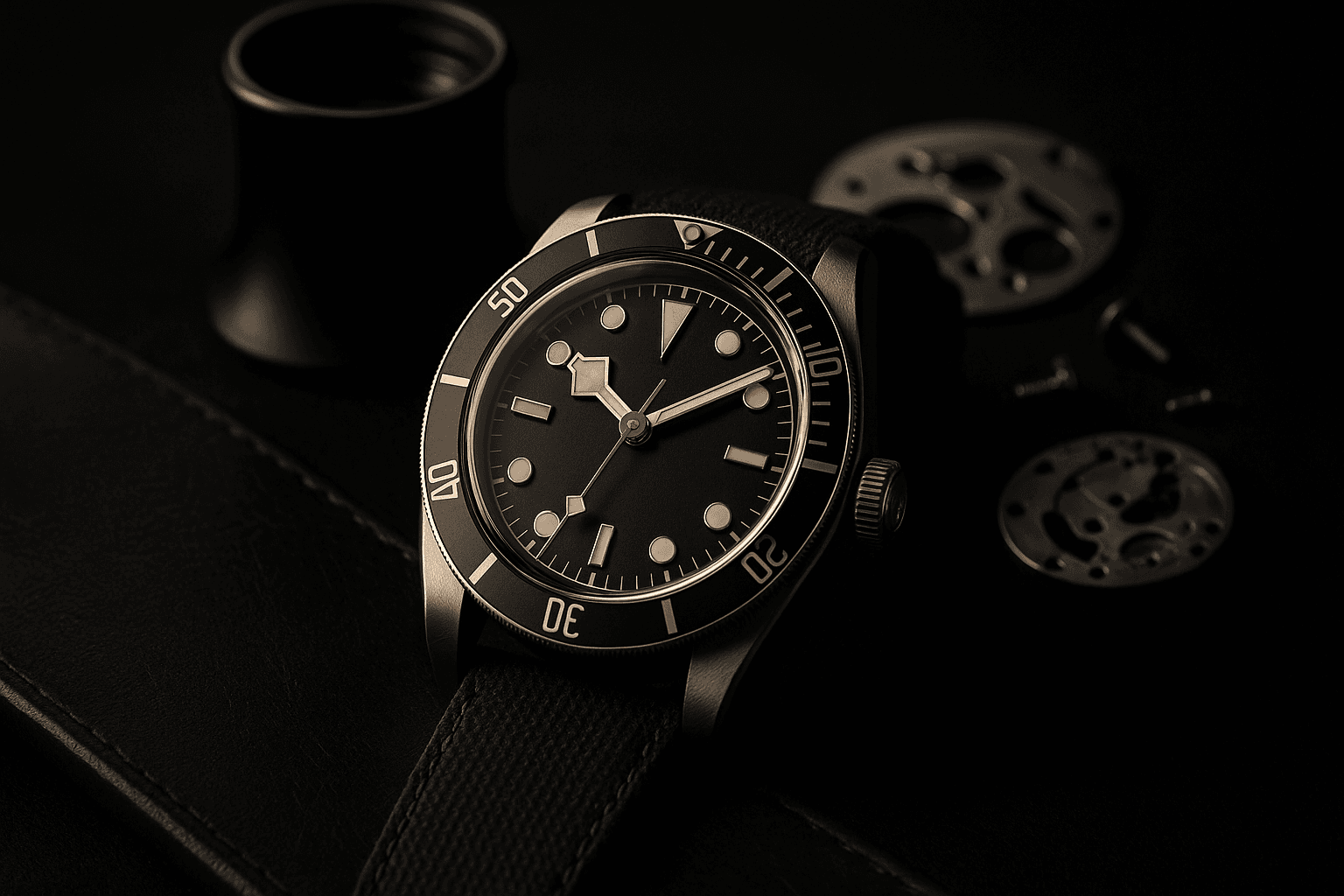
Tudor Black Bay and the In-House Transition: Collecting a Marque That Grew Out of Being the Value Option
By The Subdial Editors ·
Have you looked closely at what is actually beating inside the Black Bay you are considering? If you are shopping the pre-owned market on price alone, that question decides more about your purchase than the bezel colour, the bracelet choice, or the model year printed in the listing.
Tudor built its modern reputation on a specific proposition: Rolex-adjacent case construction and finishing, fitted with a sourced ETA calibre, sold for a fraction of the crown's asking price. That proposition no longer describes the brand — and the used market is still repricing the decade of watches that were sold under it.
The Black Bay split into two distinct collecting markets in 2016, when Tudor began fitting its own MT56xx manufacture calibres. Earlier references run sourced ETA 2824-2 movements and trade on a different logic entirely.
What Changed In 2016, And Why It Matters More Than It Looks
From the Black Bay's 2012 debut through roughly 2016, the line used the ETA 2824-2 — a workhorse automatic with a 38-hour power reserve, produced in enormous volumes and serviceable by essentially any competent watchmaker on earth. It was not a compromise so much as a deliberate cost structure.
Then Tudor introduced the MT5602 and its siblings: in-house, COSC-certified, with a roughly 70-hour power reserve and a free-sprung balance with a silicon hairspring. The functional gap is real, and it is the kind of gap that shows up in weekend-off wearing habits rather than on a spec sheet.
What makes this more consequential than a typical calibre update is that Tudor kept the same model name, largely the same case, and in several cases nearly the same dial. Two watches that photograph almost identically in a classified listing can be separated by a genuine mechanical generation.
The METAS Layer — A Second Split Inside The Manufacture Era
Tudor did not stop at COSC. Beginning with the Black Bay Ceramic in 2021, the brand added METAS Master Chronometer certification — the same independent Swiss federal testing protocol Omega adopted in 2015, covering magnetic resistance to 15,000 gauss, water resistance, power reserve, and rate across simulated wearing positions.
That means the manufacture era itself has two tiers. A 2018 MT5602 is in-house and COSC-certified; a 2023 Master Chronometer variant carries a broader, more demanding certification and, in Tudor's own literature, a five-year transferable warranty.
METAS Master Chronometer testing certifies the cased watch, not just the loose movement — covering magnetic resistance to 15,000 gauss, water resistance, and rate stability. COSC certifies the movement alone.
Collectors who came up through the Speedmaster's certification history will recognise the pattern immediately. Omega ran the same playbook — co-axial escapement first, METAS second — and the secondary market took several years to price the second step properly.
How The Two Eras Actually Trade
The naive assumption is that in-house always commands the premium. In transaction terms that is mostly true, but the spread is narrower and stranger than newcomers expect.
ETA-era Black Bays have picked up a specific kind of enthusiast demand: they are the references with the rose-logo dials, the smooth-rider snowflake handset on a thinner case, and — critically — a slimmer profile than the manufacture-era watches, which grew in thickness to accommodate the larger calibre. Thinness sells.
| Dimension | ETA era (c. 2012–2016) | Manufacture era (2016–present) |
|---|---|---|
| Calibre | ETA 2824-2 (sourced) | MT5602 / MT5402 / MT5652 family |
| Power reserve | ~38 hours | ~70 hours |
| Certification | None claimed at model level | COSC; METAS on later Master Chronometer refs |
| Balance | Regulated, index-adjusted | Free-sprung, silicon hairspring |
| Case profile | Slimmer overall package | Thicker to house the larger calibre |
| Service access | Any competent independent watchmaker | Practically Tudor service centre or a specialist |
| Warranty at retail | Two years (historical) | Five years, transferable, no registration required |
The service column is the one most buyers underweight. An ETA 2824-2 can be overhauled almost anywhere, with parts freely available and a labour cost that reflects the calibre's ubiquity.
The MT56xx family is a different proposition — parts distribution is restricted, the silicon hairspring is not something a generalist stocks, and the realistic path is Tudor's own network. That is not a defect, but it changes the total cost of ownership arithmetic in a way that belongs in your purchase decision rather than your fifth-year surprise.
The Value-Option Problem
Tudor's whole commercial identity for most of its modern life was relative value. The brand was what you bought when the Submariner was either unobtainable or philosophically objectionable at the price.
That framing has become steadily less accurate. Manufacture-era Black Bay retail pricing has climbed substantially, and the brand now fields ceramic cases, a METAS-certified movement, and a genuine in-house calibre programme — which is to say it competes on merit rather than on the gap it fills.
The collecting consequence is straightforward: you can no longer justify a Black Bay purchase purely as arbitrage against Rolex scarcity. A manufacture-era Black Bay has to earn its place against the rest of the sub-$5,000 mechanical field on its own terms.
Anyone weighing that field seriously should read the Black Bay against the broader dive watches under $5,000 landscape, because that is the actual competitive set now. And for the longer arc of how Tudor's back catalogue prices relative to its parent, the vintage pricing relationship supplies the historical spine.
Which References Anchor Each Era
Precision about reference numbers matters more here than in almost any other modern collecting question, because the visual differences are subtle and the listings are frequently vague. Note that Tudor's own reference structure changed alongside the calibre transition.
The ETA-era anchors include but are not limited to:
- 79220R — Black Bay Burgundy. The 2012 debut, rose logo on the earliest examples, ETA 2824-2. This is the reference that established the aesthetic vocabulary the entire line still uses.
- 79220B — Black Bay Blue. Introduced 2013, same movement, and the reference that proved the line had legs beyond a single nostalgic colourway.
- 79220N — Black Bay Black. Added 2014, completing the original trio, and the most commonly encountered ETA-era example on the secondary market.
- 79090 — Black Bay Thirty-Six. The smaller-case civilian variant, which carried the sourced calibre and a considerably dressier posture.
These four represent the great majority of what you will see listed as an early Black Bay. Verify the calibre rather than trusting the listing copy, because sellers who inherited a watch rarely know which generation they hold.
The manufacture-era anchors include:
- 79230 series. The 2016 in-house replacement for the original trio, carrying the MT5602 and the longer power reserve. Externally close to its predecessor, mechanically a different watch.
- 79030 — Black Bay Fifty-Eight. Launched 2018 with the MT5402, a 39mm case, and the slimmer profile that solved the manufacture era's principal aesthetic complaint. Widely regarded as the line's high point.
- 79210CNU — Black Bay Ceramic. The 2021 Master Chronometer debut, full ceramic case, and the reference that introduced METAS certification to the line.
- 7941A1A0RU — Black Bay 54. The 2023 addition at 37mm, targeting the vintage-proportion buyer the Fifty-Eight had activated.
Each of these sits at a different point on the size, certification, and price curve. Treat them as distinct propositions rather than as variants of a single watch, because the market does.
How To Price A Used Black Bay Deliberately
Start by establishing which era you are in, then price within that era rather than across it. Cross-era comparisons produce nonsense, because the two groups respond to different demand drivers.
Price an ETA-era Black Bay on condition, dial variant, and completeness. Price a manufacture-era example on remaining transferable warranty, certification tier, and case dimensions — the calibre is a constant within the era.
Within the ETA era, the variables that move money are the rose-versus-shield logo distinction on early 79220R examples, the presence of the original riveted bracelet alongside the fabric strap, and whether the box and warranty card survived. A complete early burgundy with the rose logo occupies a meaningfully different bracket from a bare-watch black.
Within the manufacture era, the dominant variable is remaining warranty. Tudor's five-year transferable coverage is genuinely transferable — it attaches to the watch, not the original purchaser — and a three-years-remaining example carries real economic value over an out-of-coverage one.
For reference points, work from dealer asking prices on established platforms and from auction results where they exist, rather than from forum anecdote. The same discipline that governs auction estimate mechanics applies here — a single realised price is a data point, not a market.
The Pre-Purchase Checks That Actually Matter
Black Bay authenticity is comparatively less fraught than it is at the Rolex tier, largely because the counterfeiting economics are less attractive. The real risks are misrepresentation and undisclosed service history rather than outright fakes.
Here is the list of checks worth running before you send money:
- Open the caseback record, not the case. Ask the seller for a photograph of the warranty card or service invoice naming the calibre. A listing that says "in-house" without documentation on a 2016-transition-year watch deserves scepticism.
- Check the power reserve yourself. Wind it fully, set it aside, and see whether it runs past 48 hours. An ETA 2824-2 will not; an MT56xx should comfortably exceed it.
- Verify bracelet and endlink fit. Riveted and folded-link bracelets were period-specific, and a mismatched bracelet is both a value adjustment and a signal about how the watch has been handled.
- Confirm the warranty transfer on manufacture-era examples. Tudor's coverage does not require registration, but you want the original purchase documentation to establish the start date.
- Ask directly about the last service. A ten-year-old ETA-era watch that has never been overhauled is not a bargain — budget the service into your offer.
All of these are answerable by a cooperative seller in a single message exchange. A seller who deflects on the calibre question specifically is the one to walk away from.
Editorial Recommendation
Our position is that the two eras serve genuinely different buyers, and that the common advice to "just get the in-house one" is lazier than the market deserves. Both are legitimate purchases when bought for the right reasons.
- For the wearer who values thinness and serviceability: an ETA-era 79220B or 79220N, complete with box and papers, bought at a price that assumes a near-term overhaul. The 2824-2 is a known quantity and any good independent can keep it running indefinitely.
- For the buyer who wants one watch to carry the rotation: the Black Bay Fifty-Eight 79030. It resolved the manufacture era's thickness problem, sits at 39mm, and has demonstrated the most durable secondary demand of any reference in the line.
- For the collector who specifically wants the certification story: a Master Chronometer reference with meaningful warranty remaining. The METAS layer is the brand's strongest technical argument and the most likely to age well in narrative terms.
- To avoid: an undocumented 2016-dated example bought at manufacture-era money. That is the single transition year where misdescription is most common and most expensive.
The Black Bay Fifty-Eight 79030 is the most broadly recommended reference in the line: 39mm, MT5402 in-house calibre, and the slimmest manufacture-era case profile Tudor has produced.
What The Transition Tells You About The Brand
A brand that manufactures its own calibres carries a structurally different long-term risk profile than one that assembles sourced movements. Parts obligations, service infrastructure, and intellectual property all become the manufacturer's problem rather than a supplier's.
Tudor has committed to that path with real capital — its Le Locle manufacturing facility, the Kenissi movement venture it shares with outside partners, and the METAS certification programme all represent fixed costs that a value-positioned brand would not undertake. Keep in mind that this commitment is what backs the five-year warranty, and it is the reason manufacture-era examples should hold service support well beyond the current decade.
Whether that translates into secondary-market strength is a separate question, and one the data cannot yet answer conclusively — the oldest manufacture-era Black Bays are only now reaching their first decade. Our reading is that the Fifty-Eight has already demonstrated it, and that the rest of the line will follow the pattern collectible dive watches have historically followed: the references with a distinct proportional identity outperform the ones that merely update a predecessor.
The practical takeaway for anyone shopping right now: identify the era before you negotiate, price within it, and treat the 2016 transition year as requiring documentation rather than assumption.
Frequently Asked Questions
Is an ETA-era Black Bay a worse watch than a manufacture-era one?
No — it is a different set of trade-offs. The ETA 2824-2 gives up power reserve and certification but returns a slimmer case and near-universal serviceability, which many long-term wearers value more highly than a 70-hour reserve.
How do I tell the two eras apart from photographs alone?
Reference number is the reliable tell — 79220-series is ETA, 79230-series and later are manufacture. Case thickness is a secondary clue, but photographs rarely capture it accurately enough to rely on.
Does the five-year warranty really transfer to a second owner?
Tudor's current warranty terms attach coverage to the watch rather than the purchaser and require no registration. You still want the original purchase documentation in hand to establish when the coverage period began.
What should a Black Bay service cost?
Service pricing varies by market and by whether the work goes through Tudor's network or an independent. Request a written quote before authorising work, and be aware that manufacture-era calibres realistically route to Tudor service centres.
Which Black Bay holds value best?
The Fifty-Eight has shown the strongest and most consistent secondary demand since its 2018 launch, driven by its 39mm proportions. Historical performance is not a forecast — verify current comps before transacting.
Where This Leaves The Collector
Tudor is no longer the value option, and pretending otherwise leads to bad purchases at both ends of the catalogue. The brand now asks to be judged on calibre engineering, certification, and case execution — and on those terms it holds up.
What the collector owes the transaction is precision: know which calibre you are buying, know which certification tier applies, and know what the case actually measures on your wrist. Everything else in a Black Bay listing is negotiable, and everything in that sentence is not.