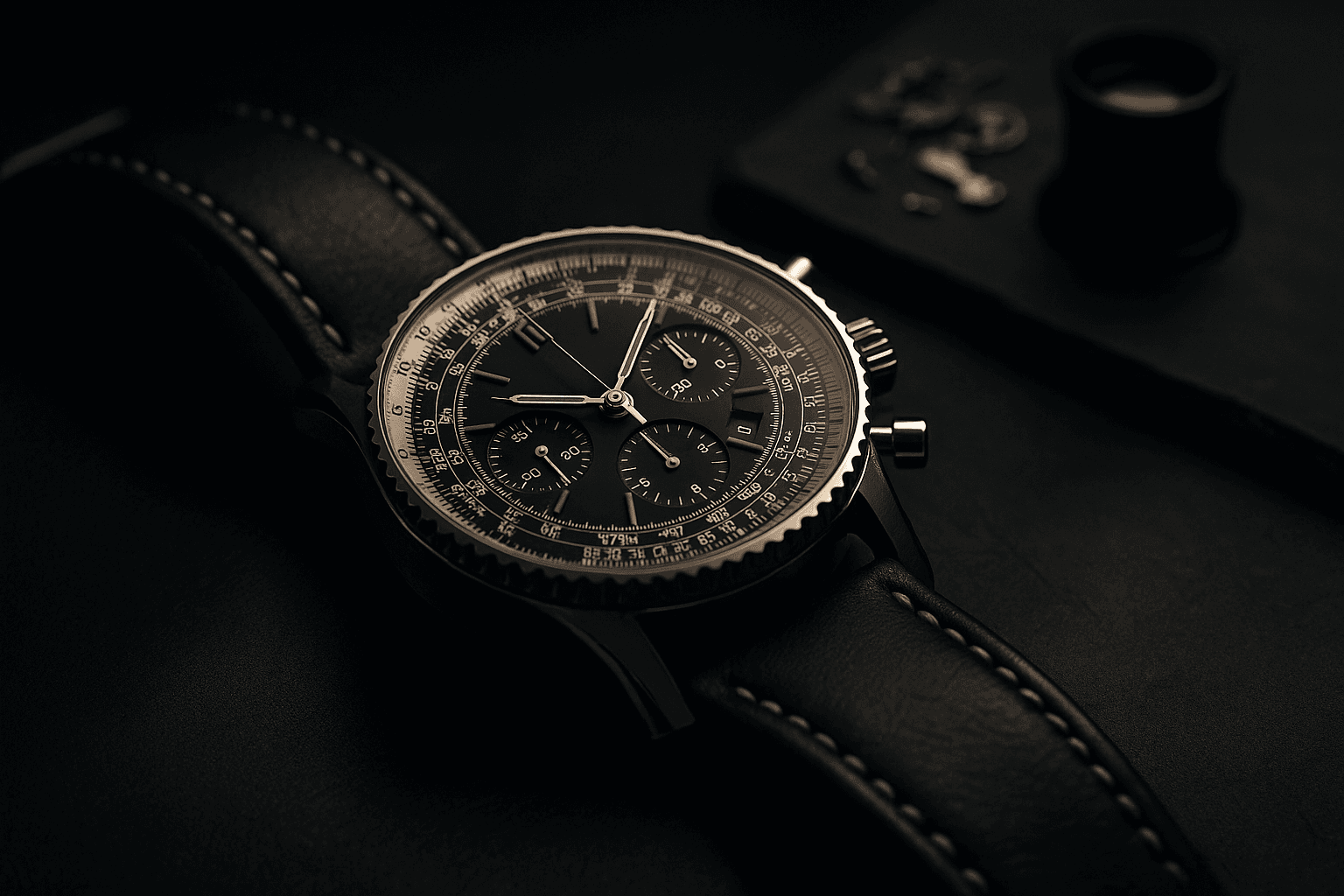
Breitling and the Navitimer: Collecting a Pilot's Chronograph Across Three Ownership Eras
By The Subdial Editors ·
Three reference numbers carry most of what a Navitimer buyer needs to know: the 806, the A13022, and the AB0120. Each belongs to a different owner of the Breitling company, and each answers the only two questions that reliably move price — who built the movement, and what the market has actually paid for that generation.
The Navitimer arrived in 1952 as a wrist-worn flight computer built for the Aircraft Owners and Pilots Association, and the circular slide rule on the bezel was the entire point rather than decoration. What has changed across seven decades is not the slide rule but the company stamping the dial, and that is precisely where collectors get tripped up.
Breitling has passed through three distinct ownership periods: the Breitling family through 1979, Ernest and later Théodore Schneider from 1979 to 2017, and CVC Capital Partners from 2017 forward. Accordingly, a Navitimer is not one watch with a very long production run so much as three related watches that happen to share a bezel.
The Three Eras In One Frame
Before any listing is worth reading, place the reference in its era — the movement, the parts pipeline, and the auction comp set all follow from that single placement. Keep in mind that Breitling's reference numbering shifted more than once across seventy years, so confirm the reference against the caseback and, where possible, the movement itself rather than the listing title.
| Era | Ownership | Representative references | Movement sourcing |
|---|---|---|---|
| 1952–1979 | Breitling family, latterly Willy Breitling | 806, 809 Cosmonaute, 7806, 1806 Chrono-Matic | Sourced ébauches: Venus 178, Valjoux 7740, Calibre 11/12 |
| 1979–2017 | Ernest Schneider, then Théodore Schneider | 81600, A13022 “Old Navitimer”, Navitimer World GMT | Sourced: 7750 as Breitling calibre 13; ETA bases elsewhere |
| 2017–present | CVC Capital Partners, Georges Kern as CEO | AB0120 Navitimer 01, Ref. 806 1959 Re-Edition, 2022 Navitimer B01 41/43/46 | Manufacture B01 family, including hand-wound B09; calibre 13 persists in transitional references |
All three eras produced good watches, and none of them produced a bad Navitimer. What separates them is serviceability, scarcity, and the shape of the demand curve sitting behind each one.
Every Navitimer chronograph built before 2009 runs a sourced calibre — Venus 178, Valjoux 7740, Calibre 11, or the 7750-based Breitling 13. Manufacture movements begin with the B01 and the Navitimer 01 references.
The Willy Breitling Era, 1952 To 1979
The original 806 carried the Venus 178, a manually wound column-wheel chronograph that is, by any measure, the most collector-desirable calibre in the model's history. Late-1960s production moved to the Valjoux 7740, a cam-switching manual chronograph that is entirely competent and, for exactly that reason, worth meaningfully less to the vintage market.
In 1969 Breitling joined Heuer-Leonidas, Büren, and Dubois Dépraz to launch the Chrono-Matic Calibre 11, among the first automatic chronographs, and the Navitimer 1806 carried it with the crown on the left side of the case. That left-hand crown remains the fastest visual era tell in the entire catalog.
The same period produced the 809 Cosmonaute, a 24-hour Navitimer that Scott Carpenter wore aboard Aurora 7 in May 1962. For a view of how flight and space provenance compounds into price over decades, our analysis of the Omega Speedmaster collecting hierarchy traces the same mechanics from the other side of the market.
The crown is the quickest era tell. A left-hand crown points to the 1969 Chrono-Matic Calibre 11 generation, while right-hand crowns cover the manual-wind 806 and every Navitimer built after the Schneider revival.
What To Check On A Pre-1979 Navitimer
Vintage Navitimer value concentrates in dial originality, and the deductions for a wrong dial are severe. Points worth confirming before you commit include but are not limited to:
- Dial signature. AOPA-winged dials, twin-jet logos, and Breitling-only printing each map to specific production windows. A mismatch between dial style and reference is a red flag rather than a charming quirk.
- Lume condition. Radium and tritium age in characteristic ways, and hands that glow evenly bright against a patinated dial usually indicate a relume.
- Case geometry. Navitimer lugs are slim to begin with, so over-polishing shows quickly in soft bevels and a thinned case profile that no photograph flatters.
- Bezel and crystal. The slide rule should rotate with even resistance, and the printed inner scale should stay aligned with the bezel markings across a full rotation.
- Movement match. A Venus 178 and a Valjoux 7740 are not interchangeable in value terms, so a clear movement photograph is not optional at any price.
All of these checks share one purpose: establishing that the watch in front of you is the watch the reference describes. That said, an honest, correct, moderately worn example will outperform a cosmetically flawless one carrying a service dial, every time.
Service dials are the single largest deduction on a vintage Navitimer. A replaced dial or relumed hands can cut an 806's value against an honest original, so request high-resolution dial macros before you bid.
The Schneider Revival, 1979 To 2017
Breitling wound down watch production under quartz-era pressure at the end of the 1970s, and Ernest Schneider — a pilot who already owned the watch company Sicura — acquired the brand in 1979 and restarted it from Grenchen. The Navitimer returned in the early 1980s, and the decision that shaped the next three decades was made quietly: Breitling would buy its chronograph movements rather than build them.
The workhorse was the 7750, first as a Valjoux and later as an ETA, which Breitling regulated, chronometer-certified, and catalogued as calibre 13. What that bought the brand was volume, reliability, and a service proposition that any competent independent watchmaker could support.
The “Old Navitimer” references of this period, most familiarly the A13022, remain the most underappreciated value in the model's history. In fact, this is one of the few corners of the modern Swiss market where a mechanically sound, chronometer-certified chronograph from a first-tier marque trades near the bottom of the enthusiast price ladder.
Moreover, the Schneider era is where Breitling built the case and bracelet vocabulary it is still known for — the rouleaux bracelet, the substantial 42mm-plus cases, and the dense dials that eventually became the brand's correction target. Readers weighing the same sourced-versus-manufacture question elsewhere in the pilot category will find parallel logic in our look at the IWC Portugieser and pilot chronographs.
The CVC Era, 2017 To The Present
CVC Capital Partners took the controlling stake in Breitling in 2017 with Georges Kern arriving as chief executive, and further shareholder changes have been reported since without altering the operating posture. The strategy has been to narrow the catalog, lighten the design language, and build the range around the manufacture calibre the previous ownership had already commissioned.
That calibre is the B01, introduced in 2009 — a column-wheel, vertical-clutch automatic chronograph with roughly 70 hours of power reserve, carried in the Navitimer first by the AB0120 Navitimer 01. Note that the B01 predates CVC by eight years; this era's contribution was making it the default rather than the flagship.
The 2019 Ref. 806 1959 Re-Edition introduced the hand-wound B09, essentially the B01 with the automatic winding stripped out, in a period-correct case with a beaded bezel and no date. It remains the most convincing bridge between the vintage and modern halves of the catalog.
Then in 2022, for the model's seventieth anniversary, Breitling rebuilt the Navitimer around a cleaner dial, a slimmer case profile, and a size range spanning 41, 43, and 46mm chronographs alongside 32 and 36mm three-hand models. For most buyers the 41 is the reference to start with, and it is the one the brand has clearly built the collection around.
Which References Carry Manufacture Movements
The dividing line is 2009, and for chronographs it is absolute: no Navitimer built before the B01 carries a Breitling-made chronograph movement, however the dial is signed. However, sourced calibres did not vanish in 2009 — calibre 13 stayed in production alongside the B01 for years, including in Navitimer 1 chronographs sold well into the CVC era.
| Calibre | Origin | Winding and switching | Typical Navitimer references |
|---|---|---|---|
| Venus 178 | Sourced ébauche | Manual, column wheel | 806 through the mid-1960s; 809 Cosmonaute |
| Valjoux 7740 | Sourced ébauche | Manual, cam | Late-1960s 806 and 7806 |
| Calibre 11 / 12 | Büren micro-rotor with Dubois Dépraz module | Automatic, module | 1806 Chrono-Matic, left-hand crown |
| Breitling 13 | Valjoux, later ETA 7750 | Automatic, cam | 81600, A13022 Old Navitimer, Navitimer 1 Chronograph 41 |
| Breitling B01 | Manufacture | Automatic, column wheel and vertical clutch | AB0120 Navitimer 01; 2022 Navitimer B01 41/43/46 |
| Breitling B09 | Manufacture, B01 derivative | Manual, column wheel | Ref. 806 1959 Re-Edition, 2019 |
Overall, the practical consequence is that “in-house” is a reference-level attribute rather than a brand-level one, and a Navitimer sold new in 2019 may well contain a 7750 derivative. Be aware that some sellers describe any modern Breitling as manufacture-equipped, so read the calibre designation on the caseback or through the sapphire back instead of trusting the listing copy.
How Each Era Prices
The Navitimer price ladder inverts the usual assumption that newer costs more. Early 806 examples with honest AOPA-winged dials occupy the top of the market, current B01 references sit in the middle at or near retail, and Schneider-era 7750 references anchor the bottom.
Breitling's published list pricing puts the steel Navitimer B01 Chronograph 41 in the high-four-figure to low-five-figure band depending on dial and bracelet, and pre-owned examples of those references typically trade below list. For anything vintage, treat every figure you encounter as indicative only and build your comp set from completed lots at Phillips, Christie's, and Sotheby's rather than from asking prices on Chrono24 — our explainer on how auction estimates are actually set covers why those two data sets diverge so widely.
Vintage 806 examples with original AOPA-winged dials sit at the top of the Navitimer market, while Schneider-era 7750 references anchor the bottom. Confirm every band against completed auction lots, not asking prices.
What's more, the spread within a single vintage reference is wider than the spread between references. A concours 806 with original dial, correct hands, and paperwork can multiply the result of a driver-condition example of the identical reference, which is the same condition-tier dynamic we traced in vintage pricing across Patek Philippe and Tudor.
Keep in mind that time-on-market matters here as much as condition tier. A Navitimer that has been relisted repeatedly across a year is telling you something about its dial, its papers, or its price that the photographs are not.
Service, Parts, And Running Costs
Movement choice determines your ownership experience more than any other decision on this list. The 7750 architecture inside calibre 13 is the most widely supported chronograph platform in Switzerland, with generic parts availability and a deep bench of independent watchmakers who service it weekly.
The B01, by contrast, is a proprietary calibre with a proprietary parts pipeline, which in practice means the brand service network and brand service pricing. And a Venus 178 is a specialist job that depends on donor parts and a watchmaker who has done the work before.
A 7750-based calibre 13 can be serviced by most independent watchmakers using generic parts. B01 work is effectively a brand-network job, and Venus 178 servicing depends on donor parts and a specialist.
Remember that a chronograph asks more of its service interval than a time-only watch, and a slide-rule bezel adds a gasket and a rotation mechanism to the maintenance list. For a fuller treatment of what mechanical ownership actually costs per year, see our breakdown of watch ownership economics.
Editorial Recommendation
The Navitimer rewards buyers who decide what they want from the watch before deciding which one to buy. Here is how we would allocate across the three eras:
- Best all-round buy: the 2022 Navitimer B01 Chronograph 41. Manufacture calibre, sapphire caseback, current parts support, and the most balanced dial the model has carried in forty years.
- Best value: a Schneider-era A13022 Old Navitimer. A chronometer-certified 7750 chronograph from a first-tier marque, serviceable almost anywhere, sitting at the bottom of the ladder for reasons that have nothing to do with how it runs.
- Best vintage entry: a Venus 178 806. Buy dial originality before you buy condition anywhere else, and pay the premium for correct hands rather than for a bright, over-polished case.
- Best bridge piece: the Ref. 806 1959 Re-Edition. Hand-wound B09, period-correct proportions, and none of the sourcing ambiguity that clouds the 1980s and 1990s references.
- Buy only with documentation: any Chrono-Matic 1806. The left-crown Calibre 11 watches are historically significant and mechanically demanding, so insist on service history and a movement photograph.
For daily wear, buy CVC-era: a 41mm B01 reference with a sapphire back and current parts support. For appreciation exposure, buy the earliest honest 806 whose dial you can document.
All of the above assumes you have inspected the watch yourself or paid a watchmaker to do it. For readers building a wider view of where Breitling sits among its peers, our survey of the major Swiss watch marques and our notes on movement hand-finishing standards supply the surrounding context.
Before you transact, confirm current retail pricing with Breitling directly, verify vintage comparables against completed auction lots at Phillips, Christie's, or Sotheby's, and commission an independent pre-purchase inspection. Reference numbers, dial variants, and production windows should be checked against authoritative references rather than seller descriptions.