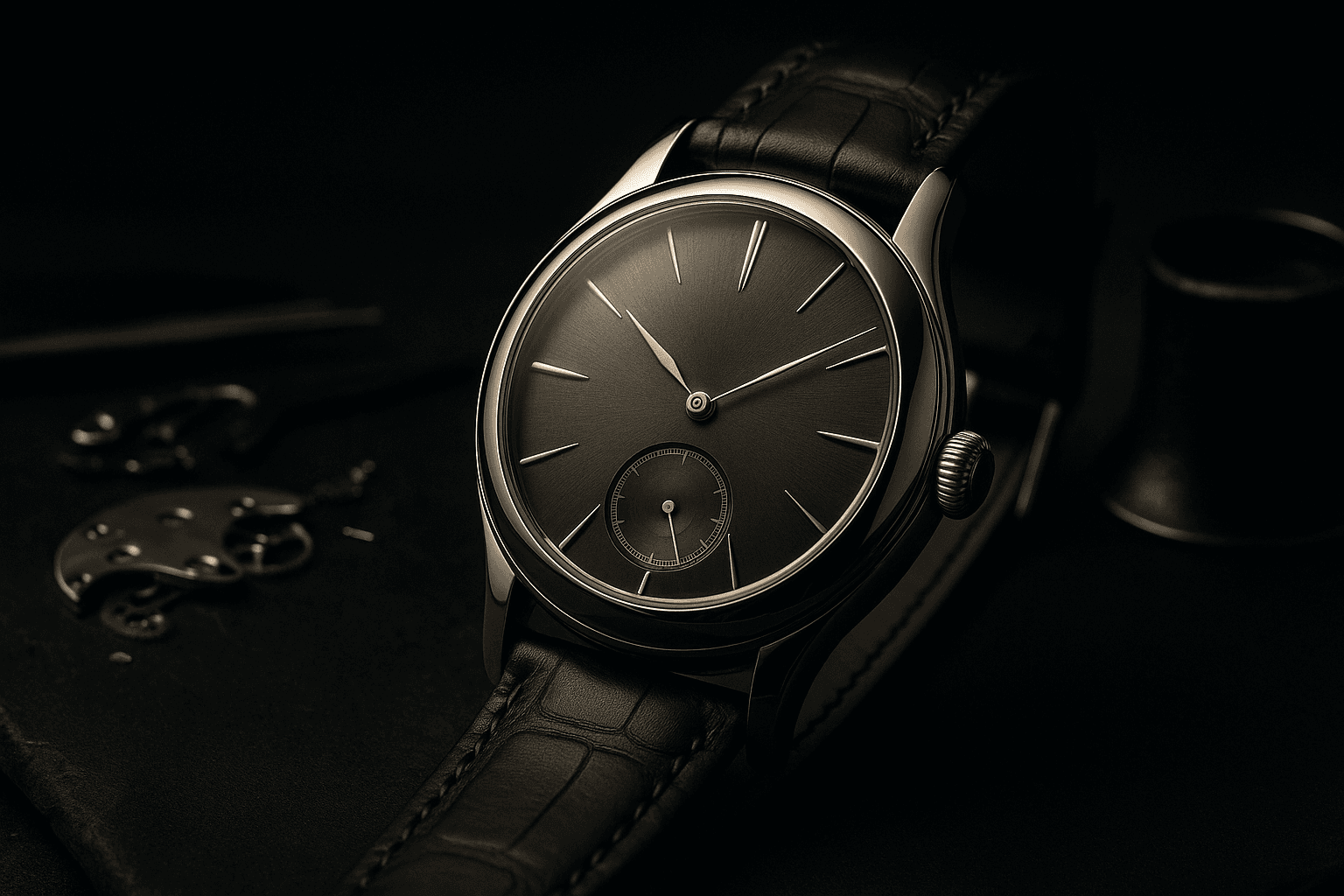
Laurent Ferrier: Collecting the Independent Built on a Patek Philippe Career
By The Subdial Editors ·
Independent watchmaking rewards two things that rarely arrive in the same package: production small enough to matter, and a résumé the rest of the industry already respects. Laurent Ferrier arrived holding both — a founder who spent close to four decades inside Patek Philippe, and a debut watch, the Galet Classic Tourbillon Double Spiral, that took the GPHG Men's Watch Prize in 2010.
That combination is the collecting case in one sentence, and it explains why the marque keeps surfacing in conversations that begin with F.P. Journe and end with a budget. Both Journe and Voutilainen have moved past the reach of most buyers who discovered them late, while Laurent Ferrier still sits within it.
What follows is a working map of the marque: the Patek years and what they actually bought, the caliber architecture, the Galet case language, the collection line by line, and the checks worth running before money moves.
What is Laurent Ferrier?
Laurent Ferrier is a Geneva independent founded in 2009 by a watchmaker who spent close to four decades at Patek Philippe. Its first watch won the GPHG Men's Watch Prize in 2010.
The Patek Philippe Years, And What They Actually Bought
Laurent Ferrier trained at the Geneva Watchmaking School and joined Patek Philippe in 1968, staying for a career that ran close to thirty-seven years and finished on the creation and product-development side of the house. That is a particular kind of experience — not bench watchmaking in isolation, but decades of deciding what a watch from the most conservative maison in Geneva is permitted to look like.
The résumé matters commercially as much as aesthetically. A collector buying into a young independent is underwriting the risk that the brand quietly disappears, and a founder with that tenure lowers that risk in a way no prototype can.
There is a second biography running alongside the first. In 1979 Ferrier finished third overall at the 24 Hours of Le Mans in a Porsche 935, sharing the car with François Servanin and François Trisconi — and Servanin later became the financial partner who made the atelier possible.
Keep that in mind when the Sport Auto and the Grand Sport Tourbillon come up further down. The motorsport thread in this catalogue is biography, drawn from a result you can look up in the 1979 classification.
Buyers who have watched Patek Philippe allocation reality from the wrong side of a waitlist tend to read the independent alternative differently. The appeal is not only the watch; it is a maker small enough to answer the phone.
What did Ferrier take from Patek Philippe?
Restraint rather than badge value. Sector-style dials, teardrop lugs and a low case profile built for wrist presence — the design grammar of a conservative Geneva house, applied without a committee.
How The Atelier Is Actually Built
Laurent Ferrier was founded in 2009 and presented publicly the following year as a small Geneva atelier rather than a manufacture attempting full vertical integration on day one. The founding tourbillon caliber, FBN 916.01, was developed with La Fabrique du Temps — the movement-development house of Enrico Barbasini and Michel Navas, acquired by Louis Vuitton in 2011.
That origin is worth understanding rather than glossing over, because it is how most credible independents begin. Constructor talent came from a specialist partner, while the identity, the finishing standard and the case language came from the founder.
The double-spiral tourbillon made the point of view explicit from the start. Two hairsprings mounted in opposition let the balance breathe concentrically, a solution aimed at isochronism instead of spectacle.
The spectacle was in fact deliberately removed: on the founding reference, the tourbillon is concealed behind the dial and visible only through the caseback. Hiding the most expensive complication in the watch tells you the audience is expected to know what is inside without being shown.
The Galet Case And Why It Reads Smaller Than It Measures
Galet is French for pebble, and the name is descriptive rather than poetic. The case is worked into a rounded, water-smoothed profile with no hard shoulder between bezel, band and caseback, so it sits low and reads smaller on the wrist than its diameter suggests.
The lugs are the first tell. Laurent Ferrier's teardrop lugs curve down and taper to a point, a detail borrowed from mid-century Geneva dress watches and executed with polished flanks set against satin upper surfaces.
The hands are the second. The assegai shape — named for the Zulu spear — tapers to a fine point across sector, opaline and grand feu enamel dials, and it is consistent enough across the collection to identify the brand at arm's length.
Diameters in the Classic and Galet families generally sit around 40mm, with the sport references running larger. Confirm exact dimensions per reference against the manufacturer's current specifications, since case sizes have shifted across successive releases.
Caliber LF229.01 And The Natural Escapement
The Classic Micro-Rotor is the volume heart of the brand and the reference most collectors mean when they say Laurent Ferrier. It runs caliber LF229.01, an automatic movement with a solid-gold micro-rotor sunk into the movement plane and a stated power reserve in the 72-hour range.
The technical argument lives in the escapement. Laurent Ferrier uses a double direct-impulse escapement — a modern reading of Breguet's échappement naturel — in which two escape wheels impulse the balance directly in both directions instead of routing energy through the sliding faces of a conventional lever.
The claimed benefit is lower friction and reduced dependence on lubrication at the impulse surfaces, which in principle means rate behavior that drifts less between services. Treat that as an engineering rationale to understand rather than a performance promise to underwrite, and ask any seller for recent timing results on the actual watch.
Finishing is where the money goes, and it is the reason the micro-rotor sits where it does. Bridges are hand-bevelled with polished anglage and the atelier finishes surfaces the owner will never see through a closed caseback — the standard we break down in how movement hand-finishing is judged.
What movement is in the Classic Micro-Rotor?
Caliber LF229.01 — an automatic with a solid-gold micro-rotor and a double direct-impulse natural escapement. Stated power reserve sits in the 72-hour range, with hand-bevelled bridges throughout.
The Collection, Line By Line
The catalogue is small enough to hold in your head, which is part of the appeal. Here is how the families sort by movement, case register, and the buyer each one is built for:
| Line | Movement register | Case register | Who it suits |
|---|---|---|---|
| Classic Origin (École line) | Hand-wound | Pebble case, classical dial | The entry point — case language without the micro-rotor |
| Classic Micro-Rotor | Automatic, LF229.01 family | Pebble case, teardrop lugs | The default first Laurent Ferrier |
| Classic Traveller | Micro-rotor with dual time and day-night | Pebble case | One-watch travellers who want a pusher-set second zone |
| Bridge One | Hand-wound, shaped movement | Curved, shaped case | Collectors who already own the round watch |
| Sport Auto | Micro-rotor automatic | Integrated bracelet, larger case | Daily wear without leaving the atelier |
| Grand Sport Tourbillon | Tourbillon | Integrated bracelet, sport case | The flagship, and the scarcest of the modern lines |
| Classic Tourbillon Double Spiral | Tourbillon, FBN 916.01 lineage | Pebble case, tourbillon concealed | The founding statement piece |
Read that table as positioning rather than as a price ladder, because configuration moves value more than line does. A grand feu enamel dial, an unusual color or a precious-metal case can push one reference past another that sits higher in the catalogue.
Where It Sits Against Journe, Voutilainen And Akrivia
Laurent Ferrier is discussed inside the same finishing conversation as its independent peers while trading much closer to retail than the loudest names in that conversation. The gap is the opportunity, and it is also the risk.
The comparison most collectors run first is against F.P. Journe, whose secondary market has spent years detached from retail — a dynamic we cover in the F.P. Journe premium. Laurent Ferrier has not seen the same multiple, which means you are buying the object rather than the exit.
Against the hand-finishing purists — the territory mapped in our look at Voutilainen and Akrivia collecting — Laurent Ferrier reads as the more wearable proposition. The cases are quieter, the dials are less demonstrative, and the watches are built to be worn to work rather than photographed on a bench.
Set beside a more engineering-forward independent such as De Bethune, the difference is temperament rather than talent. One house argues in materials and geometry; this one argues in proportion.
Buyers weighing hand-work per dollar one tier down should also read our piece on Chopard L.U.C collecting, which competes on finishing rather than on scarcity. It is the useful control case for anyone testing whether they are paying for the movement or for the name on the dial.
How does Laurent Ferrier compare with its independent peers?
It reads as the more wearable proposition — quieter cases, less demonstrative dials, and prices far closer to retail than Journe or Voutilainen command on the secondary market.
Production Volume And What Thin Supply Does To Price
Annual output is widely reported in the range of 150 to 200 watches, an estimate rather than an audited figure and worth confirming with the brand before you build a thesis on it. At that scale, every reference behaves like a limited edition whether or not it is labelled as one.
Thin supply cuts in both directions, and new collectors usually model only the flattering half. On the way in, it means few examples exist on the open market at any moment and a well-specified piece can sit unchallenged at a strong ask.
On the way out, it means price discovery is noisy and slow. A single motivated seller can set the visible comp for a reference for months, and time on market for an independent at this volume is measured in weeks rather than days.
Auction results are the better anchor, provided you read them properly — estimate ranges, condition and provenance all move a hammer price, as we set out in auction estimate mechanics. One strong result is a data point, not the market.
How many watches does Laurent Ferrier make each year?
Output is widely estimated at roughly 150 to 200 pieces annually — verify with the brand. At that volume, secondary supply stays thin and price discovery runs slow in both directions.
What To Check Before You Buy
Diligence here differs from vintage work, because most examples on the market are modern and the questions concern configuration and care as much as originality. The checks worth running include but are not limited to:
- Reference and caliber match. Confirm that the reference on the certificate matches the movement and dial in front of you. Configuration drives value in this catalogue, so a mismatch is a pricing question before it is an authenticity question.
- Dial variant and finish. Grand feu enamel, sector layouts and unusual colors trade differently from standard opaline. Ask the brand to confirm any dial you cannot place in the current or archived catalogue.
- Enamel condition. Inspect enamel dials under a loupe and under angled light for hairlines and firing flaws. An enamel dial is not a serviceable part in the way a metal dial is.
- Service history. Ask when the watch was last serviced, by whom, and whether the work went through the atelier. A double direct-impulse escapement is not a movement to hand to a general watchmaker.
- Completeness. Box, certificate, and the original strap and buckle materially affect what a future buyer will pay. On low-volume independents, incomplete sets discount harder than they do on mainstream brands.
- Time on market. Note how long the listing has been live and whether the ask has moved. On thin-volume references, a stale listing is information about the price rather than about the watch.
Run those six checks in order and most of the risk in a Laurent Ferrier purchase resolves before a deposit moves. The same authentication discipline that protects a vintage buyer, documented in our guide to vintage watch authentication, applies here with the paperwork carrying more of the load.
What should a pre-purchase check cover?
Match reference, caliber and dial variant to the certificate, loupe any enamel dial for hairlines, and confirm the last service went through the atelier. Then check how long the listing has sat.
Editorial Recommendation
Configuration decides more here than line does, so buy the specification rather than the tier. For a first Laurent Ferrier, our editorial position is as follows:
- Best default. A Classic Micro-Rotor in precious metal with a full set — the caliber, the case language and the finishing argument in a single reference.
- Best value entry. A Classic Origin from the École line, which keeps the pebble case and assegai hands at the lowest point of entry to the marque.
- Best daily wear. A Sport Auto on the integrated bracelet, for the buyer who would otherwise leave a leather-strap independent in the safe.
- Best long hold. A grand feu enamel dial in any line, since dial execution has historically separated otherwise comparable references.
- Budget the service. Price a full atelier service into your holding cost before you buy, on the logic set out in our piece on watch ownership economics.
Confirm every figure against current retail, live Chrono24 listings and recent auction records before you transact, since prices in this segment move faster than any editorial guide can track. Ranges are the honest unit here.
Questions Collectors Ask
Five questions come up in nearly every conversation about the marque, and each one tends to decide whether a buyer proceeds:
What is a natural escapement, and why does Laurent Ferrier use one?
A natural escapement impulses the balance directly in both directions through two escape wheels, cutting sliding friction and the need for lubrication on the impulse faces. Laurent Ferrier uses that architecture in its micro-rotor calibers.
Which Laurent Ferrier line is the entry point?
The Classic Origin, from the École line, is the accessible entry. It keeps the pebble case and assegai hands, uses a hand-wound movement instead of the micro-rotor, and typically lists below the automatic and tourbillon references.
Did Laurent Ferrier really race at Le Mans?
Yes. He finished third overall at the 1979 24 Hours of Le Mans in a Porsche 935, sharing the car with François Trisconi and François Servanin — the same Servanin who later became the financial partner behind the atelier.
Who developed the first Laurent Ferrier tourbillon caliber?
The founding FBN 916.01 tourbillon was developed with La Fabrique du Temps, the constructor house of Enrico Barbasini and Michel Navas that Louis Vuitton acquired in 2011. Identity and finishing stayed with the Geneva atelier.
Is the tourbillon visible on the Classic Tourbillon Double Spiral?
No. The founding reference hides the tourbillon behind the dial and shows it only through the caseback, which is the clearest statement of the brand's posture: the complication is for the owner, not the room.
None of the above replaces a conversation with the atelier or with a specialist you already trust. Handle one before you commit — the case profile is the whole argument, and it does not photograph.