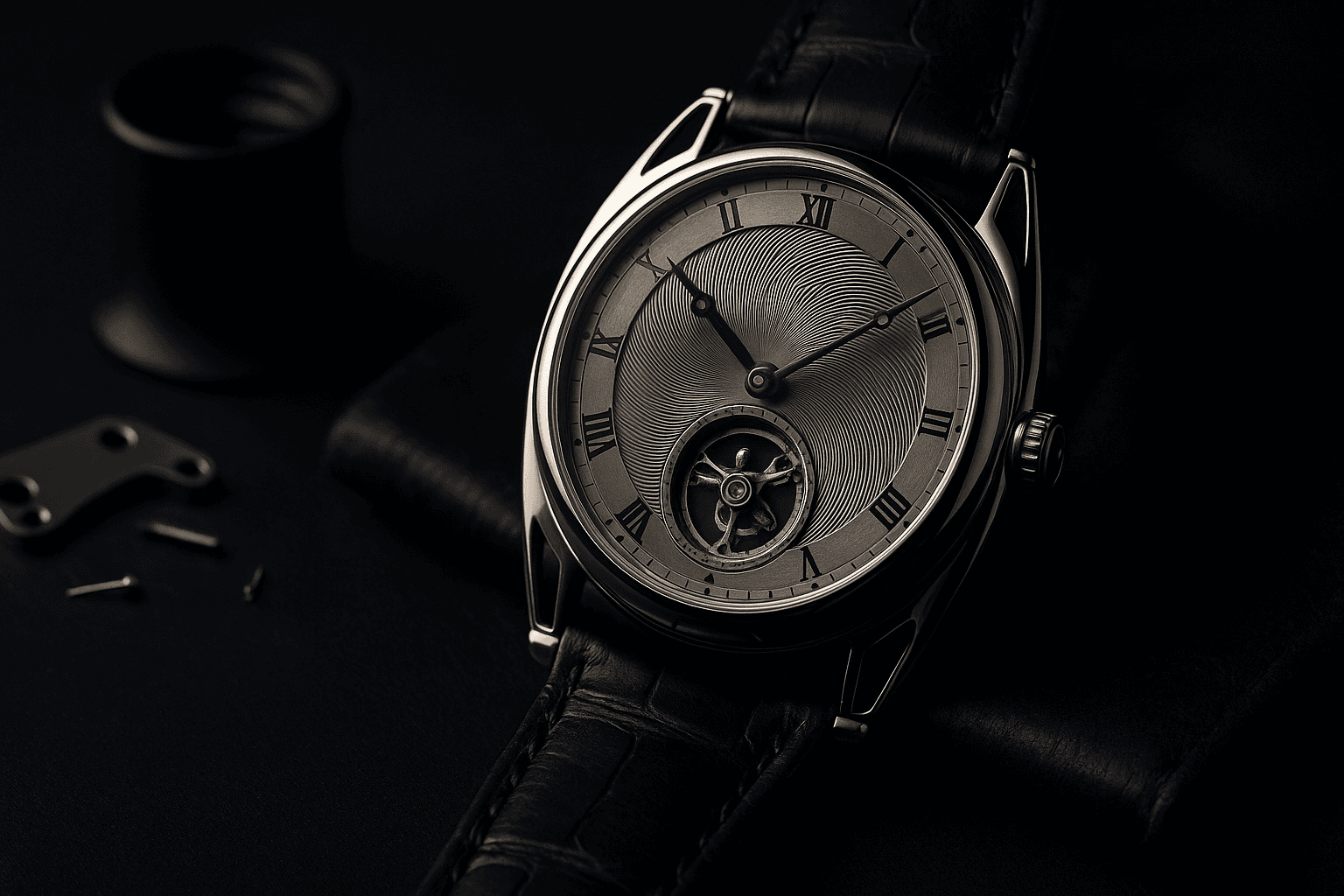
De Bethune and the Contrarian Aesthetic: Collecting an Independent That Ignores Convention
By The Subdial Editors ·
The independent sector has spent two decades sorting itself into a rough hierarchy, and most of that sorting has been done on finishing quality, rarity, and the accumulated weight of a single name on the dial. That hierarchy tends to reward watches that look like improved versions of what the industry had already agreed was beautiful — a hand-bevelled bridge, a guilloché dial, a case that could plausibly have left Geneva in 1955.
De Bethune has never competed on those terms. Since Denis Flageollet and David Zanetta founded the manufacture in 2002 in L'Auberson, in the Sainte-Croix corner of the Swiss Jura, the house has built watches that read as though they emerged from a parallel horological tradition — heat-blued titanium, lugs that float away from the case, and a moon phase that is an actual rotating sphere rather than a printed disc behind an aperture.
For a long stretch, that cost the marque. Collectors who could recite the finishing standards of a Geneva atelier from memory looked at a DB28 and saw something closer to industrial design than watchmaking.
That reading has aged badly. As the independents matured into a genuine collecting category and the major auction houses built dedicated sections around them, De Bethune's refusal to quote the past stopped looking like a positioning problem and started looking like the entire reason to own one.
What Makes De Bethune Different From Every Other Independent?
Most of the celebrated independents are, at root, editors of tradition. They take a known form — the Calátrava, the observatory chronometer, the tourbillon carriage — and execute it to a standard the industrial brands cannot match at volume.
De Bethune builds its own design vocabulary rather than reinterpreting inherited ones. Heat-blued titanium, articulated floating lugs, the delta-shaped bridge and the spherical moon phase are house inventions, not revivals.
That distinction matters commercially, not just aesthetically. A watch that reinterprets a canonical form is always measured against the original, whereas a watch that invents its own form has to be judged on whether the invention works.
De Bethune took the harder route, and the payoff arrived slowly. The DB28 winning the Aiguille d'Or — the top prize at the Grand Prix d'Horlogerie de Genève — in 2011 was the moment the wider industry conceded that the vocabulary was legitimate rather than eccentric.
The Design Language, Piece By Piece
The house style is often described in the aggregate, which does it no favors, because each element solves a specific problem. Keep in mind that these are engineering decisions first and visual signatures second.
Heat-Blued Titanium
The blue on a De Bethune case, dial or bridge is not paint, plating or PVD. The metal is heated until the oxide layer on its surface refracts light at a particular wavelength, which is the same physics that produces a blued steel screw, applied at a scale nobody else attempts.
No, the blue is not a coating. De Bethune blues titanium thermally, so the color lives in the oxide layer of the metal itself and cannot flake or peel — though heat and aggressive polishing can alter it.
The practical consequence for a buyer is that a De Bethune's most distinctive surface is also its most fragile in the wrong hands. A generalist polisher who takes a wheel to a blued titanium case will destroy value in minutes, which is why refinishing on these watches should route back to the manufacture.
The Floating Lug System
De Bethune's lugs pivot on springs and articulate independently of the case, so the strap follows the wrist rather than fighting it. This is the single feature that most often converts a skeptic in person.
De Bethune's lugs are articulated on springs and pivot independently of the case, letting the watch conform to the wrist. A large case therefore often wears closer to a conventional 40mm piece.
Photographs consistently understate this, which explains part of the marque's slow commercial start. A watch whose central virtue only reveals itself on the wrist is structurally disadvantaged in an era when most purchase decisions begin on a screen.
The Spherical Moon Phase
Rather than a disc with two moons rotating behind a cut-out, De Bethune mounts a genuine sphere — one hemisphere polished, one blued — that turns to show the correct illuminated fraction. The manufacture states the mechanism's accuracy at roughly one day of deviation in more than a thousand years, which is a manufacturer claim worth citing as such rather than treating as independently audited.
What's more, the sphere is the clearest expression of the house philosophy. A conventional moon phase depicts the moon, while this one models it.
The Delta Bridge And Mirror Polishing
The triangular delta bridge that anchors the balance is both a structural choice and a visual signature, and it appears across generations of the collection. Paired with the house's mirror-polished titanium surfaces, it gives the movement side a hard-edged, almost architectural register that has no real equivalent elsewhere in the sector.
What Is Actually Inside A De Bethune?
The design conversation tends to crowd out the technical one, which is backwards. De Bethune's claim to top-tier standing rests on the fact that it develops its own movements and its own solutions to old problems, rather than dressing sourced architecture in unusual clothes.
Yes, the calibers are in-house. De Bethune designs and builds its own movements in L'Auberson — including balance wheels, escapement components, twin barrels and shock protection — rather than finishing sourced ebâuches.
The recurring technical elements across the collection include but are not limited to:
- Titanium balance wheels with precious-metal weights. De Bethune developed balances in titanium fitted with white gold inserts, chasing low inertia and thermal stability at once. Silicon appears in escapement components across various executions.
- Self-regulating twin barrels. Two mainspring barrels working together deliver a flatter torque curve across a multi-day power reserve, which is the practical route to stable rate over the full wind rather than only the first 24 hours.
- The triple pare-chute shock absorber. A house shock-protection system for the balance staff, addressing the most common failure point in a watch that is genuinely intended to be worn rather than vaulted.
- Spherical and three-dimensional displays. Beyond the moon, the manufacture has applied sphere-and-satellite thinking to other indications, most visibly in the sculptural Dream Watch series.
- Serious chronograph work. The Maxichrono represents the house's most technically ambitious chronograph, engineered around coaxial central hands rather than conventional subdials.
All of these add up to a manufacture that earns its position on capability rather than on narrative alone. That is the same test the market applies to Greubel Forsey's invention-led tourbillon work, and De Bethune passes it by a different route.
How To Read De Bethune's Auction Standing
De Bethune now appears in the independent sections of the major sales, and the marque's presence at Phillips and Christie's is the cleanest available evidence that the market has re-rated it. It has also participated in charity sales, where one-off executions surface that never enter the regular collection.
De Bethune trades at Phillips and Christie's alongside the top independents. Pull the specific lot record before pricing anything, because hammer figures vary sharply by reference, case metal and condition.
Facts discipline. We do not quote hammer prices we cannot link to a lot record. Before you transact on any De Bethune, retrieve the actual lot pages from the auction house archive for the reference and metal you are considering, and confirm the sale date, the estimate range and whether the figure you are looking at includes buyer's premium.
The reason we hold that line here is that De Bethune results are unusually easy to misread. A single sculptural Dream Watch or a charity one-off will print a number that has almost nothing to say about what a standard DB28 in titanium is worth on a Tuesday.
The mechanics of that gap are worth understanding properly, and we have covered them in depth in our guide to how auction estimates are actually constructed. Read a De Bethune result the way you would read any thin-market comp: identify the reference, the metal, the condition tier, and the number of comparable sales behind the estimate before you let the headline figure anchor you.
Which References Matter Most To Collectors?
The collection is broader than its reputation suggests, and the spread between families is wide enough that "a De Bethune" is not a meaningful price unit. Here is how the principal families sit relative to one another:
| Family | Character | Collector case | Verify before buying |
|---|---|---|---|
| DB28 | Round case, floating lugs, delta bridge, spherical moon | The house's defining statement and its Aiguille d'Or winner in 2011 | Case metal, dial treatment, completeness of box and papers |
| DB28 XP / XS | Slimmed and resized evolutions of the DB28 | Reads more wearable on a modern wrist without losing the vocabulary | Exact reference number, since dimensions differ across executions |
| DB25 | The house's more classical round register, often complicated | Route into De Bethune for buyers who want restraint on the dial side | Which complication is fitted — it drives most of the spread |
| DB27 Titan Hawk | Sportier, more industrial, comparatively accessible | Typically the least expensive entry into the design language | Condition of the case finishing and originality of surfaces |
| Dream Watch series | Asymmetric, sculptural, extremely limited | The purest expression of the house's independence from convention | Production numbers vary and are rarely audited — verify directly |
| Maxichrono | Monopusher chronograph with coaxial central hands | The technical high-water mark of the chronograph work | Full service history, given the complexity of the movement |
| Starry Varius | Starry-sky dials with pinned white gold stars | The most immediately seductive dial the house makes | Star configuration, which varies by commission |
Note that this table is a map, not a price list. The reference families overlap in period and in movement architecture, and the correct next step is always to pin down a specific reference number rather than a family name.
Where De Bethune Sits Against The Other Independents
The useful comparison is not "which is better" but "which problem is each house solving." Framed that way, the sector sorts cleanly:
| House | Core proposition | Design register |
|---|---|---|
| De Bethune | Original materials science and an invented visual grammar | Futurist, sculptural, unapologetically modern |
| F.P. Journe | Chronometric purity carried by a single founder's signature | Classical, restrained, resolutely mid-century in feel |
| Greubel Forsey | Fundamental research into tourbillon geometry, at extreme finish | Monumental, architectural, deliberately imposing |
| Voutilainen and Akrivia | Hand-finishing and dial craft at the top of the discipline | Traditional, atelier-scale, finish-forward |
| MB&F | Narrative-driven kinetic sculpture built with outside talent | Playful, overtly conceptual, object-first |
| H. Moser & Cie. | Minimalist dials with serious in-house movement work underneath | Quiet, dial-led, deliberately understated |
De Bethune occupies the space between MB&F's conceptual play and Greubel Forsey's research seriousness, and it is the only house in that group doing both simultaneously. That position explains why it took so long to price correctly — it was legible to neither the traditionalist collector nor the pure object collector until both camps learned to read it.
What To Check Before You Buy
A pre-purchase inspection on a De Bethune diverges from the standard checklist in specific ways, because the failure modes are unusual. The points that matter most include:
- Original blued surfaces. Confirm the blue is even and unaltered across the case, bridges and any blued dial elements, since a heat event or an outside polish will show as a color shift rather than as a scratch.
- Mirror-polish integrity. The house's polished titanium is a distortion-free surface, and any waviness under raking light indicates it has been worked on somewhere other than the manufacture.
- Lug articulation. Work the floating lugs by hand and confirm both pivot freely and return, since the spring system is a wear point that generalist watchmakers rarely service correctly.
- Reference and serial concordance. Match the reference number and serial against the papers and against any manufacture extract available, and be wary of any gap in that chain.
- Service history. Establish who has opened the watch and when, because De Bethune's proprietary escapement and shock components are not serviceable from a generic parts drawer.
- Books, tools and commission documentation. Completeness matters more than usual on a marque this thinly traded, since a full set materially narrows the buyer pool's objections.
Buy the design language you actually want to wear, in a reference with complete books, papers and service history. Condition of the blued and mirror-polished surfaces drives more of the price spread than age does.
The Ownership Case
Output at L'Auberson is very small — widely reported in the low hundreds of pieces per year, though the manufacture does not publish audited figures, so treat that as an estimate and verify against authoritative sources before relying on it. Scarcity of that order cuts both ways for an owner.
On the positive side, it means you will not see your watch on another wrist, and it means the secondary supply is thin enough that a genuinely well-specified example rarely lingers. On the other, it means servicing runs through a narrow channel and that the transaction costs of ownership are not trivial, which is the same arithmetic we work through in our breakdown of the real cost of owning a high-horology watch.
The value question is best treated separately from the acquisition question. De Bethune's secondary results have firmed as the sector matured, but the spreads by reference remain wide, and anyone approaching this as a portfolio decision should first read our analysis of what actually drives value retention across the luxury market.
Our position is that De Bethune is a wear-and-hold proposition rather than a trade. The watches reward the owner who handles them daily, and the articulated lugs are wasted on anyone who buys one for a safe.
Editorial Recommendation
For a first De Bethune, we would spend the money on the design language at its most complete rather than on the most complicated movement available. Specifically:
- Start with the DB28 family, in titanium. It is the reference that carries every house signature at once — floating lugs, delta bridge, spherical moon, blued titanium — and it is the one the market understands best, which protects you on the exit.
- Prefer a slimmed XP-family execution if wearability is your constraint. The thinner case preserves the vocabulary while removing the single objection most buyers raise after a week on the wrist.
- Take the DB27 Titan Hawk as the value entry. It is the least expensive route into the house style and a defensible purchase if you want to live with the design before committing at the DB28 level.
- Insist on full set and documented service history. On a marque this thinly traded, incomplete provenance costs more at resale than it saves at purchase.
- Verify every number against a primary source. Pull the Phillips or Christie's lot record for your reference and metal, confirm whether the figure includes premium, and treat production estimates as estimates.
What we would not do is buy a Dream Watch or a one-off as a first acquisition. Those pieces are the clearest statement of what De Bethune believes, and they are also the hardest to price and the hardest to sell.
Frequently Asked Questions
What is De Bethune's signature design element?
The combination of heat-blued titanium, articulated floating lugs, the delta-shaped bridge and a rotating spherical moon phase. No other manufacture uses all four together, which makes a De Bethune unusually easy to identify across a room.
Is heat-blued titanium durable on a De Bethune?
The blue lives in a thermal oxide layer of the titanium itself, so it cannot chip or peel the way a coating does. It can be changed by heat or by aggressive polishing, which is why refinishing should route back to the manufacture.
Which De Bethune reference is the best entry point?
The DB27 Titan Hawk and the round DB25 typically sit at the accessible end, while the DB28 family carries the design's full expression. Confirm reference numbers and case metal, since both drive most of the price spread.
Are De Bethune movements made in-house?
Yes. The manufacture develops its own calibers at L'Auberson, including balance wheels, escapement components, self-regulating twin barrels and its triple pare-chute shock protection system.
Do De Bethune watches hold their value?
Secondary results have firmed as the independents sector matured, but spreads by reference remain wide. Treat any figure you have not pulled from a Phillips or Christie's lot record as unverified before you transact.
How many watches does De Bethune make each year?
Output is very small, commonly reported in the low hundreds, but the manufacture does not publish audited figures. Treat production estimates as estimates and verify against authoritative sources before relying on them.
What should a pre-purchase inspection cover?
Original blued and mirror-polished surfaces, free articulation of the floating lugs, matching reference and serial records, documented service history, and the original box, papers and any commission documentation.
Where This Leaves The Serious Buyer
De Bethune spent its first decade being penalised for the thing that now justifies its price, which is a pattern the independent market repeats often enough to be worth learning. A house that invents its own vocabulary is illegible until enough collectors learn to read it, and by the time they have, the accessible examples are gone.
If you are building a position in the independents, De Bethune belongs in the conversation on capability and on originality, not merely on scarcity. Start with a specific reference, verify every figure against a primary source, and buy the example with the cleanest surfaces and the most complete file.
Our full coverage of the sector continues in the independents cluster, where we track how each house is pricing and why. If you are weighing De Bethune against another acquisition, the comparison work in our analysis of the F.P. Journe premium is the right place to start.