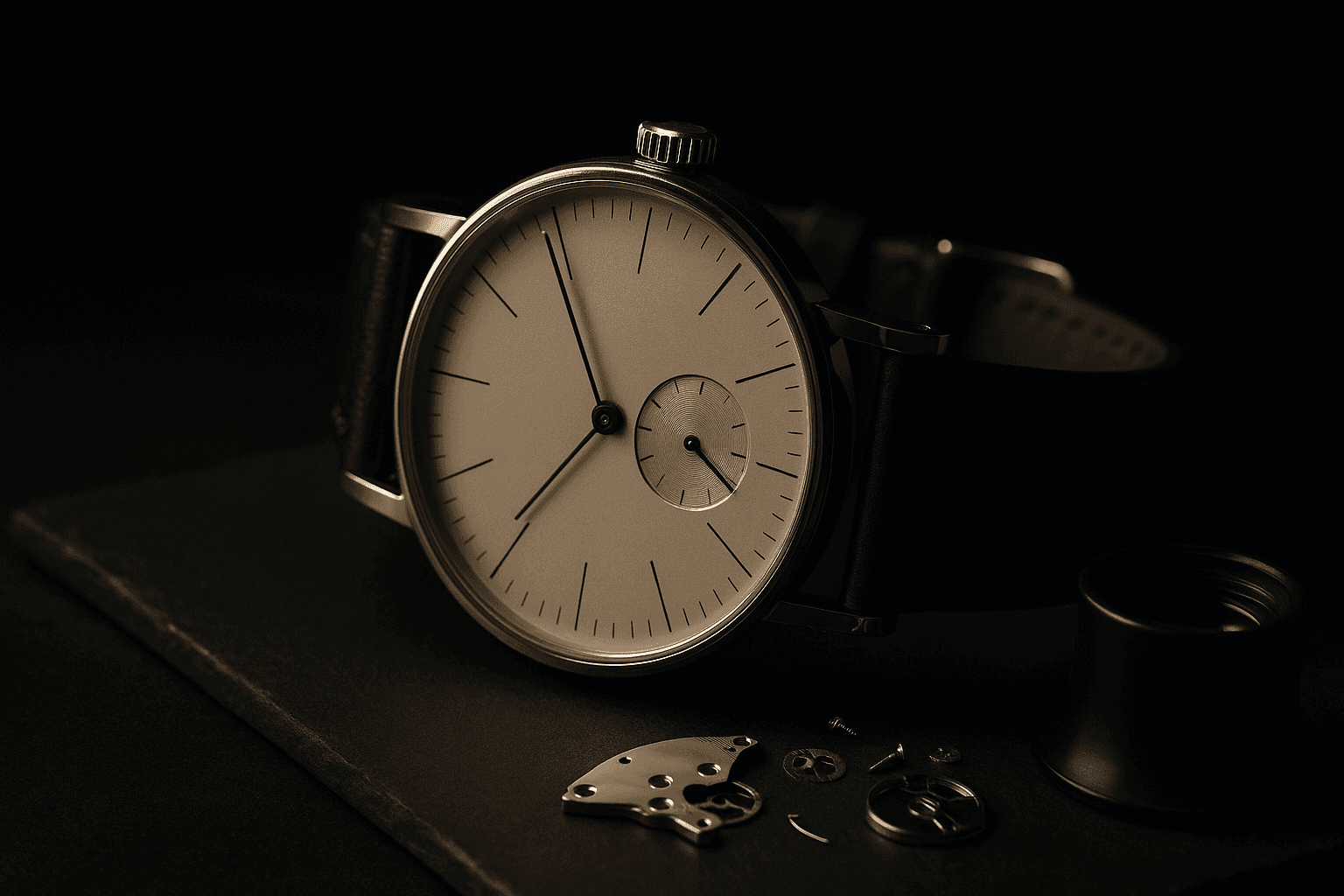
Nomos Glashütte: Collecting Bauhaus Design at an Entry Price Point
By The Subdial Editors ·
Have you ever wondered why a watch with an in-house caliber, an in-house escapement, and a Glashütte address sells for roughly the price of a mid-tier Swiss watch running a modified Sellita? If you have spent any time in the independents corner of the market, that question should bother you.
Nomos Glashütte occupies an odd position in the collecting hierarchy. It is routinely described as an entry-level brand, and just as routinely recommended by people whose collections start well above the point where entry-level advice matters.
Nomos Glashütte makes its own calibers and its own escapement in Glashütte, Saxony, with most references priced between roughly $2,000 and $6,000 at retail — vertical integration usually found several times higher.
That gap between what the brand does and where it sits in the conversation is the subject here. We have given the larger Saxon manufactures close scrutiny in our coverage of the A. Lange & Söhne Saxonia Thin and Glashütte Original's collecting case, and Nomos has earned the same treatment.
Why Does Nomos Get Filed Under "First Nice Watch"?
Part of the answer is design. The Bauhaus vocabulary — flat dial, thin bezel, minimal case, sans-serif numerals — reads as simple, and simplicity is easy to mistake for cheapness.
The other part is price positioning, which the brand chose deliberately. Nomos has kept its core Tangente, Club, and Orion lines in a band where a first-time buyer can reach them, and that band anchors the brand's public identity more firmly than its movement program does.
Keep in mind that positioning and capability are separate variables. A brand can price for accessibility while building at a level its price neighbors cannot approach, and that is precisely the gap worth exploiting as a collector.
What Nomos Actually Manufactures
The claim that matters is the escapement. Nomos developed the Swing System — its own escapement assembly including hairspring, balance, escape wheel, and pallet fork — and brought it into production in the mid-2010s.
That is a shorter list of companies than most collectors assume. Producing a hairspring in-house is one of the genuine dividing lines in watchmaking, and a brand selling three-hand watches under $5,000 is not where you expect to find it.
The Swing System is the Nomos in-house escapement, covering hairspring, balance wheel, escape wheel, and pallet fork. Very few manufactures at any price produce their own hairspring, which makes it the brand's strongest technical claim.
Beyond the escapement, the caliber families are the brand's own designs rather than reworked ébauches. Alpha, the hand-wound base, gave way to the DUW 3001 automatic — a movement roughly 3.2mm thick that enabled the slimmer Neomatik cases.
Finishing follows a Glashütte grammar rather than a Genevan one. You get the three-quarter plate, a Glashütte ribbing pattern, blued screws, tempered blue or gold-toned components, and a sunburst on the ratchet wheel.
It is machine-applied finishing, executed cleanly and honestly, rather than the hand-anglage that defines the top tier. For readers who want the vocabulary for judging that distinction, our piece on how to read movement hand-finishing sets out what separates decoration from craft.
The Core Lines, And What Distinguishes Them
Nomos runs a small number of families and iterates within them rather than launching constantly. That consistency is a collecting advantage — the design language does not reset every three years.
The main collections you will encounter on the secondary market include but are not limited to:
- Tangente. The signature reference and the most recognizable Bauhaus silhouette in production, with its long lugs, sub-seconds at six, and numerals derived from the brand's 1990s founding design. Case sizes have ranged from 33mm through 38mm and beyond, and the 38mm remains the default recommendation for most wrists.
- Club. The sportier interpretation, with a California-influenced dial, thicker lugs, and a more casual register. It is the line most often chosen by buyers who want a Nomos that does not read as dressy.
- Orion. The most formal of the group, with no numerals, a dot or baton index layout, and a slimmer profile. It is the closest Nomos comes to competing directly with traditional dress watches.
- Metro. A more contemporary design by Mark Braun, with a distinct color palette and a date-and-power-reserve execution in some references. It divides opinion more than the others, which has consequences on resale.
- Ludwig, Lambda, Lux. Ludwig sits alongside Tangente as a Roman-numeral alternative, while Lambda and Lux represent the brand's precious-metal, higher-complication end with the hand-wound DUW 1001 and a longer power reserve.
Within those families, the meaningful split is Neomatik versus the older hand-wound and standard automatic references. Neomatik designates the thin DUW 3001 automatic platform, and it changes both the case profile and the wearing experience considerably.
How Does Nomos Pricing Compare To Its Neighbors?
Most of the range sits between roughly $2,000 and $6,000 at retail depending on reference, material, and movement, with the precious-metal Lambda and Lux climbing well above that. Verify current figures against the manufacturer's own price list before any transaction, since the brand has adjusted pricing more than once in recent years.
The comparison that clarifies the value proposition is not against other German brands but against the Swiss watches occupying the same shelf.
| Attribute | Nomos Glashütte | Typical Swiss peer at similar price |
|---|---|---|
| Movement origin | In-house caliber families (Alpha, DUW 3001, DUW 1001) | Commonly ETA or Sellita base, sometimes modified |
| Escapement | In-house Swing System including hairspring | Sourced escapement and hairspring |
| Finishing idiom | Glashütte three-quarter plate, ribbing, blued screws | Côtes de Genève or perlage, often on a sourced base |
| Design authorship | Single coherent Bauhaus language since the 1990s | Frequently revisionist or heritage-reissue driven |
| Secondary-market liquidity | Thinner; brand-aware buyer pool | Generally broader, name-recognition driven |
| Retail-to-secondary delta | Meaningful discount common on non-limited references | Varies widely by brand and reference |
Note that the final row is where the collecting calculus actually turns. Nomos gives you manufacture content at the purchase and gives some of it back at the sale, which is a different trade than most buyers think they are making.
The Resale Reality, Stated Plainly
Nomos does not hold value the way a steel sports watch from a hype brand does, and pretending otherwise would be a disservice. The buyer pool is smaller, the design is polarizing to people outside it, and there is no allocation scarcity generating artificial demand.
Nomos references generally trade below retail on the secondary market. Limited editions and discontinued colorways hold better, but no Nomos should be bought on an expectation of appreciation.
What that means in practice is that the secondary market is the collector's entry point, not their exit strategy. Buying a pre-owned Tangente or Orion from a dealer with photographs of the movement, the box, and the papers puts you meaningfully below retail on a watch whose mechanical content has not depreciated at all.
Be aware that the discount varies sharply by line. Tangente and Club — the volume references — see the deepest pre-owned supply and therefore the widest spreads, while Lambda, Lux, and the harder-to-find limited runs behave differently.
This is a version of the same dynamic we examined in the ownership economics of a mechanical collection: the watch that costs less to acquire and less to maintain can outperform a nominally better investment across a decade of actual ownership.
Which References Reward Scrutiny?
Not every Nomos deserves the same attention, and the brand's consistency means the differences between references are narrower than at manufactures that reinvent themselves regularly. The distinctions that matter are movement generation, case size, and dial rarity.
Here is how to think about the hierarchy:
- Tangente 38 and Tangente 38 Datum. The reference case size for most collectors and the clearest statement of the design. The hand-wound Alpha version wears thinner than the automatic and is the purist's choice.
- Tangente Neomatik 41 Update. The date ring executed as a circumference of numerals with a red marker bracketing the date is one of the genuinely clever date solutions in modern watchmaking, and it is worth the premium over a conventional window.
- Orion 38 and Orion Neomatik. The most underrated line. A dress watch with an in-house escapement at this price has very few direct competitors, and the index-only dial ages better than numeral dials for formal wear.
- Club Campus. The entry point proper, priced below the rest of the range and frequently the reference people mean when they call Nomos a starter brand. It is a legitimate watch, but it is not where the collecting interest sits.
- Lambda and Lux. Precious metal, the DUW 1001 with a longer power reserve, and hand-finishing well beyond the core range. These are the references that answer the question of what Nomos can do when price is not the constraint.
- Limited and boutique colorways. Anniversary editions, Ace Jewelers and other retailer collaborations, and discontinued dial colors carry whatever secondary-market premium exists in the brand. Check production figures against the manufacturer's own announcement rather than a forum post.
All of these come down to a single decision: whether you are buying the design or the movement. If it is the design, case size and dial color should drive the purchase, and the volume references serve perfectly well.
What To Check Before Buying Pre-Owned
Nomos is not a heavily counterfeited brand, which removes the authentication anxiety that shadows a pre-owned Rolex or Patek purchase. The diligence here is about condition and service history rather than legitimacy.
Nomos authentication is low-risk relative to heavily faked brands. Focus your pre-owned diligence on case-polishing, lug sharpness, dial condition under magnification, and documented service rather than counterfeit detection.
The vulnerable element is the case. Nomos lugs are long, thin, and precisely faceted, and an over-polished example loses the crispness that makes the design work in the first place.
Request photographs of the lugs from an angle that shows the transition from the case flank to the lug top. On a healthy example that edge is a clean line; on a polished one it is a soft radius, and no amount of dial condition compensates.
Ask about service as well. The Swing System is serviceable by the manufacture and by competent independents, but the brand's escapement components are not shared with the ETA ecosystem, and that has implications for turnaround and parts availability outside authorized channels.
Some examples of the questions worth asking a seller include:
- Which caliber is in it? Alpha, DUW 3001, DUW 4301, or DUW 1001 — the answer determines thickness, winding behavior, and service expectations.
- Has the case been polished? A truthful seller will say so; ask for the lug-angle photograph regardless of the answer.
- Are the box, papers, and original strap present? Nomos straps are Horween shell cordovan on many references and a replacement strap is a small but real cost.
- What is the service history? Any mechanical watch over roughly seven or eight years without service carries a maintenance liability that should be priced into the offer.
- What is the time on market? A Nomos sitting unsold for several months is negotiating leverage, given how thin the buyer pool is.
All of this adds up to a straightforward inspection. Nomos rewards patience on the pre-owned market more than urgency, because supply refreshes steadily and nothing in the catalog is genuinely scarce except the deliberate limited runs.
Where Nomos Fits In A Collection
The honest framing is that Nomos is not competing with the watches collectors usually compare it to. It is not a value alternative to a Swiss sports watch, and it is not a lesser version of the Saxon manufactures up the road.
It is a design house that happens to manufacture its own movements, and the collection reads best as one coherent statement rather than as a stepping stone. A Tangente bought at 38mm in 2016 looks exactly as intended in 2026, which is more than most catalogs at any price can claim.
For collectors building around independents, Nomos also functions as ballast. Alongside the volatility of Voutilainen and Akrivia at the top of the independent market, a watch you can buy without allocation politics and wear without anxiety serves a genuine purpose.
Our Editorial Recommendation
If you want the clearest expression of what the brand does, buy an Orion Neomatik 39 or a Tangente Neomatik 41 Update, pre-owned, from a dealer who will photograph the lugs. Both put the DUW 3001 on your wrist and both sit in the part of the market where the retail-to-secondary delta works for you.
If you want the hand-wound purity, the Tangente 38 with the Alpha caliber is the reference the brand was built on, and the thinner case is the version people keep. And if the budget extends, the Lambda is the piece that settles any argument about whether Nomos belongs in the serious collecting conversation.
What we would not do is buy a Nomos expecting the market to reward you later. Buy it because it is the most design-literate watch you can own with an in-house escapement, and treat whatever it returns at sale as a rebate rather than a return.
Every price band and range on this page reflects publicly observable market conditions at the time of writing and should be verified against manufacturer pricing and current dealer listings before any transaction. Production figures for limited references should be confirmed against the manufacturer's own announcements.
Definitions And Background Information On Nomos Collecting
What does Neomatik mean on a Nomos dial?
Neomatik designates a reference running the DUW 3001 automatic caliber, an ultra-thin movement of roughly 3.2mm. The designation signals a slimmer case profile than the brand's earlier automatic references.
Is Nomos actually made in Glashütte?
Yes. The manufacture operates from the former railway station building in Glashütte, Saxony — the same village that houses A. Lange & Söhne and Glashütte Original — and German law governs what may carry the Glashütte designation.
What is the three-quarter plate and why does Nomos use it?
The three-quarter plate is a single large bridge covering most of the going train, introduced in Glashütte watchmaking in the nineteenth century. It is a regional signature that also adds rigidity to the movement architecture.
Who designed the Tangente?
The Tangente's design language descends from Bauhaus-era German wristwatch design and was established at the brand's founding in the early 1990s. It has been iterated in size and movement since, but the dial grammar has stayed remarkably fixed.
Frequently Asked Questions
The questions below cover the practical ground that comes up most often when collectors evaluate the brand for the first time.
For readers working through the independents category more broadly, our coverage of H. Moser & Cie collecting addresses a brand that took the opposite positioning route from the same starting point.