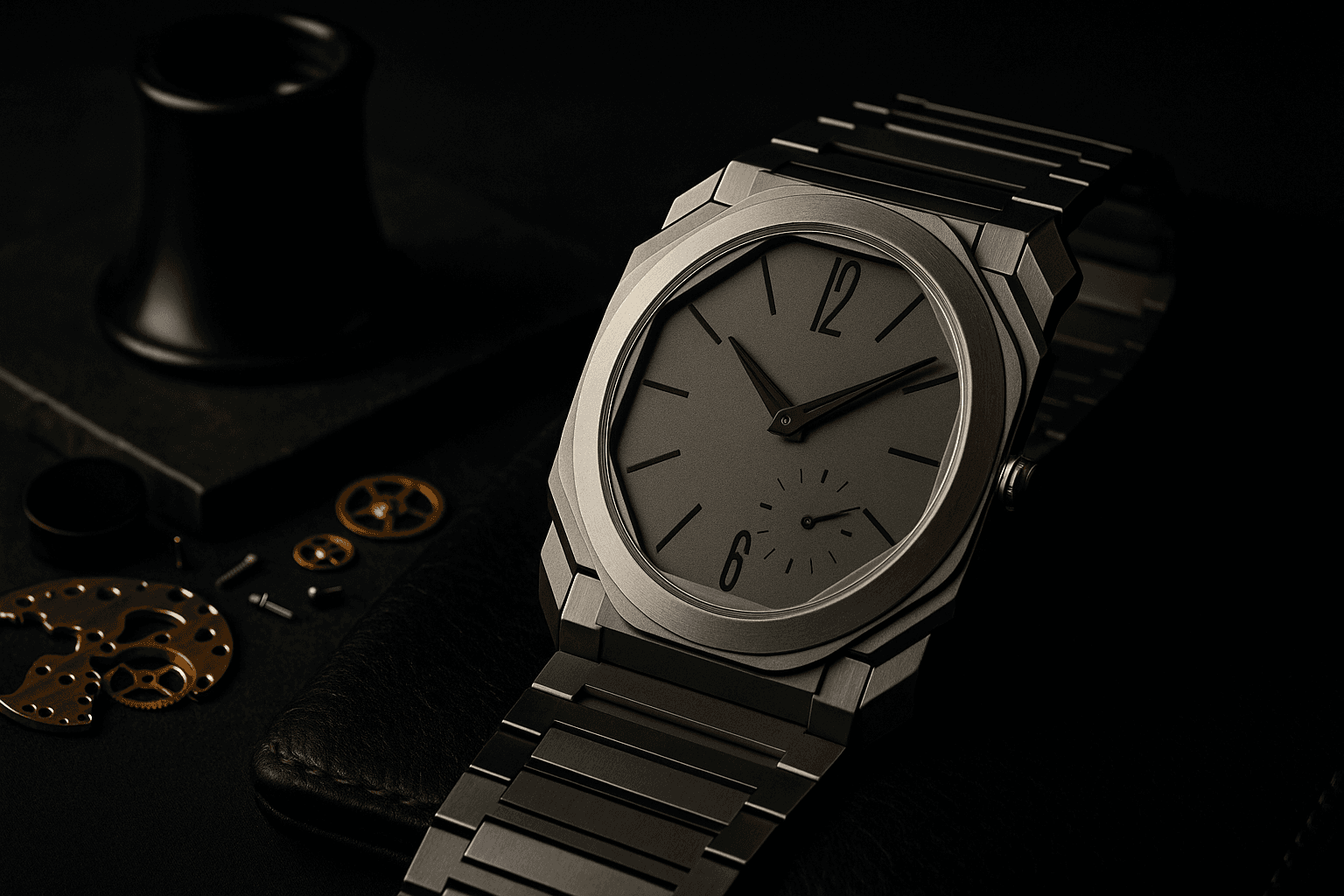
Bulgari Octo Finissimo: How a Roman Jeweler Won the Ultra-Thin Race
By The Subdial Editors ·
When Bulgari introduced the Octo Finissimo Ultra in 2022, the finished watch measured 1.80mm from caseback to sapphire, and the Ultra COSC that followed in 2024 took that figure to 1.70mm. Those are not movement dimensions presented as case dimensions; that is the entire object, crystal to skin.
What makes the run remarkable is the house that produced it. Bulgari is a Roman jeweler founded in 1884, and in roughly a decade it has claimed more ultra-thin world records than any of the Swiss manufactures that spent the previous century defining the discipline.
This post walks the Octo Finissimo line reference by reference, explains the movement architecture behind the records, and looks at how the collection trades against its Geneva rivals. Where figures matter, they are given as ranges and flagged when they are estimates.
The Octo Finissimo is Bulgari's ultra-thin collection, launched in 2014 with the thinnest tourbillon then made. Later references claimed records for the thinnest automatic, chronograph, perpetual calendar, and mechanical watch.
Where The Octo Finissimo Came From
Bulgari's route into serious watchmaking ran through an acquisition rather than a founding myth. In 2000 the group bought Gérald Genta and Daniel Roth, and with them the Le Sentier workshops along with the complication expertise that had produced minute repeaters and jumping-hour movements for two of the most inventive names in the trade.
The octagonal case came from the same purchase. Genta's Octo paired an eight-sided case with a round bezel, and Bulgari relaunched the shape under its own name in 2012 before reworking the geometry into the flat, faceted architecture that debuted as the Octo Finissimo Tourbillon in 2014.
Fabrizio Buonamassa Stigliani, a former automotive designer who joined Bulgari in 2001, led that redesign. His background matters, because the Octo reads as an industrial-design object — proportion first, decoration second — in a category that usually leads with hand-finishing.
That first Finissimo reference set the pattern for everything after it. It carried the hand-wound BVL 268 at 1.95mm, the thinnest tourbillon movement made to that point, in a sandblasted titanium case that has since become the line's signature.
Keep in mind that the design and the engineering are inseparable here. The Octo case is routinely described as carrying more than a hundred facets, and the reason a watch this thin still holds presence on the wrist is that those facets catch light along the flanks where a conventional round case would show only a slab.
Bulgari acquired Gérald Genta and Daniel Roth in 2000, gaining the Le Sentier manufacture and the octagonal Octo case. The Octo Finissimo launched in 2014 with a 1.95mm hand-wound tourbillon caliber.
The Record Run, Reference By Reference
Bulgari's record claims are easier to judge laid side by side than recited in prose. The table below lists the headline references, the record each was announced against, and the published movement and case dimensions.
| Year | Reference | Record claimed at launch | Movement | Case |
|---|---|---|---|---|
| 2014 | Octo Finissimo Tourbillon | Thinnest tourbillon | BVL 268, 1.95mm, hand-wound | 5.00mm |
| 2016 | Octo Finissimo Minute Repeater | Thinnest minute repeater | BVL 362, 3.12mm, hand-wound | 6.85mm |
| 2017 | Octo Finissimo Automatic | Thinnest automatic | BVL 138, 2.23mm, micro-rotor | 5.15mm |
| 2018 | Octo Finissimo Tourbillon Automatic | Thinnest automatic tourbillon | BVL 288, 1.95mm, peripheral rotor | 3.95mm |
| 2019 | Octo Finissimo Chronograph GMT Automatic | Thinnest automatic chronograph | BVL 318, 3.30mm, peripheral rotor | 6.90mm |
| 2020 | Octo Finissimo Tourbillon Chronograph Skeleton | Thinnest tourbillon chronograph | 3.50mm, self-winding | 7.40mm |
| 2021 | Octo Finissimo Perpetual Calendar | Thinnest perpetual calendar | BVL 305, 2.75mm, peripheral rotor | 5.80mm |
| 2022 | Octo Finissimo Ultra | Thinnest mechanical watch | Integrated into caseback | 1.80mm |
| 2024 | Octo Finissimo Ultra COSC | Thinnest mechanical watch, chronometer-certified | Integrated into caseback | 1.70mm |
Two caveats belong with that table. The records are as claimed by Bulgari at launch, and at least one was contested almost immediately — Richard Mille's RM UP-01 Ferrari arrived in 2022 at a stated 1.75mm, which is why the 1.70mm Ultra COSC mattered strategically as much as technically.
What the sequence shows is a campaign rather than a lucky prototype. Bulgari worked outward from a single hard problem — how to compress a complication into roughly two millimetres of movement height — and then applied the same solutions to a tourbillon, a repeater, a chronograph, and a perpetual calendar in turn.
How Bulgari Actually Builds Thin
Thin movements are not shrunken conventional movements. Below roughly 3mm the usual stack of mainplate, bridges, going train, winding system, and dial stops fitting, and the architecture has to be rearranged rather than reduced.
The first move is winding. A central rotor sits above the movement and adds height, so the BVL 138 in the Octo Finissimo Automatic uses a platinum micro-rotor recessed into the movement plane, while the BVL 318 chronograph and BVL 305 perpetual calendar use peripheral rotors that orbit the outside of the caliber and add almost nothing vertically.
The second move is bearing design. The tourbillon in the BVL 268 runs on a ball bearing rather than under a conventional upper bridge, which removes an entire structural layer from the tallest part of the movement.
The third move, reserved for the Ultra, is to delete the mainplate. In that caliber the titanium caseback is the mainplate — the wheels mount directly into the back of the watch, the dial is displaced off-centre, and the escapement sits exposed on the dial side because there is nowhere left to hide it.
Material choice does the rest. Sandblasted titanium gives Bulgari stiffness per gram that steel cannot match at these wall thicknesses, and it keeps a 40mm case from flexing enough to foul a movement running on microns of clearance.
Note that the physics extracts a price. Thin barrels store less energy, so Bulgari widens them rather than deepening them to reach the roughly 55 to 60 hours quoted across the automatic calibers, and water resistance across the line is dress-watch modest rather than sports-watch serious.
Vertical integration underpins all of it. Bulgari's watchmaking is reported to run across Le Sentier for movements, Saignelégier for cases and bracelets, and Neuchâtel for assembly, which is why the house can iterate a record attempt annually instead of waiting on a supplier's development cycle.
Ultra-thin calibers rearrange architecture rather than shrink it. Bulgari uses micro-rotors and peripheral rotors in place of central rotors, ball-bearing tourbillon cages, and in the Ultra, a caseback that serves as the mainplate.
The Ultra As A Halo Reference
The Ultra references are demonstrations, and they should be read that way. At 1.80mm in 2022 and 1.70mm in 2024, they exist to establish a ceiling, and the constraints that come with the thickness — minimal water resistance, a displaced dial, an exposed escapement, strictly limited production — make them unsuitable as daily watches.
List pricing sat in six-figure territory and edition sizes were small enough that both references are effectively broker-and-auction propositions rather than boutique purchases. Verify the edition size and original price against Bulgari's official release for the specific reference before treating any secondary ask as reasonable.
The 2022 Ultra also carried a small QR code engraved on the barrel cover, linking the physical watch to a digital artwork. It reads very much of its moment, and it is worth knowing about when authenticating a specific example.
For most buyers the Ultra matters indirectly. It is the proof that the engineering underneath the 5.15mm Octo Finissimo Automatic is real rather than marketed, and that credibility is what separates Bulgari's thin watches from a jeweler's fashion product.
The References That Actually Get Worn
Strip out the halo pieces and the collection resolves into a handful of references that do the real work. Each uses the same faceted case language, so the choice between them comes down to complication and material.
Here is how the core references sort out:
- Octo Finissimo Automatic. The 40mm, 5.15mm reference built on the BVL 138 micro-rotor caliber, offered over the years in sandblasted titanium, steel, rose gold, and ceramic. This is the line's clearest statement and the reference most collectors should audition first.
- Octo Finissimo Chronograph GMT Automatic. A 42mm, 6.90mm case housing the BVL 318, an integrated chronograph with peripheral winding and a second time zone. It is the most wearable complicated reference in the line and the one that best justifies the thin-case engineering in daily use.
- Octo Finissimo Skeleton. The openworked treatment of the hand-wound architecture, which suits the Octo's industrial geometry better than skeletonisation usually suits a dress watch. Expect firmer secondary demand than the plain automatic in the same metal.
- Octo Finissimo Perpetual Calendar. The 2021 record holder, BVL 305 at 2.75mm inside a 5.80mm case, with a retrograde date and peripheral winding. Among the line's serious complications, this is the one that reads as a considered watch rather than a technical exercise.
- Artist and architect editions. Bulgari has released Octo Finissimo collaborations with Tadao Ando and Kazuyo Sejima, among others, in small runs. Market reporting suggests these have held value better than the standard references; confirm against live comps before paying a scarcity premium.
All of the above share one practical decision point. The integrated bracelet defines the Octo Finissimo silhouette and adds very little height, but strap versions wear differently and cost meaningfully less, so try both before you commit to a reference.
The Octo Finissimo Automatic is the line's core reference: 40mm wide, 5.15mm thick, powered by the BVL 138 micro-rotor caliber at 2.23mm. It is also the most liquid Octo Finissimo on the secondary market.
How The Line Trades Against Geneva
Thinness is a specification, and specifications do not by themselves set prices. The table below places the Octo Finissimo Automatic against the ultra-thin and integrated-bracelet references it is cross-shopped against, using figures as published by each manufacture.
| Watch | Case thickness | Caliber | Positioning |
|---|---|---|---|
| Bulgari Octo Finissimo Automatic | 5.15mm | BVL 138, 2.23mm, micro-rotor | Integrated bracelet, sandblasted titanium, record-holding automatic |
| Piaget Altiplano Ultimate Automatic | 4.30mm | 910P, movement and case unified | The historic ultra-thin house; classical round case |
| Vacheron Constantin Historiques Ultra-Fine 1955 | 4.13mm | 1003, 1.64mm, hand-wound | Geneva pedigree, hand-wound, heritage reissue |
| Jaeger-LeCoultre Master Ultra Thin | from roughly 4.05mm | 849 family, 1.85mm, hand-wound | Value-led ultra-thin with manufacture credentials |
| A. Lange & Söhne Saxonia Thin | 5.90mm | L093.1, 2.90mm, hand-wound | Finishing-first Saxon alternative at similar height |
| Audemars Piguet Royal Oak "Jumbo" | roughly 8.10mm | 7121 family, ultra-thin automatic | The integrated-bracelet benchmark on demand, not dimensions |
Read that table and Bulgari looks competitive on engineering and generous on price. Read the secondary market and a different picture appears, because brand hierarchy rather than case thickness sets residual values in this segment.
Bulgari's problem is categorical. The house is understood first as a Roman jeweler, and buyers who accept a jeweler's watch at retail tend not to bid it up in resale the way they bid up a Geneva manufacture — the same dynamic covered in our analysis of how luxury watches retain value.
The practical consequence is that common Octo Finissimo references have generally traded below original list on the secondary market, while limited editions, the Perpetual Calendar, and the Ultra have held far better. Treat those as estimated bands rather than quoted figures, and verify current levels against live Chrono24 asks and recent auction results before you transact.
That gap is an opportunity if you intend to wear the watch. A titanium Octo Finissimo Automatic bought well is one of the more interesting mechanical objects available at its money, particularly next to A. Lange & Söhne's Saxonia Thin at similar height but with very different finishing priorities.
It is a poor argument if you intend to trade. Buyers chasing appreciation are better served by the allocation mechanics behind the Royal Oak's integrated-bracelet heritage or by the collecting hierarchy we map in our Vacheron Constantin collecting guide, where scarcity is manufactured rather than incidental.
Octo Finissimo references have generally traded below original list on the secondary market, while the Perpetual Calendar, Ultra, and limited editions hold better. Verify current bands against live Chrono24 and auction comps.
The Buying Playbook
Ultra-thin watches reward specific diligence, and the Octo Finissimo has a short list of failure points worth checking before money moves. Here is what to inspect, in order:
- Sandblast integrity. The matte titanium finish cannot be polished out conventionally; damage requires re-blasting, and partial refinishing leaves a visible texture mismatch. Inspect the case flanks and bracelet links in raking light before you agree a price.
- Bracelet condition. The integrated bracelet is thin by design, so stretch or a bent link is expensive to correct because replacement components are reference-specific. Check the clasp action and lay the bracelet flat to look for wave.
- Service history and interval. Ultra-thin calibers run at tighter clearances than conventional movements, which makes a lapsed service a larger risk here than on a 12mm sports watch. Ask for dated documentation rather than a seller's assurance.
- Service access and cost. Expect Bulgari-network servicing rather than a local independent, because few independents are tooled for these tolerances. Budget accordingly, and read our breakdown of the real economics of watch ownership before you set an all-in number.
- Reference and caliber confirmation. Bulgari has offered similar-looking references across metals, dial finishes, and complications over the years. Match the caseback reference and the caliber to the specific model rather than trusting the listing title.
- Completeness. Box, papers, and spare links move price materially on the secondary market. Their absence is the main reason two apparently identical examples show a wide spread in asking price.
All of these check the same underlying thing: whether the example in front of you has been treated as a precision instrument or as jewelry. The Octo Finissimo tolerates the first and punishes the second.
Sandblasted titanium cannot be polished conventionally, so damaged cases must be fully re-blasted. Inspect the flanks and bracelet links in raking light, and budget for Bulgari-network servicing on ultra-thin calibers.
Editorial Recommendation
For a first Octo Finissimo, buy the Automatic in sandblasted titanium on the integrated bracelet, pre-owned, with box, papers, and documented service history. It is the reference that defines the line, the most liquid one if you change your mind, and the one where the secondary-market discount does the most work for you.
Step up to the Chronograph GMT Automatic if you want a complication you will actually use, or to the Perpetual Calendar if you want the reference that best rewards the engineering story. Leave the Ultra to buyers collecting records rather than watches.
Common Questions
The questions below come up repeatedly when collectors weigh an Octo Finissimo against a more conventional Geneva purchase.
Is the Octo Finissimo too fragile for daily wear?
The titanium references wear robustly for a dress watch, but the thin cases and modest water resistance punish drops and desk-diving. Treat them as considered daily wear rather than knockabout sports watches.
How does the Octo Finissimo hold value on the secondary market?
Common titanium and steel references have generally traded below list, while the Ultra, the Perpetual Calendar, and limited artist editions hold considerably better. Verify current bands against live Chrono24 asks and recent auction comps.
Which Octo Finissimo reference is the best entry point?
The Octo Finissimo Automatic in sandblasted titanium, caliber BVL 138 at 2.23mm inside a 5.15mm case, is the line's clearest statement and its most liquid reference on the secondary market.
Can sandblasted titanium cases be polished after damage?
Not conventionally. The matte surface has to be re-blasted, and partial refinishing leaves a visible texture mismatch, so budget for full-case work through Bulgari rather than a local polisher.
Does Bulgari make its own ultra-thin movements?
Yes. The Finissimo calibers are developed and assembled at Bulgari's Le Sentier manufacture, the former Gérald Genta and Daniel Roth workshops acquired in 2000, with case and dial operations held in-house as well.
Where To Go From Here
Bulgari's decade of record-taking has done something durable. It moved a jewelry house into the technical conversation on merit, with in-house calibers and a design language that is genuinely its own.
Whether that translates into a watch you should buy depends less on the records than on how you weigh engineering against brand hierarchy. If you are weighing an Octo Finissimo against a Geneva alternative, start with our overview of the Swiss watch marques and our work on Chopard's L.U.C in-house movements, then read how auction estimates are set before bidding on a limited reference.
The engineering case for the Octo Finissimo is settled. The value case is one you should build yourself, against live comps and a verified service history.