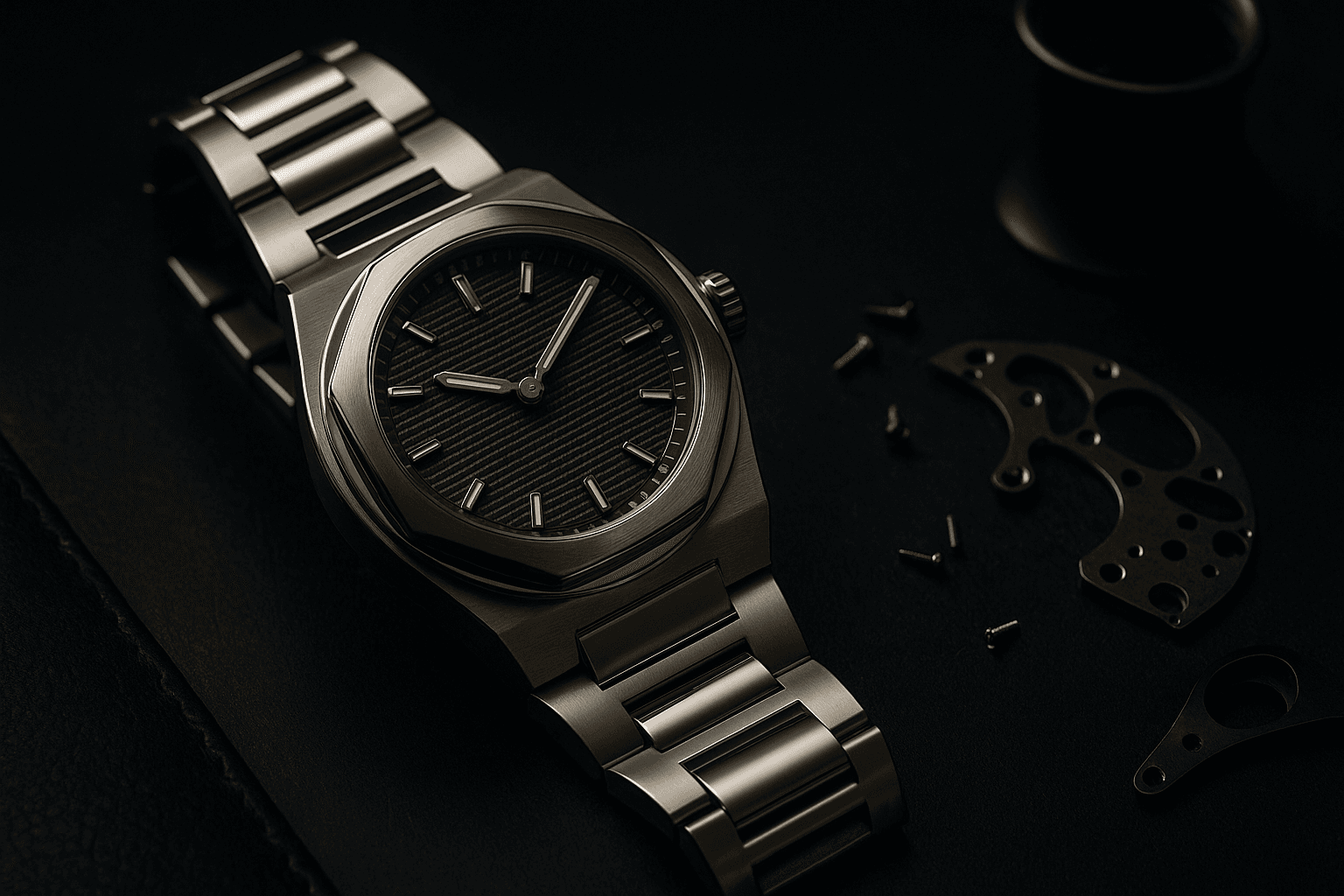
Girard-Perregaux and the Laureato: The Integrated-Bracelet Sports Watch Collectors Skip
By The Subdial Editors ·
The mid-1970s produced a narrow and strange body of work in Swiss watchmaking: steel sports watches priced like precious-metal dress watches, launched into a market that was losing its floor to quartz. Most of that work has since been canonized, reissued on a schedule, and priced accordingly.
The canon edits, however. It remembers two Gérald Genta commissions and forgets that several manufactures answered the same brief inside the same five-year window, with their own designers, their own cases, and their own movements.
Girard-Perregaux's Laureato is the most substantial of the forgotten answers. It arrived in 1975, and four decades of uneven marketing have left it trading at a discount that has very little to do with how it was built.
The Laureato launched in 1975 with an octagonal bezel on a round case and a bracelet integrated into the case flanks. It predates both the Nautilus and Vacheron's 222 by one to two years.
What Arrived In 1975
The original Laureato paired that octagonal bezel with a round case and a bracelet that grew out of the case rather than hanging off it, a design vocabulary that reads as entirely familiar now and did not then. Girard-Perregaux has consistently credited the drawing to a Milanese architect whose name the house has never published.
Inside was a Girard-Perregaux quartz caliber, which sounds like an apology today and was a statement at the time. The manufacture's early-1970s quartz work is part of why 32,768 Hz became the industry's standard oscillator frequency, a piece of technical history that survives in essentially every quartz watch sold since.
That provenance matters for how you read the watch. The Laureato came from one of the very few Swiss houses that had actually won something in quartz, which is a different starting position from a mechanical firm improvising a defensive gesture.
The name is worth a moment as well. Laureato is Italian for graduate, and the watch was positioned as the thing you bought yourself at the moment you arrived — a register that the Italian market understood immediately and the American market largely never heard.
What Girard-Perregaux Actually Builds
The house traces its lineage to 1791 through Jean-François Bautte's Geneva workshop, with the Girard-Perregaux name itself dating to the 1856 marriage of Constant Girard and Marie Perregaux. It has spent most of its modern life in La Chaux-de-Fonds.
Its signature is the Tourbillon with Three Bridges, an architecture Constant Girard developed in the 1860s that turned a structural element into the dial's entire composition. Very few brands own a visual idea that specific, that old, and that difficult to copy.
More relevant to a Laureato buyer is the industrial fact underneath: Girard-Perregaux designs, produces, and finishes its own calibers rather than assembling a supplier base behind a house name. If you weigh movement hand-finishing and in-house caliber development when you buy, the Laureato is competing several tiers above its price.
Girard-Perregaux designs and produces its own movements in La Chaux-de-Fonds, including the GP01800 automatic in the modern Laureato. That places it in a genuinely small group of Swiss manufactures.
The Generations, And Which One You Are Looking At
The 1975 quartz Laureato ran through variations into the 1980s, in steel and in two-tone, with dial and case changes that no single reference catalogue documents cleanly. The original's case sat in the high thirties, which was an unusually assertive size for 1975 and reads as perfectly modern now.
A mechanical Laureato followed in the mid-1990s, and that generation is the one most often mispriced today. Examples surface quietly, frequently without full link sets, and the market has no consensus on what they should cost.
The modern era starts in 2016, when Girard-Perregaux built a 38mm Laureato for the manufacture's 225th anniversary in a run reported at 225 pieces, then expanded the design into a full collection the following year. That 2017 relaunch established the sizes the line still runs today.
Since then the family has grown to include chronographs, skeletonized executions, a perpetual calendar, tourbillon references on the Three Bridges architecture, and the larger Laureato Absolute in titanium and composite cases. The Absolute is best understood as a separate design brief that borrowed the name.
The modern Laureato runs in 34mm, 38mm, and 42mm, plus a 44mm Absolute. The 38mm tracks the 1975 proportions most closely, while the 42mm is the volume seller and the easier one to find used.
Reference By Reference: Where The Value Sits
The Laureato line is broad enough that a buyer's real decision is which of five or six distinct propositions they are actually after. The table below sets out how we read each family against its secondary-market position.
| Reference family | Case | Movement | Editorial read |
|---|---|---|---|
| Laureato 38mm steel | 38mm, integrated steel bracelet | GP01800 in-house automatic | Closest to the 1975 proportions and the reference we would buy first. Wears flatter than the specs suggest. |
| Laureato 42mm steel | 42mm, integrated steel bracelet | GP01800 in-house automatic | Volume seller with the deepest used supply and, accordingly, the widest discount to list. |
| Laureato Chronograph | 42mm, steel or gold | In-house automatic chronograph | The strongest mechanical content per franc in the line. Budget for a real service interval. |
| Laureato 225th Anniversary (2016) | 38mm, run reported at 225 pieces | GP01800 in-house automatic | The scarcity play. Verify numbering, papers, and the original presentation set before paying the premium. |
| Laureato Absolute | 44mm, titanium and composite | GP in-house automatic | A different watch wearing the family name, with the weakest residual logic of the group. |
| Laureato Tourbillon, Three Bridges | Varies by execution | GP tourbillon calibers | Bought for the movement rather than the case. Comparable sales are thin and auction-driven. |
Read across that table and the pattern is consistent: the references that hew closest to the 1975 brief hold their position best, and the ones that stretch the name furthest give the most back. That is the same residual logic that governs Royal Oak heritage references, applied to a brand nobody is queuing for.
How It Wears, And Why That Sells It
The Laureato's case is thin for a watch with an integrated bracelet and a screw-down execution, and Girard-Perregaux publishes 100 metres of water resistance on the steel three-hand references. Confirm the figure on the individual reference, because it does vary across the family.
The GP01800 runs at 4 Hz with a manufacturer-stated power reserve in the region of 54 hours, which is competitive rather than remarkable. The finishing is where the money shows: the Clous de Paris dial treatment, the bevelled bezel edge, and the bracelet's alternating brushed and polished surfaces are executed at a level that survives close comparison with the Octo Finissimo and the Tonda PF.
On the wrist, the 38mm disappears under a cuff in a way the 42mm does not. Buyers coming from a 40mm sports watch usually expect to want the larger case and usually leave with the smaller one.
Reading The Secondary Market
The Laureato trades where it trades because Girard-Perregaux does not generate the waiting-list theatre that props up its neighbours. There is no allocation game here of the kind we have covered in Patek allocation reality and Rolex retail dysfunction, which means retail is a real transaction rather than a lottery ticket.
Our read of current listing data puts clean, complete, well-specified steel three-hand examples in a broad band of roughly 50 to 70 percent of current list. Treat that figure as an estimate and a starting frame only.
Verify it against live Chrono24 inventory, dealer stock, and completed results at the major houses before you commit to a number. Auction comps for the Laureato are thin enough that a single unusual result can distort a whole reference, which is exactly the failure mode we set out in auction estimate mechanics.
Steel Laureato references typically resell well under list, on our read of current listing data. Verify any specific figure against live Chrono24 comps and completed auction results before transacting.
The buy-side consequence, if the pattern holds, is that a used Laureato buyer absorbs a manufacture-grade watch at a discount someone else already paid for. What remains is running cost rather than further decline, which is the frame we use throughout our work on long-run ownership economics.
Keep in mind that this cuts both ways. A watch that does not appreciate is a poor speculation and a good purchase, and the Laureato is emphatically the second thing.
What To Inspect Before You Buy
Integrated-bracelet watches concentrate their wear in places that a casual inspection misses, and the Laureato is no exception. Here is what a pre-purchase inspection should actually cover:
- Bracelet stretch. Hold the watch horizontally by the case and look for sag in the first three links either side. Stretch is expensive to correct and often uncorrectable, and it is the single most common defect on used integrated-bracelet watches.
- The bezel bevel. The polished chamfer running around the octagonal bezel is the first casualty of a careless polish. If the bevel has lost its crispness or the brushed and polished zones have started to blur into each other, the case has been worked.
- Service file. Ask for dated service records tied to the caliber, not a generic receipt. A Laureato chronograph without a documented service history should be priced with the next service already built into the number.
- Link count and sizing. Confirm that removed links are included in the sale. A short bracelet on a large wrist turns a good buy into a problem with no easy solution.
- Papers and dating. For the 2016 anniversary reference in particular, the numbering, warranty card, and presentation set carry a real share of the value.
- Water resistance. Any case that has been opened should be pressure-tested before it goes near water, regardless of what the published specification says.
All of the above adds up to a straightforward rule: on this family, condition of the bracelet and case surfaces drives more of the price spread than dial variation or reference rarity does. Pay for a good case and a tight bracelet before you pay for a scarce configuration.
Inspect bracelet stretch, the polished bevel on the bezel, and the service file before buying. Original links, box, and papers move a Laureato's price more than small differences elsewhere.
Ownership, Independence, And What That Means For Supply
Kering took control of Sowind Group, the Girard-Perregaux parent, in 2011, and sold the brand through a management-led buyout that completed in 2022. The manufacture has been independently held since.
Independence changes the incentive structure in ways that matter to a collector. A conglomerate optimizes for volume and shelf presence, while an owner-operated manufacture generally optimizes for margin and restraint, which tends to slow production growth rather than accelerate it.
Note that this is a directional read rather than a forecast. Girard-Perregaux does not publish production volumes, and any figure you encounter for annual output should be treated as an outside estimate until the house says otherwise.
Girard-Perregaux left Kering in a management-led buyout completed in 2022 and has been independently held since. Independence tends to slow production growth rather than accelerate it.
Editorial recommendation
Four positions in the Laureato family, named by specification rather than by budget tier.
- First Laureato. The 38mm steel three-hand on the integrated steel bracelet, GP01800 caliber, bought used with a full link set, box, and papers.
- Best value. The 42mm steel three-hand, where the deepest supply produces the widest discount to list and the least competition on any given example.
- Collector reference. The 2016 225th anniversary 38mm, verified against its numbering and paperwork, bought only from a seller who can produce the complete set.
- Approach with caution. The 44mm Absolute, unless the specific case material and dial execution are the thing you actively want; the residual logic here is the weakest in the line.
Where The Laureato Belongs In A Collection
The Laureato does the job that a serious integrated-bracelet watch is supposed to do, from a house with a 19th-century movement architecture of its own and a working manufacture behind it. What it does not do is arrive with a social premium attached.
For a collector already holding a dress piece and a diver, it fills the everyday slot without the acquisition friction that its obvious competitors impose. Read alongside our work on Vacheron Constantin and the wider field in Swiss watch marques, the Laureato looks less like a substitute and more like a parallel answer that history filed in the wrong drawer.
That said, buy it because you want to wear it. The discount is real, the watchmaking is real, and neither of those is a reason to expect the market to reprice the brand on your schedule.
Common Questions
A few points that come up repeatedly when buyers work through the Laureato line for the first time.
What movement powers the modern Laureato?
The 38mm and 42mm three-hand references use the in-house GP01800 automatic, beating at 4 Hz with a manufacturer-stated power reserve near 54 hours. The chronograph runs a separate in-house caliber.
When did Girard-Perregaux leave Kering ownership?
Kering took control of Sowind Group, the Girard-Perregaux parent, in 2011 and sold the brand in a management-led buyout completed in 2022. The manufacture has been independently held since.
What size Laureato works best on a smaller wrist?
The 38mm sits closest to the 1975 original's proportions and wears flatter than the 42mm. Girard-Perregaux has also produced 34mm references, though those trade thinner on the secondary market.
What should a pre-purchase inspection cover on a Laureato?
Check bracelet stretch at the first three links, the polished bevel on the octagonal bezel for over-polishing, and service records against the caliber. Ask for the box, papers, and original links.
Does the Laureato have a vintage market worth chasing?
The 1975 quartz references and the mid-1990s automatic generation surface occasionally, usually well under modern retail. Condition and bracelet completeness drive most of the spread, and comps are thin.
Subdial covers the integrated-bracelet field reference by reference rather than by brand hierarchy. If you are working through this category, start with our reads on Royal Oak heritage and Chopard L.U.C, then price the Laureato against both before you decide.