Urwerk and the Wandering-Hours Display: What Collectors Get for the Complication
By The Subdial Editors ·
Mechanical timekeeping settled on the pivoting hand several centuries ago, and the industry has spent most of its modern history refining that one idea — better escapements, better hairsprings, better finishing, all in service of a needle sweeping a circle. Urwerk built a durable independent business by reaching past that convention to an older one.
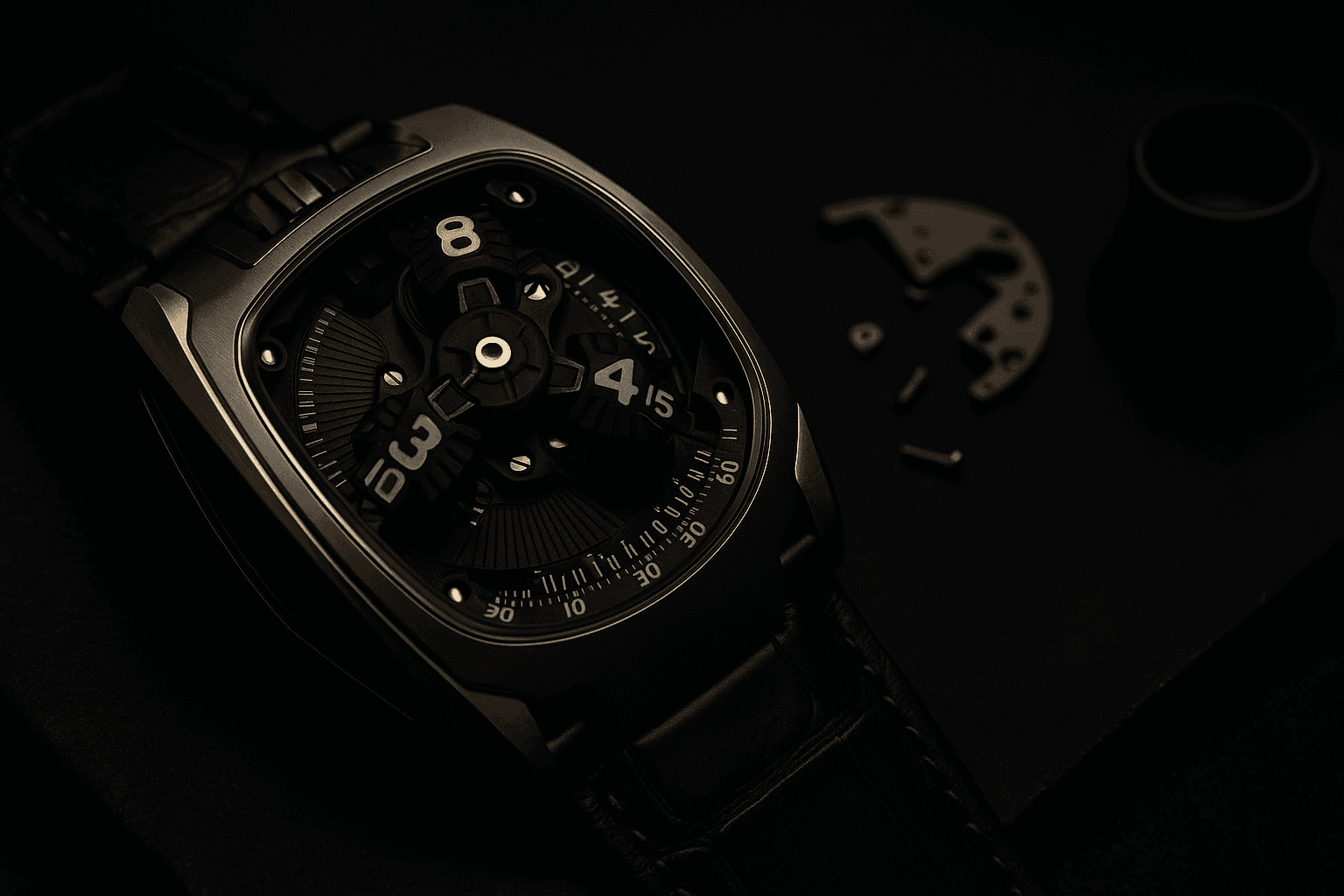
The wandering-hours display the brand has produced since 1997 traces to a silent night clock made for Pope Alexander VII in the mid-1650s. The provenance is the romance; the consequences are mechanical and commercial, because a satellite module carries service obligations and a narrower resale audience than a conventional three-hander from a larger house.
The wandering hour predates the wristwatch. Roman clockmakers used it in the 1650s so a numeral traveling across a lit arc could be read in the dark, and Urwerk has built its entire catalog on that logic.
Where The Wandering-Hours Display Came From
The Campani brothers, working in Rome in the 1650s, built night clocks that answered a specific domestic problem: telling the time after dark without a striking train loud enough to wake the household. Their answer placed an oil lamp behind pierced numerals that traveled across a fixed arc, so the position of the number carried the minutes while the number itself carried the hour.
That is the entire logic of the wandering hour, and it has survived nearly four centuries essentially intact. What changed is scale — moving the idea from a case clock to a forty-something-millimeter wristwatch demanded a carousel, planetary gearing, and a torque budget no 17th-century movement had to respect.
Audemars Piguet brought the display back commercially with the Star Wheel in the early 1990s, using three rotating sapphire discs. Urwerk followed with a different ambition when Felix Baumgartner, a third-generation watchmaker, and Martin Frei, an artist and designer, founded the brand in 1997 and showed the UR-101 and UR-102 at Basel.
The wandering hour has been the through-line of nearly every Urwerk reference since, which makes the servicing and liquidity questions structural rather than incidental. Buyers weighing the brand against MB&F's Horological Machines are choosing between two different bets: one house varies its architecture from release to release, the other has spent three decades refining a single one.
How The Satellite Module Tells Time
The modern Urwerk carousel carries three satellites, each bearing four hour numerals, for twelve hours in total. As the carousel rotates, planetary gearing turns each satellite on its own axis so the correct numeral faces outward when its turn arrives.
The active numeral then travels an arc calibrated in minutes and drops away at the end of its run as the next numeral enters. Reading the watch means reading a position rather than an angle, which most owners describe as a few days of adjustment rather than a permanent compromise.
Every one of those parts costs energy. A three-satellite carousel is a far larger rotating mass than a minute hand, and the torque required to drive it explains why Urwerk has spent its engineering budget on winding regulation and power management rather than on chronometry records.
Three satellites carry four numerals each, twelve hours in total. Planetary gearing presents the correct numeral as the carousel turns it across a minute-calibrated arc, then hands the display to the next satellite.
The UR-201 and UR-202 of 2008 addressed the torque problem with telescopic minute hands and a pair of air turbines on the caseback that damp the winding rotor, letting the owner select full, reduced, or stopped automatic winding. The UR-210 of 2012 went further, pairing a retrograde minute hand with an indicator that reports how efficiently the watch has been wound over the preceding two hours.
Those turbines and indicators exist because of a genuine constraint. An oscillating weight feeding a high-torque module wears differently from one feeding a conventional going train, and the value in an Urwerk sits in that mechanism instead of in the hand-finishing of movement components that anchors prices at more traditional houses.
The References Worth Pursuing
The catalog splits into a few clearly defined eras, and they do not all make the same argument to a buyer. The references that matter most to a collector building a position include but are not limited to the following.
UR-103 Family (2003–2011)
The 103 is the reference that turned the satellite idea into a product line, in a hand-wound case with the crown at twelve and variants in titanium, steel, gold, and the hexagonal 103T. It remains the least expensive route into an Urwerk with genuine historical weight, and the hand-wound movement removes the rotor-wear question entirely.
UR-201 And UR-202 (2008)
These introduced the telescopic minute hand, which extends and retracts as it crosses the arc, along with the twin-turbine winding regulator visible through the caseback. They are the most mechanically ambitious of the early automatics, and also the references where a pre-purchase inspection earns its fee.
UR-210 (2012)
The 210 added a retrograde minute hand sweeping a wide arc and the winding-efficiency indicator Urwerk calls a control board. Its presence on the wrist is substantial, and it is the reference that most reliably reads as an Urwerk from across a room.
UR-105 (2014–2019)
The 105 covered the carousel with a hinged shield and brought the case into more wearable proportions, which made it the brand's practical daily-wear option for several years. Values have held steadier here than on the design-forward flagships, largely because the case suits more wrists.
UR-100 Series (2019–present)
The 100 is the accessible band and the most liquid Urwerk on the secondary market, with the satellite display joined by two indications the manufacture publishes as fixed figures: 555.55 kilometers of rotation at the equator and 35,742 kilometers of orbital travel, each per twenty minutes. Its case dimensions are the most conventional in the catalog, which is precisely why it moves.
UR-220 And UR-230 (2020, 2023)
These are the modern flagships in carbon and precious metal, and the 220 introduced an oil-change indicator on the caseback that counts elapsed running time in years and months. The 230 brought the telescopic minute hands back, and both sit at the top of the brand's pricing.
Prices across these families vary widely by case material, series length, and condition, and current list pricing should come from an authorized retailer rather than from an editorial page. The table below summarizes where value concentrates within each family.
| Reference | Era | Winding | What Drives Price | Ownership Note |
|---|---|---|---|---|
| UR-103 | 2003–2011 | Hand-wound | Case metal, series, completeness | No rotor wear; oldest parts supply |
| UR-201 / 202 | 2008 | Turbine-regulated automatic | Telescopic hand condition | Most complex to service |
| UR-210 | 2012– | Turbine-regulated automatic | Case material, dial variant | Large on the wrist; narrower buyer pool |
| UR-105 | 2014–2019 | Automatic | Wearability, condition of the shield | Steadiest values of its era |
| UR-100 | 2019– | Automatic | Limited-series colorways | Most liquid; shortest time-on-market |
| UR-220 / 230 | 2020– | Automatic | Carbon and precious metal, series size | Highest entry; service indicator fitted |
Read that table as a map of where the money concentrates rather than as a price list. Within any one family, a complete set with documented service history and unblemished case finishing will clear a compromised example by a margin that dwarfs the difference between two neighboring references.
What Ownership Actually Demands
The satellite module makes Urwerk a captive-service brand in practice. Very few independent watchmakers will open a carousel, parts are not distributed outside the manufacture, and an owner who buys a neglected example is buying a trip back to Geneva rather than a visit to a local bench.
Plan on a full service roughly every three to five years, the standard interval for a modern automatic under load. Turnaround of three to six months is a realistic planning assumption for a module of this complexity, and older references awaiting parts can run considerably longer.
Cost should be quoted by the manufacture for the specific reference, though a planning range in the region of $1,500 to $4,000 is a reasonable estimate for a full service on a complication of this kind rather than a published figure. Budget separately for luminous-material renewal, which fades on satellite numerals just as it does on hands, and for case refinishing in alloys and coatings that do not respond to conventional polishing.
The captive-service reality. An Urwerk arriving with no service history carries a repair estimate you have not received yet, and on the older automatics that estimate reaches four figures quickly.
Ask for the service record before you ask about the price, and treat a missing one as a priced defect rather than a detail to sort out later.
Expect a full Urwerk service every three to five years, performed by the manufacture. Independent watchmakers rarely open a satellite carousel, and parts are not distributed outside Geneva.
Urwerk's annual output is small — reporting in the specialist press has put it at roughly 150 watches a year, a figure worth treating as an estimate rather than an audited number. Scarcity supports the brand's positioning, and it also caps service capacity and spare-parts inventory, which is the practical face of buying from a house this size.
Collectors moving into independents from mainstream steel sports watches routinely underestimate this line item. The full picture of what a watch costs after the purchase sits in our watch ownership economics breakdown, and Urwerk occupies the demanding end of every variable in it.
The Secondary-Market Record
Most Urwerk references trade below original list. Observed asking prices commonly land somewhere in the range of 55 to 80 percent of retail for well-kept examples with box and papers, a directional estimate drawn from listings rather than a published index — and asking prices are not transaction prices.
The cause is audience size. A conventional dress watch can be sold to almost anyone, while a satellite-display Urwerk can be sold to the narrow slice of collectors who actively want one, which stretches time-on-market to months and hands negotiating leverage to the buyer.
Urwerk generally resells below list, with observed asking prices clustering near 55 to 80 percent of retail for complete examples. Time-on-market runs to months, not weeks, because the buyer pool is narrow.
Compare that against the independents that have escaped the pattern. The F.P. Journe secondary premium rests on tiny production, a classical design vocabulary that reads as investment-grade, and a collector base that competes at auction — a combination Urwerk has never fully replicated.
The brand does appear at Phillips, Christie's, and Sotheby's, with thinner and more variable results than the top independents. Before treating any hammer price as a comparable, read the lot record for condition, completeness, and reserve, which is the discipline set out in our guide to how auction estimates are set.
Keep in mind that the same narrowness that suppresses resale also protects the second owner. A collector purchasing at 60 percent of list has let someone else absorb the steepest part of the curve, which is the strongest argument for buying an Urwerk pre-owned.
What A Pre-Purchase Inspection Should Cover
A generalist watchmaker's inspection will not catch what goes wrong inside a satellite module, so the checklist has to be specific to the architecture. Points to verify before funds move include but are not limited to:
- Satellite alignment. Each numeral should sit square in the aperture through its entire arc. Drift or tilt suggests carousel wear or a past repair by someone who should not have attempted it.
- Hour transition. Watch a full handoff between satellites at the top of the hour. The change should be clean and complete, with no hesitation and no numeral hanging in the window.
- Telescopic hand action. On the 201, 202, and 230, the minute hand must extend and retract smoothly across its travel. Binding here is expensive and manufacture-only.
- Turbine selector function. On the turbine-regulated automatics, confirm each winding setting engages and holds. A seized selector is a caseback-off repair.
- Luminous condition. Compare the glow across all twelve numerals under the same charge. Uneven output points to age or a partial reapplication.
- Case finishing integrity. Urwerk's alloys and coatings do not tolerate generic polishing. Softened edges or a mismatched sheen indicate work done outside the manufacture.
- Documentation. Original box, tools, warranty card, and service invoices materially change the resale position. Their absence should be priced, not overlooked.
All of the above reduces to one question: has this watch been maintained by people who understood what they were opening? Nearly every other variable in an Urwerk purchase is negotiable, and that one is not.
Inspect satellite alignment through the full arc, a clean hour handoff, telescopic hand travel, turbine selector function, and even lume across all twelve numerals. Missing service records should be priced in.
Editorial Recommendation
Urwerk rewards a buyer who wants a mechanism nobody else builds and who accepts a captive service relationship as the cost of it. For collectors weighing where the brand sits alongside De Bethune and Greubel Forsey, our position is specific.
Where we would put the money.
- First Urwerk: UR-100 series. The most wearable case, the most liquid reference, and the shortest path back out if the display does not hold your interest.
- Best mechanical argument: UR-103, hand-wound. The founding architecture with no rotor in the system, and the reference most likely to read as historically important in twenty years.
- For presence: UR-210. Buy on condition and completeness, and plan for a longer sale when you exit.
- Approach with documentation: UR-201 and UR-202. Extraordinary watches that punish deferred maintenance more severely than anything else in the catalog.
- Verify before transacting. Pricing, production figures, and service costs here are ranges and estimates; confirm each against the manufacture, an authorized retailer, or a lot record before committing funds.
Questions Collectors Ask About Urwerk
How often does an Urwerk need servicing, and who can do the work?
Plan on a full service every three to five years, and plan on it returning to Urwerk. Very few independent watchmakers will open a satellite carousel, and parts are not distributed outside the manufacture.
How many watches does Urwerk produce each year?
Reported output is roughly 150 pieces a year, an estimate rather than an audited figure. That scarcity supports the brand's positioning, and it also means service capacity and spare-parts inventory are correspondingly small.
Do Urwerk watches hold their value on the secondary market?
Most references trade below original list, with observed asking prices commonly landing near 55 to 80 percent of retail for well-kept examples. Early hand-wound UR-103s and short carbon series have held better than mid-run automatics.
Which Urwerk is the most sensible entry point?
The UR-100 series is the accessible band: a self-winding satellite display with the distance indications, in the most conventional case dimensions Urwerk builds. It is also the most liquid reference, which matters if you may sell.
What does the UR-220's oil-change indicator actually do?
It counts elapsed running time in years and months on the caseback, so the owner can see how long the watch has run since service. It is a reminder rather than a sensor, and it does not measure lubricant condition.
The wandering-hours display gives a collector something increasingly rare: a mechanism with a documented four-century lineage that almost nobody else is willing to build at scale. It asks for patience with servicing and realism about resale in exchange, and it repays both.
Readers building a position in this segment can continue with our coverage of independent watchmaking at Voutilainen and Akrivia and our analysis of Laurent Ferrier collecting, both of which sit on the traditionalist side of the same independent-market question.