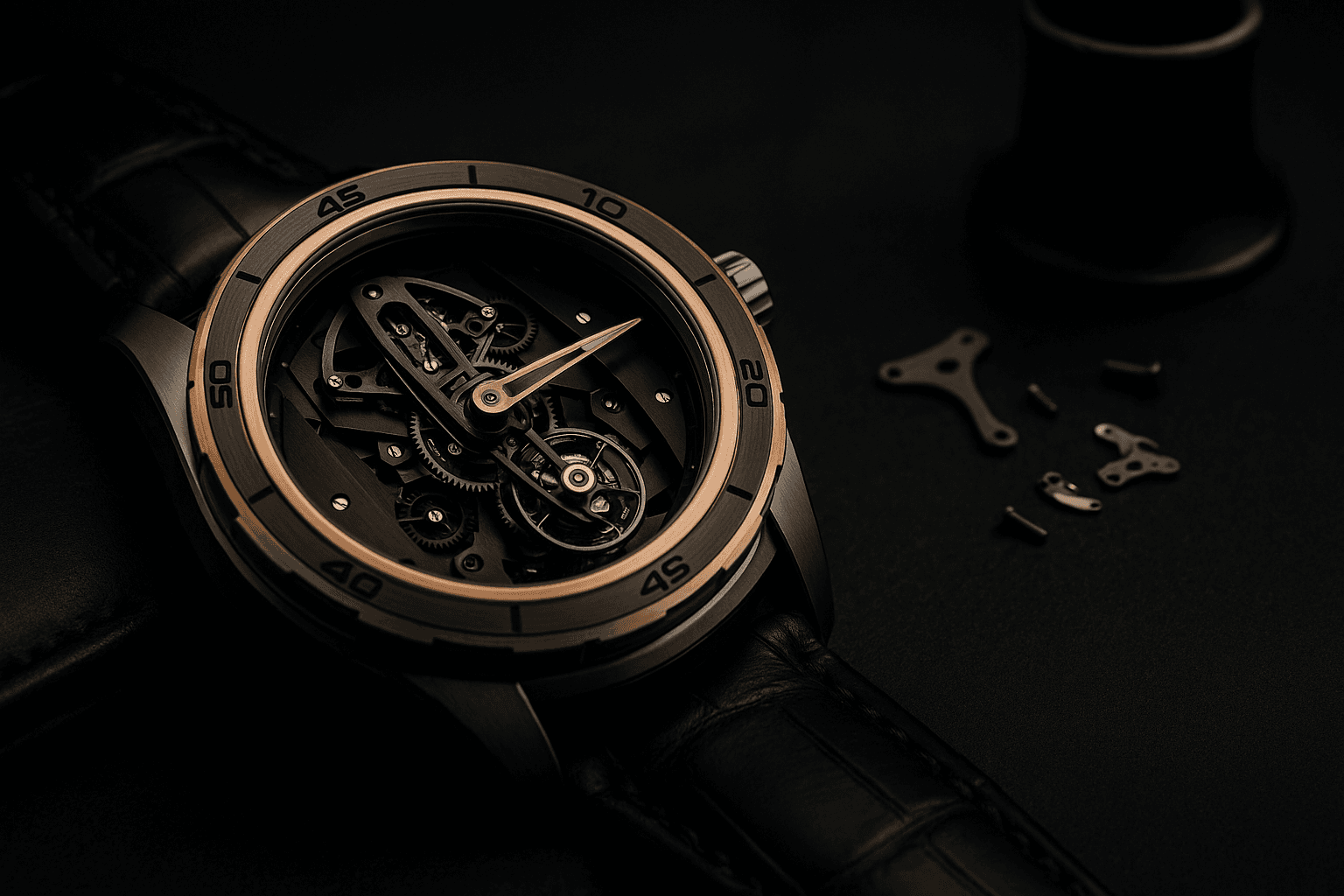
Ulysse Nardin: The Freak, Silicon, and Collecting a Marque Mid-Transition
By The Subdial Editors ·
Silicon has become so ordinary in fine watchmaking that most buyers skim past it on a spec sheet — etched escape wheels, etched pallet forks, etched hairsprings, all antimagnetic, all dimensionally stable, all largely indifferent to the lubrication cycle that governs a conventional steel escapement. Yet the material reached a production wristwatch in 2001, on a watch that had no dial, no hands, and no conventional crown.
That watch was the Ulysse Nardin Freak, and the manufacture behind it has spent the quarter-century since assembling one of the deeper engineering records in Switzerland. Its secondary-market standing has not kept pace with that record, and the distance between the two is the single most important fact for anyone considering the marque today.
Ulysse Nardin is also a company mid-transition — sold to a luxury conglomerate in 2014, sold back out to its own management in 2022, and rebuilding a collection identity in public ever since. What follows works through what the manufacture actually engineered, what the ownership churn did to pricing, and how to buy into the marque with the transition priced in rather than wished away.
Why The Freak Was A Structural Break
The Freak, launched in 2001 and developed with Ludwig Oechslin under owner Rolf Schnyder, discards the entire display convention of a wristwatch. There is no dial and there are no hands: the baguette-shaped movement itself rotates inside the case, with the upper bridge carrying the escapement sweeping once around per hour to read minutes, and the plate beneath it turning once every twelve hours to read the hour.
The construction is a carousel rather than a tourbillon, and the distinction is not pedantry. In a tourbillon the rotating cage is driven through the fourth wheel of the going train; in a carousel it is driven by a separate branch of that train, which is the arrangement the Freak uses and which frees the whole assembly to become the indication rather than a component hidden beneath one.
Early Freaks were also set and wound through the case rather than through a crown: the bezel turns to set the time, and the back rotates to wind a seven-day mainspring. That decision is the reason a used Freak needs a different inspection routine from a used three-hander, which is covered further down.
What the Freak established, in short, is that Ulysse Nardin was willing to rebuild the watch from the movement outward rather than restyle a case around a purchased caliber. That posture is what places it in the same conversation as the technical independents we cover in our De Bethune collecting guide and in the Voutilainen and Akrivia independents piece.
Silicon: First To Market, Second In The Story
The first-series Freak carried escape wheels made from silicon, which is widely credited as the material's first use in a commercial wristwatch escapement. Ulysse Nardin then built the supply chain behind it, taking a stake in Sigatec, a Valais-based joint venture founded with Mimotec to produce micro-components by deep reactive ion etching rather than by conventional machining.
From there the program compounded. DIAMonSIL applied a synthetic diamond coating over a silicon substrate to raise surface hardness at the escapement's contact points; the in-house UN-118 caliber of 2012 paired that escapement with a silicon hairspring in a COSC-certified, roughly sixty-hour movement; and the Ulysse Anchor construction of 2014 suspended the anchor on flexible silicon blades to produce a constant-force escapement with no pivots at all.
Meanwhile, the parallel research consortium formed by the industry's largest houses developed its own silicon program and, with far greater distribution and marketing weight behind it, effectively set the public narrative for the material. Ulysse Nardin got there first and a larger cohort got the credit — a pattern that repeats across the marque's history and shows up directly in resale.
Note that engineering novelty and hand-finishing quality are separate axes, and Ulysse Nardin has always indexed heavily on the first. If you value anglage, black polish, and interior angles above architectural invention, read our breakdown of movement hand-finishing before you shop this marque, because that is not where its money went.
The Ownership Timeline That Prices The Watches Today
Ulysse Nardin was founded in Le Locle in 1846 and made its reputation on marine chronometers, supplying navies internationally and taking a substantial share of precision awards at the observatory trials of the period. That heritage is genuine, and it is also more than a century removed from anything you can buy.
The modern company begins in 1983, when Rolf Schnyder bought a quartz-crisis remnant and paired it with Oechslin, producing the astronomical Trilogy of Time — the Astrolabium Galileo Galilei in 1985, the Planetarium Copernicus in 1988, the Tellurium Johannes Kepler in 1992 — and then the Freak in 2001. Schnyder died in 2011, and the company was acquired by Kering in 2014.
In 2022 Kering divested both Ulysse Nardin and Girard-Perregaux to their management team, returning the marque to independence under the Sowind Group umbrella. Anyone weighing this transition should also look at the sister brand's trajectory, which we trace in our Girard-Perregaux Laureato analysis, because the two houses have moved through the same corporate weather on the same timetable.
The practical consequence for a buyer is distribution instability: retail networks contracted and expanded, unsold inventory found its way into gray channels, and list prices were repeatedly set at levels the resale market never validated. All of this shows up as depreciation that has very little to do with how well the watches are made.
How The Collection Breaks Down For A Buyer
The current catalogue splits into four practical groups, and they behave differently enough on the secondary market that treating "Ulysse Nardin" as one asset is a mistake. Here is how the lines compare:
| Line | What It Is | Why A Collector Buys It | Secondary-Market Behavior (estimated) |
|---|---|---|---|
| Freak | Carousel movement as the display; no hands | The marque's actual argument for existing | Strongest of the four; still trades well under retail pre-owned |
| Marine / Marine Torpilleur | Steel three-hand and small-complication dress-sport | Chronometer lineage and wearable sizing | Weakest; competes in the most crowded band in Swiss watchmaking |
| Diver | Sports divers, including recycled-material cases | Daily wear and material experiments | Soft overall, with lightweight and limited references holding better |
| Blast / Skeleton Tourbillon | Architectural skeletonised tourbillons | Case and bridge design, visible engineering | Steep initial drop, then a flatter floor on limited runs |
The Freak Family
The modern Freak line runs from the Freak X — a smaller, crowned, more accessible carousel built on the UN-230 caliber and the most widely produced modern reference — up through the Freak Vision, which introduced the Grinder automatic winding system and its four-blade frame in place of a conventional rotor. Above those sit the Freak S, with two inclined oscillators linked by a differential in the UN-251, and the Freak neXt, whose flexure-based three-dimensional oscillator dispenses with the hairspring entirely.
The Freak One returns the line to its hand-wound, crownless character on the UN-240 caliber, and it is the reference that best represents what the collection is for. In every case, the Freak is the part of this marque that will still read as significant in thirty years.
Marine And Marine Torpilleur
These are steel forty-two-millimetre-class watches with in-house automatic calibers and, on the better references, silicon escapements and hairsprings. They are competent and comfortable, and they sit in the exact price band where a buyer's alternatives are numerous and better-supported at resale.
The Diver Line
The Diver family is where the manufacture's materials work went recreational — cases built with recycled fishing-net composite, and ultralight constructions the manufacture has quoted at figures around fifty grams, a manufacturer claim worth confirming on the specific reference. If a diver is the goal rather than the marque, weigh these against the field in our collectible dive watch guide and the dive watches under $5,000 roundup before committing.
Blast And The Skeleton Tourbillons
The Blast collection, introduced at the start of the 2020s, carries the X-braced skeleton tourbillon architecture that most clearly signals the house style. These take the hardest initial hit against list price, which makes them one of the better arguments in the catalogue for buying second-hand.
Taken together, the collection asks a buyer to separate the engineering from the marketing tier it was sold in — the Freak carries the intellectual weight, and the remaining lines are conventional watches wearing a technical badge.
What The Retail-To-Secondary Gap Actually Costs You
Ulysse Nardin's core problem is not build quality; it is that list prices were positioned against houses with far deeper brand equity, and the resale market declined to ratify that positioning. Clean, complete, boxed modern examples routinely list at a substantial discount to their original retail — a band a buyer should establish empirically rather than take on faith.
Do not transact on any figure quoted in an editorial piece, including this one. Pull live Chrono24 listing bands for the exact reference, adjust for completeness and time on market, and cross-check against published auction results before you make an offer.
The corollary is straightforward: the first owner absorbs the depreciation, and the second owner buys genuine mechanical invention at a price the mechanism alone would not otherwise command. For the arithmetic behind how that discount interacts with servicing and holding period, see our piece on watch ownership economics, and for reading published results properly, the guide to auction estimate mechanics.
Keep in mind that a wide retail-to-secondary gap is a feature for a buyer and a liability for a seller. Enter this marque expecting to hold the watch, not to trade it.
Servicing A Silicon Manufacture
Silicon components are etched in a cleanroom rather than turned on a lathe, which means no independent watchmaker can fabricate a replacement escape wheel, pallet fork, or hairspring for one of these calibers. An independent can clean, lubricate, assemble, and regulate the rest of the movement competently, but the escapement parts have exactly one source.
That constraint matters more than usual here because of the ownership history: a reference sold under Schnyder, serviced under Kering, and now supported under Sowind has crossed two organisational boundaries. Before buying anything from the 2001–2014 window, contact the service operation with the reference and serial and get parts availability confirmed in writing.
Be aware that a Freak service is not priced like a three-hand service, given the carousel architecture and the bezel-driven winding and setting train. Ask for a written quote range on the specific reference, and treat that number as part of the purchase price rather than a future surprise.
Pre-Purchase Inspection Points Specific To This Marque
A standard pre-purchase inspection will not catch what goes wrong on these watches. The items below are the ones a Ulysse Nardin PPI should add:
- Bezel setting engagement. On crownless Freaks, the bezel is the setting interface and the primary wear point. Confirm it engages cleanly in both directions without slipping, and watch the carousel advance smoothly through a full hour.
- Case-back winding action. Early Freaks wind through the back. The action should be firm and consistent, with no free-spinning stretch and no audible grinding at the end of the wind.
- Amplitude and rate on a timing machine. Silicon escapements degrade gracefully rather than dramatically, which means a tired one can look fine on the wrist. Ask for timing results in multiple positions, not a single dial-up reading.
- Service records against the ownership eras. Any gap covering the 2014–2022 corporate handover deserves a direct question about where the work was done and whether original parts were used.
- Books, tools, and the winding accessory. Completeness moves the price on this marque more than it does on higher-liquidity brands, because a thin set is harder to make whole later.
All of these are answerable in a single inspection appointment, and none of them require the seller's cooperation beyond access. Remember that on a marque with soft resale, the cost of a bad example is not just repair — it is repair on top of a watch that will not resell to fund the repair.
Editorial Recommendation
Ulysse Nardin rewards a buyer who wants mechanical invention and is indifferent to social recognition, which is a narrower profile than the catalogue's breadth suggests. Our position on how to enter the marque:
- Buy a Freak, or buy nothing. The carousel line is the reason this manufacture matters, and the rest of the catalogue asks you to pay a technical brand premium for conventional watches.
- Start with the Freak X. Deeper production, a conventional crown, and the softest pre-owned pricing in the family make it the lowest-consequence way to live with the architecture.
- Buy the Freak One if you want the statement. Hand-wound, crownless, and closest in spirit to the 2001 original, it is the reference that will still explain itself decades from now.
- Buy pre-owned and complete. Let the first owner absorb the depreciation, then insist on box, papers, and the full accessory set rather than assembling one later.
- Price the service in before you offer. Get a written parts-availability confirmation and a service quote range on the exact reference, and subtract it from what you are willing to pay.
What holds this together is a single judgement: buy the engineering, at the discount the market has attached to the badge, and plan to keep it. Collectors weighing this against other technically-led houses should also read our H. Moser collecting guide and the Swiss watch marques overview, which place Ulysse Nardin against the field it competes with rather than the one it is priced against.
Frequently Asked Questions
Which Freak reference is the usual entry point?
The Freak X is the usual entry point. It is a smaller carousel built on the UN-230 caliber with a conventional crown, and it is the most widely produced modern Freak, so pre-owned supply is deeper and pricing is softer than on the flagships.
Can an independent watchmaker service a silicon escapement?
An independent can service and regulate the rest of the movement, but silicon escapement parts cannot be turned on a lathe — they are etched, and replacements come only from the manufacture. Confirm parts access before you buy.
Does the 2022 management buyout affect service and warranty?
Ownership moved to the Sowind Group management team in 2022, and the Swiss service operation carried over rather than closing. For any reference older than roughly a decade, request a written quote and written parts-availability confirmation first.
What does the Grinder winding system actually do?
The Grinder replaces the conventional rotor with a four-blade frame that converts smaller wrist movements into winding energy. It debuted in the Freak Vision and carries through the automatic Freak calibers that followed it.
Is a Marine Chronometer worth buying for the marque's naval history?
Buy it for the watch, not the lineage. The modern Marine and Marine Torpilleur are steel three-hand and small-complication pieces competing in the most crowded band in Swiss watchmaking, and they depreciate accordingly.
What is the single biggest inspection item on a used Freak?
Check the bezel. On Freaks that set and wind through the case, the bezel mechanism is the wear point — confirm it engages without slip in both directions and that the carousel advances smoothly through a full hour.
Ulysse Nardin is a marque you buy on your own analysis rather than on consensus, which is exactly the kind of position our editors are built to pressure-test. Continue with the rest of our brand playbooks in the Swiss watch marques index before you commit to a reference.